

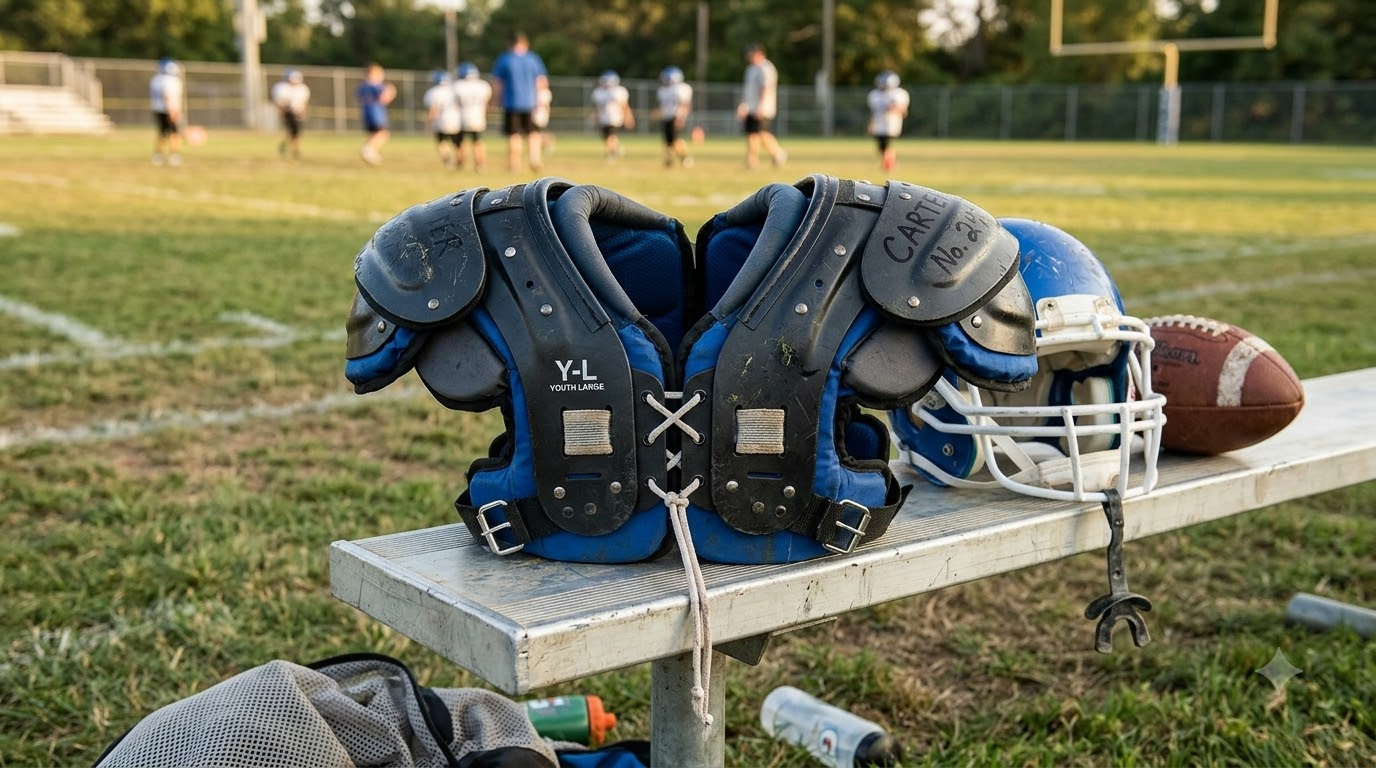
Skill Position Shoulder Pads: A Practical Guide to Fit, Adjustments and Accessories

Choosing football shoulder pads can be confusing when several models appear to offer similar features. Players may see descriptions mentioning lightweight construction, shoulder foam, adjustable closures, and accessory attachment points, but those terms do not always make it clear how a product will fit or work with their equipment. When comparing skill position shoulder pads for football, start with the player's measurements and then assess the construction, adjustment system, and compatibility with other gear.
The TAG TSP-SP BattleGear II Adult Series is listed as a skill-position shoulder pad. Its product description identifies several construction and adjustment features that buyers can review. However, a product label alone does not establish that a particular model is suitable for every athlete. Players should be measured and fitted individually, with the team's equipment requirements taken into account.
Start with the player's equipment needs
Before looking at product features, establish what the player needs from the equipment. A wide receiver, defensive back, and running back may all be described as skill-position players, but their roles and preferences are not identical.
Discuss the intended use with the coach or equipment manager. Confirm whether the player needs any additional accessories, whether the team has specific equipment rules, and whether the current shoulder pads have a fit or condition problem.
A useful starting checklist includes:
-
Player's current shoulder measurement
-
Product's intended use
-
Team equipment requirements
-
Desired accessory configuration
-
Current equipment condition
-
Fit and comfort during movement
This prevents a buyer from focusing on a feature that may not matter to the player's actual setup.
Read the product specifications carefully
The TAG TSP-SP BattleGear II listing describes a lightweight skill-position model with corrugated matte-finish arches and epaulets. It also identifies a swivel front-and-back system, HDOC arch padding, EVA shoulder foam, sewn-in clavicle shock pads, and deltoid pads.
These terms describe different parts of the shoulder pad. Buyers should use the product details to understand the construction, but should avoid assuming that a feature guarantees a particular performance result.
When comparing models, look for clear descriptions of:
Shoulder components: Identify the shape and construction of the arches, epaulets, and shoulder pads.
Padding: Check what type of padding is listed and where it is positioned.
Adjustment system: Review how the front, back, neck, and straps are adjusted.
Fastening: Check the belt, buckle, and other fastening components.
Lining: Review the material and care instructions.
A feature list is useful only when it is connected to the player's fit and equipment requirements.
Use the size chart as the first fitting reference
The adult TSP-SP BattleGear II listing provides the following measurements:
|
Size |
Shoulder measurement |
Chest measurement |
Weight range |
|
S |
16–17 in |
36–38 in |
120–150 lb |
|
M |
17–18 in |
38–40 in |
150–180 lb |
|
L |
18–19 in |
40–42 in |
180–210 lb |
|
XL |
19–20 in |
42–44 in |
210–240 lb |
Follow the manufacturer's measuring instructions. A player's jersey size or the size of a previous shoulder pad should not replace current measurements.
If the shoulder measurement, chest measurement, and weight range do not appear to point to the same size, contact the retailer or manufacturer. Do not guess or assume that choosing a larger size will solve a fitting problem.
Understand the adjustment system
An adjustment system helps the player secure the shoulder pads in the intended position. The TAG product description identifies a swivel front-and-back system and Velcro neck adjustment, as well as a one-inch belt and buckle.
During a fitting, follow the product instructions and check whether the closures can be secured correctly. Look for even positioning and avoid excessive tightening.
A good fitting routine should include:
-
Put on the shoulder pads as directed.
-
Position the shoulder components according to the instructions.
-
Secure the front and back adjustments.
-
Check the neck adjustment.
-
Secure the belt and buckle.
-
Check that the pads sit evenly.
-
Perform normal movement checks.
If the pads cannot be adjusted to sit correctly, ask the equipment manager or retailer to review the size and fit.
Plan accessory compatibility before buying
A shoulder pad may have attachment points for additional equipment, but that does not mean every accessory will fit.
The TSP-SP BattleGear II listing describes drilled holes for a back plate or rib protector. Buyers who need either accessory should confirm compatibility before purchase. Check the manufacturer's instructions for the correct attachment method and any hardware requirements.
Do not drill new holes, replace components with unapproved parts, or improvise an attachment. Changes to protective equipment can affect its intended construction.
When evaluating skill position shoulder pads, accessory compatibility should be treated as part of the overall equipment decision—not as an afterthought once the shoulder pads have arrived.
Check mobility during a proper fitting
The player should be able to perform normal football movements while wearing the equipment. A fitting should include more than standing still in front of a mirror.
Ask the player to raise and lower both arms, reach forward, rotate the upper body, and move through appropriate warm-up positions. Check whether the shoulder pads shift or create obvious restrictions.
The player should also try the shoulder pads with the clothing and compatible accessories they expect to wear. A fit that seems acceptable without other equipment may feel different once the complete setup is assembled.
If there is discomfort, pressure, or unusual movement, review the adjustment instructions. Do not remove padding or alter the equipment without the manufacturer's approval.
For football equipment and product information, TAG Sports Gear provides a range of options for players and teams.
Create a simple equipment inspection routine
The condition of the shoulder pads matters throughout the season. A product that fitted correctly when new may develop problems after repeated use.
Before practices and games, check:
-
Straps for fraying or damage
-
Buckles and hardware for wear
-
Padding for visible damage
-
Stitching around key components
-
Lining for tears or deterioration
-
Accessory attachment points
-
Whether the pads still fit correctly
If anything appears damaged, seek advice before the next use. Follow the manufacturer's care instructions rather than assuming that every shoulder pad can be cleaned in the same way.
Two examples of better equipment planning
Example 1: A player needs a back plate
A defensive back wants to use a back plate with a new set of shoulder pads. The player finds a model that lists attachment holes and assumes the accessory will fit.
Before ordering, the player checks the manufacturer's accessory instructions and confirms the correct compatibility. The equipment is then fitted with the accessory attached, so the team can review the complete setup rather than assessing the shoulder pads alone.
Example 2: A player is between two listed sizes
A player measures near the boundary between two sizes. Instead of choosing based on the jersey label, the family compares the current measurements with the product chart and asks the retailer for clarification. They then complete a fitting before the player uses the equipment in practice.
Both examples show why measurements and equipment compatibility should be considered before purchase.
Illustrative case study: Reviewing a team's shoulder-pad setup
This is a hypothetical example, not a reported customer result.
A team is preparing several skill-position players for a new season. Some players want to replace older shoulder pads, while others want to add a back plate or rib protector.
The equipment manager asks each player to provide current measurements and records the model being considered. They review the size chart, inspect the adjustment system, and confirm accessory compatibility. Each player then completes an individual fitting and movement check.
Rather than buying one model in a single size for the entire group, the team checks each player's requirements separately. The result is a more organised selection process and fewer assumptions about equipment fit.
Common mistakes to avoid
-
Choosing based only on the skill-position label
-
Treating a lightweight description as proof of suitability
-
Using a jersey size instead of the product's measurements
-
Assuming all accessories are interchangeable
-
Over-tightening the adjustment system
-
Ignoring damaged straps or hardware
-
Making unauthorised changes to the shoulder pads
Conclusion
Selecting skill position shoulder pads involves more than comparing product names or a list of features. Buyers should confirm the player's measurements, understand the construction, check how the equipment adjusts, and verify compatibility with any required accessories.
The TAG TSP-SP BattleGear II listing provides useful details about its arches, foam, clavicle and deltoid padding, swivel adjustment system, and accessory attachment points. Use those specifications as a starting point, then confirm the individual player's fit and follow the manufacturer's instructions throughout the season.
Frequently asked questions
1. What should I check before buying skill-position shoulder pads?
Check the player's measurements, intended use, adjustment system, padding construction, and compatibility with any accessories required by the team.
2. What sizes are listed for the TAG TSP-SP BattleGear II?
The adult listing shows sizes S through XL, with shoulder, chest, and weight ranges. Use the current product chart and measuring instructions before selecting a size.
3. Can I attach a back plate to this model?
The product listing describes drilled holes for a back plate or rib protector. Confirm that the specific accessory is compatible and follow the manufacturer's attachment instructions.
4. Should shoulder pads feel tight?
They should fit and be adjusted according to the manufacturer's instructions. Do not over-tighten closures or accept a fit that restricts normal movement.
5. How often should shoulder pads be inspected?
Inspect them before use and regularly during the season. Check straps, buckles, padding, stitching, lining, and accessory attachment points.

