

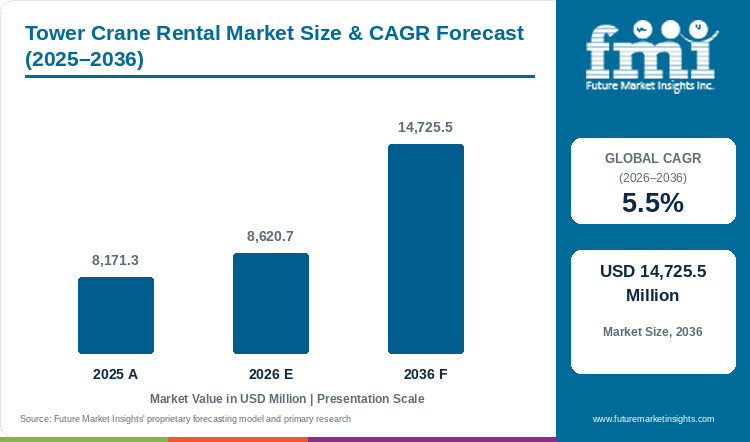

The global tower crane rental market is estimated to reach USD 8,620.7 million in 2026, compared with USD 8,171.3 million in 2025. The market is projected to grow to USD 14,725.5 million by 2036, registering a compound annual growth rate (CAGR) of 5.5% from 2026 to 2036, according to Future Market Insights (FMI).
Tower crane rental services are becoming an important option for construction companies seeking access to specialized lifting equipment without the financial and operational commitments associated with direct ownership. Rental arrangements can include equipment configuration, erection, maintenance, and availability during the agreed hire period. As construction projects become more complex, contractors are evaluating rental providers based on lifting capacity, load requirements at specific radii, equipment availability, site conditions, and contractual responsibilities.
Get Detailed Market Forecasts, Competitive Benchmarking & Industry Insights — Request a Sample Report: https://www.futuremarketinsights.com/reports/sample/rep-gb-13954
Tower Crane Rental Market: Key Metrics
- Market Size (2026): USD 8,620.7 million
- Market Size (2025): USD 8,171.3 million
- Forecast Value (2036): USD 14,725.5 million
- Growth Rate (2026–2036):5% CAGR
- Leading Capacity Category: 10–20 tons
- Leading Product Category: Mobile tower cranes
- Dominant Vendor Category: Independent service providers
What Is Driving Demand for Tower Crane Rental Services?
Demand for tower crane rental services is supported by construction activity, infrastructure development, and contractors' preference for flexible access to specialized lifting equipment.
Tower cranes are used across high-rise construction, commercial building projects, residential developments, and large infrastructure sites. Renting allows contractors to access lifting capacity for a defined project period while avoiding the full costs of equipment ownership, storage, and long-term fleet management.
Rental decisions depend on more than monthly hire rates. Contractors must consider the required load at a particular working radius, erection and dismantling arrangements, maintenance responsibilities, and equipment availability. Project delays can extend rental periods and increase costs, making clear overrun terms and lifting schedules important parts of the agreement.
Site conditions also influence equipment selection and utilization. Wind exposure, surrounding buildings, adjacent infrastructure, and access constraints can affect the crane's operating configuration and practical availability. These considerations increase the importance of pre-hire planning and coordination between rental providers and construction teams.
Five Key Trends Shaping the Tower Crane Rental Market
- Growing Demand for Mid-Capacity Tower Crane Rentals
The 10–20 tons capacity category leads the market's capacity mix in 2026. This reflects the importance of rental equipment suited to construction projects requiring defined lifting capacity and working configurations.
- Increasing Role of Mobile Tower Cranes
Mobile tower cranes lead the product classification in 2026. Their mobility can support projects requiring adaptable equipment deployment, subject to site access, lifting requirements, and operating conditions.
- Independent Service Providers Dominate the Vendor Mix
Independent service providers dominate the vendor mix in 2026. Their role in supplying equipment and coordinating rental services creates opportunities to serve contractors with project-specific lifting requirements.
- Greater Focus on Rental Contract Transparency
Rental agreements increasingly require clear allocation of responsibilities for erection, maintenance, availability, cross-hire arrangements, and project overruns. Defined contract terms can help reduce uncertainty for both equipment owners and customers.
Opportunities Across Tower Crane Rental Applications
The tower crane rental market offers opportunities across several construction activities:
- High-Rise Construction: Rental tower cranes support vertical material movement and lifting requirements across multi-storey building projects.
- Commercial Construction: Office buildings, shopping centres, and large commercial developments require lifting solutions suited to project layouts and construction schedules.
- Residential Development: Tower crane rentals can support large residential projects where material handling requirements change throughout construction.
- Infrastructure Projects: Selected infrastructure developments require specialized lifting configurations for structural components and heavy materials.
- Industrial Construction: Manufacturing facilities and industrial developments can require temporary lifting equipment for construction, installation, and expansion work.
Competitive Landscape
Competition in the tower crane rental industry is shaped by fleet availability, equipment configuration, lifting capacity, service coverage, maintenance quality, erection capabilities, contract flexibility, and safety documentation.
Companies operating across the broader tower crane rental and lifting equipment ecosystem include:
- Bigge Crane and Rigging Co.
- Maxim Crane Works
- ALL Crane
- Wolffkran
- Liebherr Group
- Sarens
- ALE Heavylift
- Al Faris Group
- NFT Group
- Select Plant Hire
These companies represent participants across crane rental, lifting services, and tower crane equipment markets; the list is not a ranking of market share in the tower crane rental segment.
What This Means for Industry Participants
Tower crane rental companies, construction contractors, equipment owners, and project developers can benefit from market opportunities by focusing on equipment availability, contractual clarity, and reliable service delivery.
Key priorities include:
- Maintaining rental fleets with configurations suited to different lifting requirements.
- Providing clear load-capacity information at specified working radii.
- Strengthening inspection records and preventive maintenance procedures.
- Defining responsibilities for erection, dismantling, maintenance, and cross-hire arrangements.
- Establishing transparent terms for project delays and extended rental periods.
- Improving coordination between equipment availability and construction schedules.
Rental providers that combine dependable equipment access with technical planning, transparent contracts, and responsive service support may be better positioned to address evolving contractor requirements.
Related Reports:
Stair Lift Motors Market- https://www.futuremarketinsights.com/reports/stair-lift-motors-market
Plate Heat Exchanger Market- https://www.futuremarketinsights.com/reports/plate-heat-exchanger-market
Solar Inverter Market- https://www.futuremarketinsights.com/reports/solar-inverter-market
About Future Market Insights (FMI)
Future Market Insights (FMI) is a leading provider of market intelligence and consulting services, delivering actionable insights and strategic analysis to businesses across industries. FMI supports organizations in identifying emerging opportunities, understanding market dynamics, and making informed business decisions through data-driven research.
Contact:
Rahul Singh
AVP – Marketing and Growth Strategy
Future Market Insights, Inc.
Phone: +91 8600020075
Email: sales@futuremarketinsights.com
Rahul.singh@futuremarketinsights.com
Website: www.futuremarketinsights.com

