

Brazil Silicone Rubber Market Research Report: Demand, Applications and Forecast

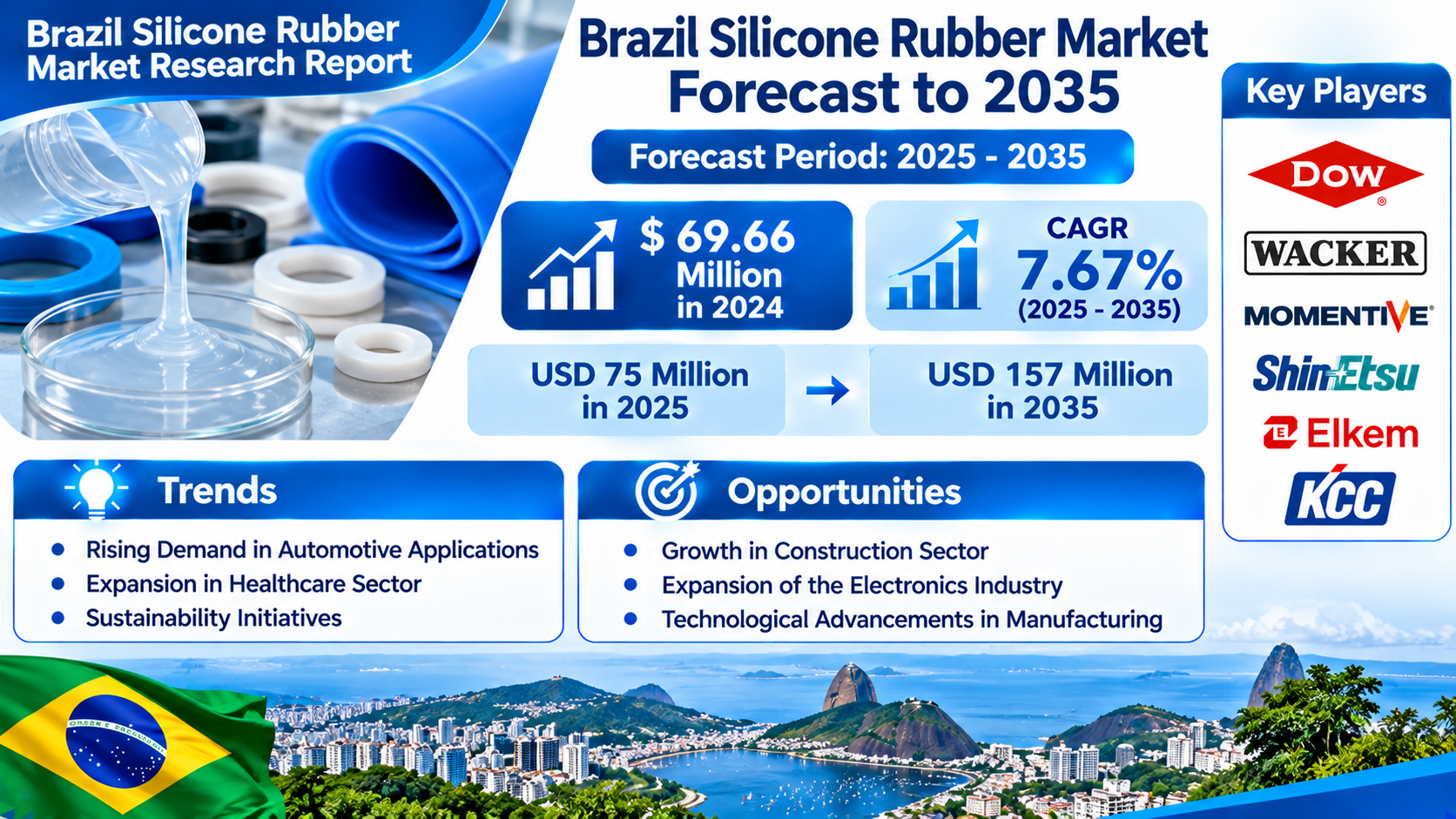
According to Market Research Future® (MRFR), the Brazil Silicone Rubber Market is projected to grow from USD 75 million in 2025 to USD 157 million by 2035, reflecting a CAGR of 7.67% over the forecast period. The market's development is associated with demand across automotive, medical, electronics, construction, footwear, consumer goods, and sportswear applications. Increasing automotive requirements, healthcare expansion, sustainability initiatives, and improvements in manufacturing technology are identified as important trends and opportunities shaping the industry's long-term prospects.
Industry Growth and Market Outlook
Brazil's silicone rubber industry is positioned for expansion as different end-use sectors contribute to the demand for silicone-based materials. The market covers multiple product types and applications, creating a diversified industry structure that connects material suppliers with manufacturing and commercial sectors.
The market was valued at USD 69.66 million in 2024 and is estimated at USD 75 million in 2025. The projected value of USD 157 million by 2035 indicates a considerable increase over the forecast period. The CAGR of 7.67% reflects the growth anticipated between 2025 and 2035.
The market outlook is influenced by the development of industries that require materials suited to specific manufacturing and product applications. Automotive and healthcare are identified as important trends, while construction, electronics, and technological advancements in manufacturing provide additional opportunities. The market's expansion will depend on demand patterns across these sectors and the ability of industry participants to respond to evolving application requirements.
Rising Automotive Demand
Automotive applications represent an important area of the Brazil silicone rubber market. The report identifies rising demand in automotive applications as a key trend, highlighting the industry's relevance to the overall market outlook. Automotive manufacturing and its associated supply chains provide a context for assessing demand for materials used in different production applications.
Material selection is an important consideration in automotive manufacturing, where manufacturers evaluate materials according to their application requirements and production processes. Silicone rubber is included within the materials considered across the automotive application landscape. The expansion of automotive activity may create opportunities for material suppliers serving relevant applications.
The report does not provide a detailed breakdown of automotive component applications, specific vehicle-related uses, or automotive segment revenue. Nevertheless, automotive demand is identified as a trend contributing to the industry's broader development. The market opportunity will depend on the evolution of automotive production and the adoption of appropriate materials across the sector.
Healthcare and Medical Applications
Healthcare sector expansion is another trend influencing the market's development. The report includes Medical among its application categories, emphasizing the relevance of healthcare-related activity to silicone rubber demand.
As healthcare-related industries expand, demand for materials used in manufacturing and associated product applications may evolve. Material suppliers and manufacturers need to consider the requirements of the industries they serve, including application suitability, product specifications, and relevant quality expectations.
The healthcare opportunity is particularly relevant within a market that covers multiple applications and material types. However, the supplied information does not provide medical segment revenue, detailed healthcare product categories, or specific adoption statistics. The healthcare sector's contribution should therefore be considered as an identified growth trend rather than a quantified segment forecast.
Sustainability Initiatives and Manufacturing Advancements
Sustainability initiatives are among the key trends identified in the report. Environmental considerations can influence industrial manufacturing, material selection, and operational planning. As businesses assess sustainability priorities, they may evaluate production processes and material-related approaches that align with changing environmental expectations.
The report also identifies technological advancements in manufacturing as a market opportunity. Manufacturing improvements can be relevant to production capabilities, process development, and the evolution of material offerings. Technological progress may influence how suppliers respond to customer requirements and industry developments.
Although sustainability and technological advancement are identified as important market influences, the supplied specifications do not detail particular production technologies, environmental certifications, or sustainability-related performance improvements. Their role is best understood as a broader influence on industry development and commercial opportunities.
Silicone Rubber Types and Market Structure
The market is categorized into three types: Liquid Silicone Rubber, High Consistency Rubber, and Fluorosilicone Rubber. These categories represent the product types covered in the Brazilian market assessment and provide a basis for understanding the industry's material structure.
Liquid Silicone Rubber, High Consistency Rubber, and Fluorosilicone Rubber form distinct categories in the report's segmentation. Their inclusion indicates that the market assessment considers multiple product types rather than treating silicone rubber as a single undifferentiated category.
The supplied information does not identify individual segment market shares, specific technical characteristics, or the fastest-growing product type. Further segment-level data would be necessary to evaluate the relative commercial position and growth prospects of each category.
Applications Across Industries
The report covers Automotive, Medical, Electronics, Construction, Footwear, Consumer Goods, and Sportswear. These application categories reflect the breadth of the market's potential demand across manufacturing, industrial, and consumer-related sectors.
Construction growth is identified as an opportunity. Construction-related activity can influence demand for materials and products used throughout the building and construction ecosystem. The report identifies the sector as an opportunity for silicone rubber, although it does not provide a detailed construction application breakdown or quantify its contribution to the market.
Expansion of the electronics industry is also listed as an opportunity. Electronics manufacturing and related industrial activity may create additional demand avenues for material suppliers, depending on application requirements and product suitability.
Footwear, consumer goods, and sportswear are also included within the market's application coverage. These categories broaden the market's scope beyond automotive, healthcare, and construction. The available data, however, does not provide specific product-level uses or segment revenue figures for these application areas.
Competitive Environment
The competitive landscape includes Dow, Wacker Chemie, Momentive, Shin-Etsu Chemical, Elkem, and KCC Corporation. These companies are identified as key players profiled in the report. The supplied market information does not provide company-specific revenue figures, market shares, or a competitive ranking.
Market participants may evaluate opportunities through product development, manufacturing capabilities, customer relationships, and their ability to serve different application industries. The market's diverse segmentation provides a framework for assessing competitive positioning, although specific company strategies are not outlined in the supplied report data.
Future Prospects Through 2035
The Brazil silicone rubber market is forecast to reach USD 157 million by 2035, growing at a CAGR of 7.67% from 2025. Automotive demand, healthcare expansion, sustainability initiatives, construction growth, electronics industry expansion, and manufacturing technology advancements are among the trends and opportunities identified in the report.
The market's future development will depend on the performance of end-use industries and evolving material requirements. With applications extending across industrial and consumer sectors, the market presents an expanding outlook for the forecast period. The identified trends and opportunities provide a framework for understanding the industry's potential development through 2035.

