

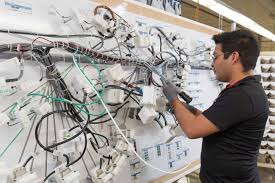

Group discussions centered on modern manufacturing and automotive engineering increasingly spotlight the critical role of specialized wiring harnesses and high-voltage interconnect systems. As global automakers transition rapidly from internal combustion engines toward 800-volt electric vehicle platforms and advanced driver assistance systems, traditional wire routing is undergoing a complete structural redesign. A single electric vehicle requires significantly heavier insulation ratings, electromagnetic shielding, and precision-crimped terminals capable of handling fast charging and high-bandwidth sensor data without signal loss. Reviewing a detailed Cable Assembly Market analysis highlights how automotive electrification has become the single largest revenue contributor, accounting for over 35 percent of overall industry demand.
In a group discussion setting, engineers and supply chain leaders often debate the trade-off between adding safety sensors and reducing total vehicle copper weight. Zonal vehicle architectures and automated crimping lines help tier-one suppliers reduce manual touch labor while lifting first-pass manufacturing yields above 99.5 percent. At the same time, volatility in copper and specialty insulation polymer pricing forces manufacturers to rethink material efficiency and supplier contracts. Participants examining automotive supply chains quickly realize that cable assemblies are no longer passive commodity parts; they are mission-critical nervous systems governing vehicle safety, charging speed, and autonomous reliability.
FAQ 1: Why do electric vehicles require more complex cable assemblies than traditional combustion cars?Electric vehicles operate at much higher voltages—often moving from 400-volt to 800-volt battery systems—which demands thicker insulation, superior thermal protection, and strict electromagnetic shielding for ADAS cameras and radar sensors.
FAQ 2: How are manufacturers reducing the weight of automotive wiring harnesses?Automakers are adopting zonal wiring architectures that shorten cable runs, replacing heavy copper gauges with high-speed data buses, and utilizing lightweight aluminum conductors where power loads permit.
➤➤➤Explore MRFR’s Related Ongoing Coverage In Semiconductor Industry:
Factory Automation Sensor Market
Mmwave Sensors And Modules Market
Radio Frequency Component Market
Interconnects And Passive Components Market

