

India Caps and Closures Market Report: Competitive Landscape and Future Developments

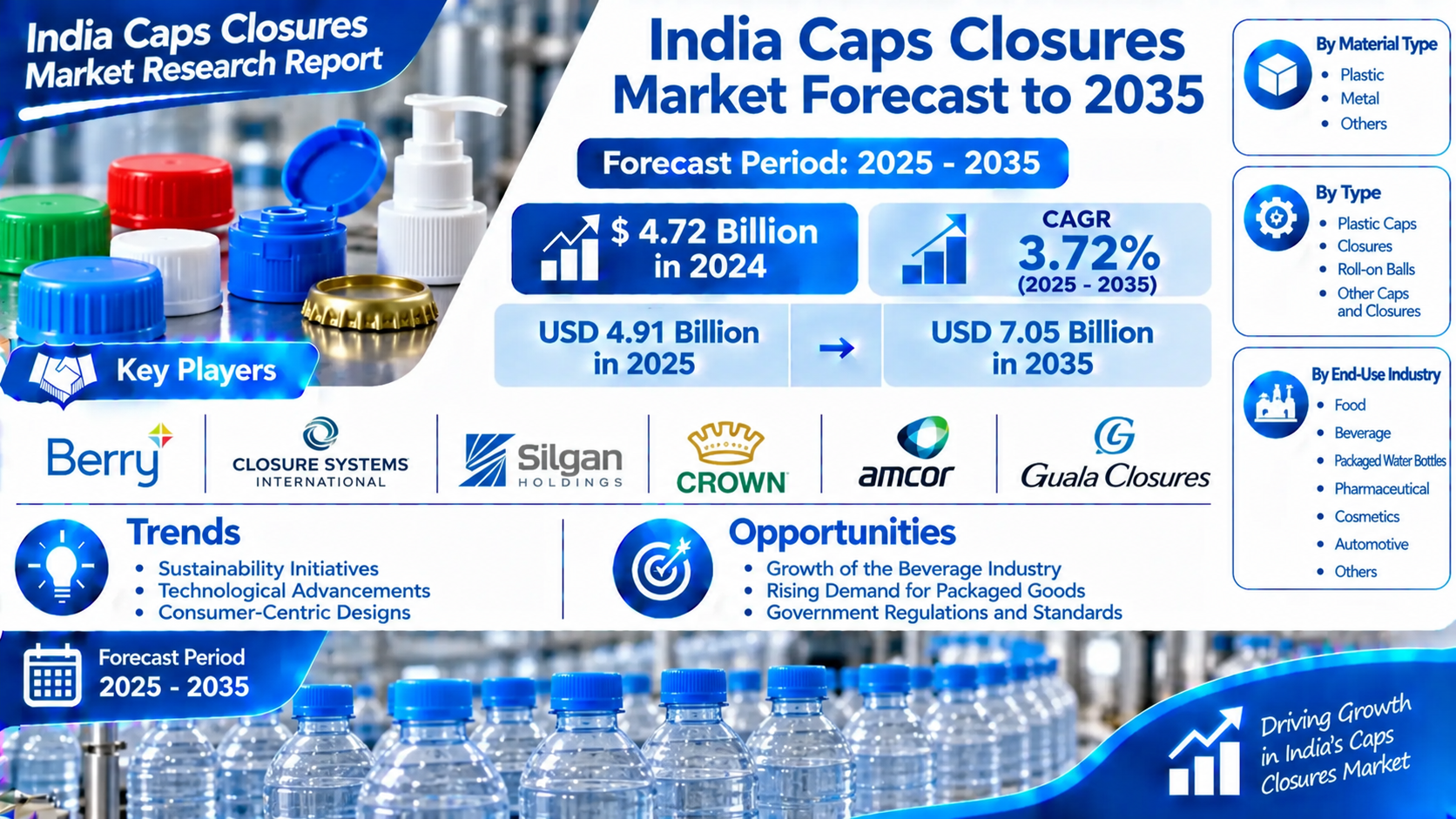
According to Market Research Future® (MRFR), the India Caps and Closures Market is expected to grow from USD 4.91 billion in 2025 to USD 7.05 billion by 2035, reflecting a CAGR of 3.72% over the 2025–2035 forecast period. The market recorded a valuation of USD 4.72 billion in 2024. Its outlook is connected to the broad use of packaging components across consumer and industrial products, with demand spanning food, beverages, packaged water bottles, pharmaceuticals, cosmetics, automotive, and other applications. Sustainability, manufacturing technology, and consumer-focused product design are among the developments shaping the sector.
Packaging Requirements Support Market Development
Caps and closures play a practical role in packaging by providing container access and closure functionality. Their use across a broad selection of industries makes the market an important part of the wider packaged-goods ecosystem. The India market is projected to advance from USD 4.72 billion in 2024 to USD 4.91 billion in 2025, with further growth to USD 7.05 billion by 2035.
The forecast CAGR of 3.72% indicates a steady expansion during 2025–2035. This outlook is supported by opportunities linked to the beverage industry and rising demand for packaged goods. Since packaging requirements differ across industries, manufacturers and suppliers serve a market with varied material preferences and product formats.
The report's segmentation provides a structured view of this diversity. It classifies the market by material type, product type, and end-use industry, showing how caps and closures are supplied in different forms and used across several sectors.
Material Choices: Plastic, Metal and Others
Plastic, metal, and others are the three material categories identified in the report. These groups form the basis for examining the materials used in India's caps and closures market.
Plastic is one of the principal material segments, while metal represents another category in the market. The others segment captures materials outside these two separately named groups. The segmentation reflects the variety of material choices available to manufacturers and users across different packaging applications.
Sustainability initiatives are a key trend influencing this part of the industry. As environmental considerations become more relevant to packaging decisions, material selection receives increased attention. This trend creates an ongoing need for industry participants to consider the materials used in packaging components and how product development can respond to changing expectations.
The market data does not specify the individual shares of plastic, metal, or other materials. Nevertheless, the segmentation highlights the range of material categories that contribute to the overall market.
Product Types Serve Different Packaging Needs
The type-based classification covers plastic caps, closures, roll-on balls, and other caps and closures. These categories illustrate the different product formats included in the market.
Plastic caps are a distinct segment, while closures are separately identified in the report. Roll-on balls provide another product category, with other caps and closures accounting for the remaining classification. This product mix reflects the range of packaging formats served by market participants.
Technological advancements are an important trend in the industry. Developments in manufacturing and product design can influence how caps and closures are produced and adapted to application requirements. Product development must also consider the expectations of the industries using these components.
Consumer-centric designs are increasingly relevant because caps and closures form part of the direct interaction between consumers and packaged products. Ease of use and product functionality can influence design considerations. This trend places user experience alongside material and manufacturing requirements in the industry's development priorities.
End-Use Diversity Across Consumer and Industrial Sectors
The market serves food, beverage, packaged water bottles, pharmaceutical, cosmetics, automotive, and other end-use industries. This range of applications demonstrates the breadth of demand for packaging components in India.
Food and beverage applications are central categories in the report's segmentation. Packaged water bottles are separately identified, emphasizing the role of caps and closures in bottled water packaging. The pharmaceutical segment represents another area where packaging components are required as part of product packaging systems.
Cosmetics and automotive applications broaden the market's coverage beyond food and healthcare-related products. The others category further extends the scope to additional uses. This diverse application base creates opportunities for suppliers to serve different industries rather than relying exclusively on one end-use segment.
The report does not provide market shares or separate growth forecasts for these applications. Its overall projection therefore represents the combined outlook across the listed end-use categories.
Beverage Industry Growth and Packaged Goods Demand
The growth of the beverage industry is identified as an important opportunity for the India Caps and Closures Market. Beverage packaging requires components suited to the containers and products being supplied. Expansion in this industry can therefore support demand for caps and closures.
Rising demand for packaged goods is another opportunity. As packaged products serve multiple consumer and industrial needs, packaging components remain relevant across a range of categories. Food, pharmaceuticals, cosmetics, and other applications all contribute to the market's broad end-use structure.
These opportunities are closely linked to the market's product diversity. Different packaging applications may require different closure formats and material choices. Suppliers serving a wide range of industries can therefore operate across several demand areas within the overall market.
Regulations and Standards Influence Industry Practices
Government regulations and standards are also identified as an opportunity area. Regulatory requirements can shape the conditions under which packaging products are designed, manufactured, and supplied. For companies in the caps and closures industry, understanding relevant standards is important when serving different end-use sectors.
Regulatory developments also connect with sustainability initiatives. As packaging expectations evolve, manufacturers may need to consider how material and product choices align with applicable requirements. The report identifies government regulations and standards as a market opportunity but does not specify individual regulations or their expected commercial impact.
Competitive Landscape
The market's key players include Berry Global, Closure Systems International, Silgan Holdings, Crown Holdings, Amcor, and Guala Closures. These companies are identified as participants in the competitive landscape of India's caps and closures industry.
Competition takes place across a market characterized by different materials, product formats, and end-use applications. Suppliers must respond to varied packaging requirements while keeping pace with sustainability initiatives, technological advancements, and consumer-centric design preferences. The report does not provide company-level market shares or a ranking of these participants.
India Caps and Closures Market Forecast to 2035
The market is projected to increase from USD 4.91 billion in 2025 to USD 7.05 billion in 2035, registering a CAGR of 3.72%. Its demand base spans food, beverages, packaged water bottles, pharmaceuticals, cosmetics, automotive, and other industries. Plastic, metal, and other materials, together with plastic caps, closures, roll-on balls, and other product formats, define its market structure.
The beverage industry's growth and rising demand for packaged goods provide opportunities, while government regulations and standards influence industry practices. Sustainability initiatives, technological advancements, and consumer-centric designs will remain important themes as market participants respond to changing packaging requirements through 2035.

