

Electrochromic Glass Market Opportunities in Energy-Efficient Smart Glass Solutions

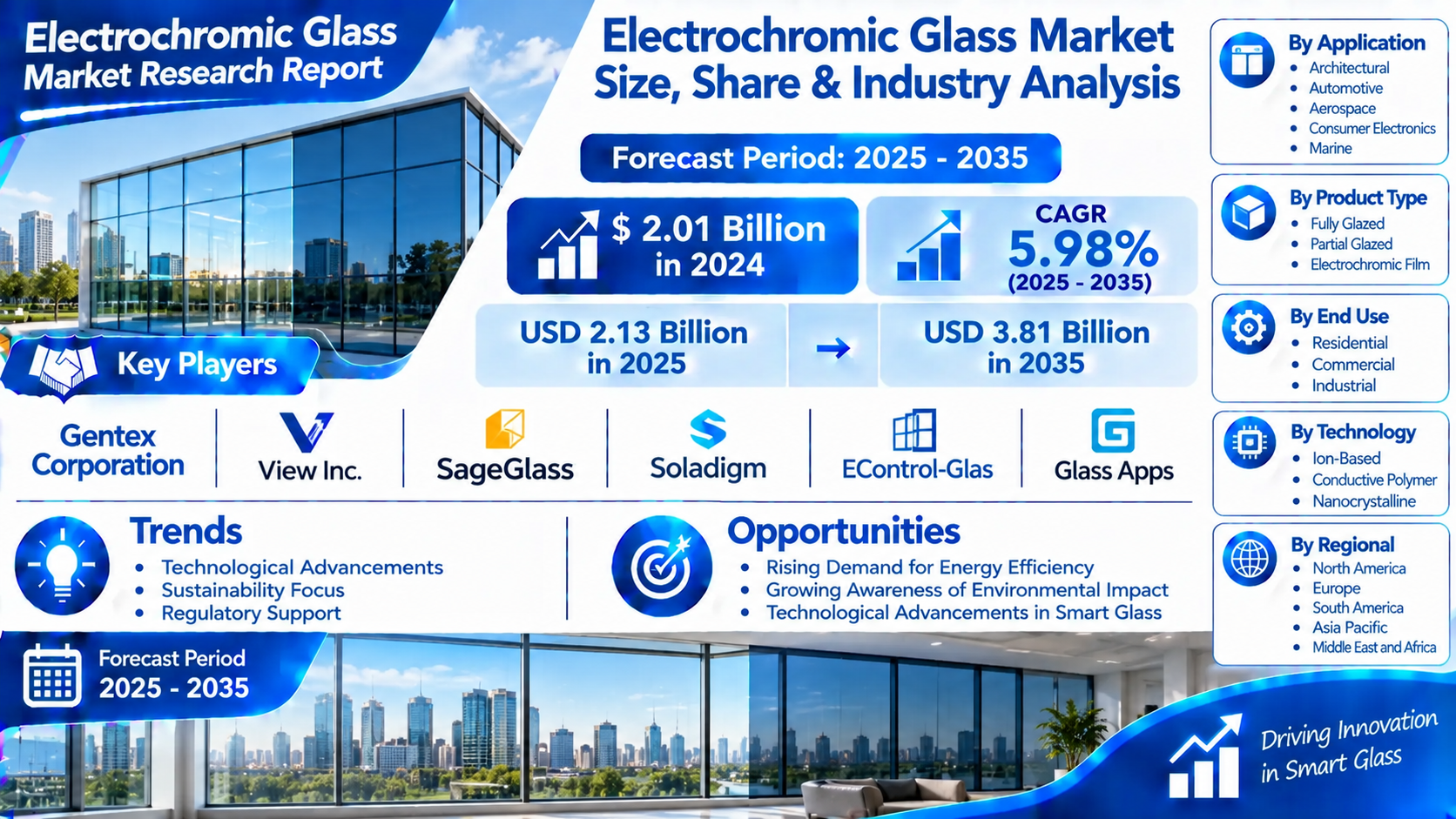
According to Market Research Future® (MRFR), the Electrochromic Glass Market is expected to reach USD 3.81 billion by 2035, up from USD 2.13 billion in 2025, at a CAGR of 5.98% over the 2025–2035 forecast period. The market recorded a value of USD 2.01 billion in 2024. Its outlook is influenced by the increasing emphasis on energy-efficient solutions, environmental awareness, technological advancement, and regulatory support. Demand spans architectural, automotive, aerospace, consumer electronics, and marine applications, giving the industry a broad base of potential adoption.
Market Direction and Industry Context
The development of electrochromic glass is closely connected with the growing interest in smart glass technologies. Across multiple industries, product and building decisions are increasingly influenced by energy efficiency, sustainability considerations, and the availability of advanced materials. These priorities create opportunities for manufacturers offering electrochromic glass solutions.
The market's forecast growth reflects interest across a range of applications rather than dependence on one end-use sector. Buildings, vehicles, aerospace applications, consumer electronics, and marine uses all form part of the market's application structure. This diversity gives the industry several potential demand channels and encourages manufacturers to consider different product formats and technologies.
The market is projected to expand at 5.98% annually during 2025–2035. Its value is expected to rise by the end of the forecast period as smart glass adoption and product development continue to influence the industry.
Architectural and Transportation Applications
Architectural applications are one of the five application categories identified by MRFR. The emphasis on energy efficiency and sustainability provides a relevant setting for the use of advanced glazing solutions in buildings. Property stakeholders and construction-related businesses increasingly consider the environmental and operational implications of building materials, supporting interest in technologies associated with more efficient buildings.
Automotive applications represent another important market category. The automotive sector's interest in advanced materials and technology creates opportunities for smart glass products. As manufacturers assess different approaches to vehicle design and functionality, electrochromic glass remains part of the broader advanced glazing landscape.
Aerospace and marine applications extend the market into additional transportation environments. These segments broaden the potential customer base and highlight the relevance of electrochromic glass beyond residential and commercial buildings.
Consumer electronics completes the application segmentation. Its inclusion demonstrates the market's reach into technology-oriented product categories, where continued technological development can influence demand for advanced glass solutions.
Product Formats and Technology Structure
The market's product categories are Fully Glazed, Partial Glazed, and Electrochromic Film. This segmentation distinguishes the different product formats represented in the industry. Each category contributes to the market's overall portfolio and provides a basis for serving different application needs.
Technology is another defining element of the market. The report identifies Ion-Based, Conductive Polymer, and Nanocrystalline technologies. Technological advancements are listed as a key industry trend, making the evolution of these technology categories an important consideration for manufacturers.
Continued development in smart glass technology may create opportunities to improve product offerings and address the needs of different end users. Companies operating in this space must consider how product formats and technology choices align with the requirements of architectural, automotive, aerospace, marine, and consumer electronics customers.
Residential, Commercial and Industrial Demand
The end-use segmentation comprises Residential, Commercial, and Industrial markets. Residential demand is associated with the wider interest in energy efficiency and environmentally conscious product choices. As awareness of environmental impact grows, smart glass technologies may receive greater consideration in residential settings.
Commercial applications offer another area for adoption. Businesses and commercial property stakeholders have reasons to evaluate solutions that support energy-efficiency objectives. This creates a potential market for advanced glazing products in commercial environments.
Industrial end use adds a further dimension to the market. The presence of residential, commercial, and industrial categories shows the breadth of potential demand and the range of environments in which electrochromic glass may be considered.
Sustainability, Technology and Regulatory Support
The industry's trend profile identifies three influences: technological advancements, sustainability focus, and regulatory support.
Technology development can shape product capabilities and broaden the range of potential applications. As smart glass technologies advance, manufacturers may be better positioned to respond to different performance expectations and application requirements. The report's identification of Ion-Based, Conductive Polymer, and Nanocrystalline technologies provides a clear view of the technology categories represented in the market.
Sustainability is another important influence. Growing awareness of environmental impact is encouraging businesses and consumers to consider the broader environmental implications of materials and products. Rising demand for energy efficiency complements this focus and creates opportunities for electrochromic glass solutions.
Regulatory support can also influence market adoption. Regulations and policy measures related to energy efficiency and environmental priorities may shape decisions by building owners, manufacturers, and other end users. The extent of this influence can vary across regions, reflecting differences in market conditions and regulatory environments.
Regional Market Coverage
The geographical segmentation includes North America, Europe, South America, Asia Pacific, and the Middle East and Africa. These regions represent the market's stated coverage and provide a framework for understanding its international reach.
Regional adoption is connected with technology awareness, sustainability priorities, and demand from the industries that use advanced glass products. The available information does not specify regional revenue shares or identify a leading region, so individual regional performance cannot be ranked from the supplied figures.
Competitive Landscape and Growth Opportunities
The key players named in the Electrochromic Glass Market are Gentex Corporation, View Inc., SageGlass, Soladigm, EControl-Glas, and Glass Apps. Their inclusion reflects the competitive landscape of an industry serving multiple applications and end-use categories.
The opportunity areas identified by MRFR are rising demand for energy efficiency, growing awareness of environmental impact, and technological advancements in smart glass. These factors reinforce one another: energy-efficiency priorities and environmental awareness can encourage interest in advanced glazing, while technology development can help manufacturers respond to evolving customer expectations.
The market's future growth will depend on how effectively industry participants develop their technologies, serve different applications, and respond to changing sustainability and regulatory priorities. With the market forecast to reach USD 3.81 billion by 2035 from USD 2.13 billion in 2025, the Electrochromic Glass Market is positioned for continued expansion across residential, commercial, and industrial demand.

