

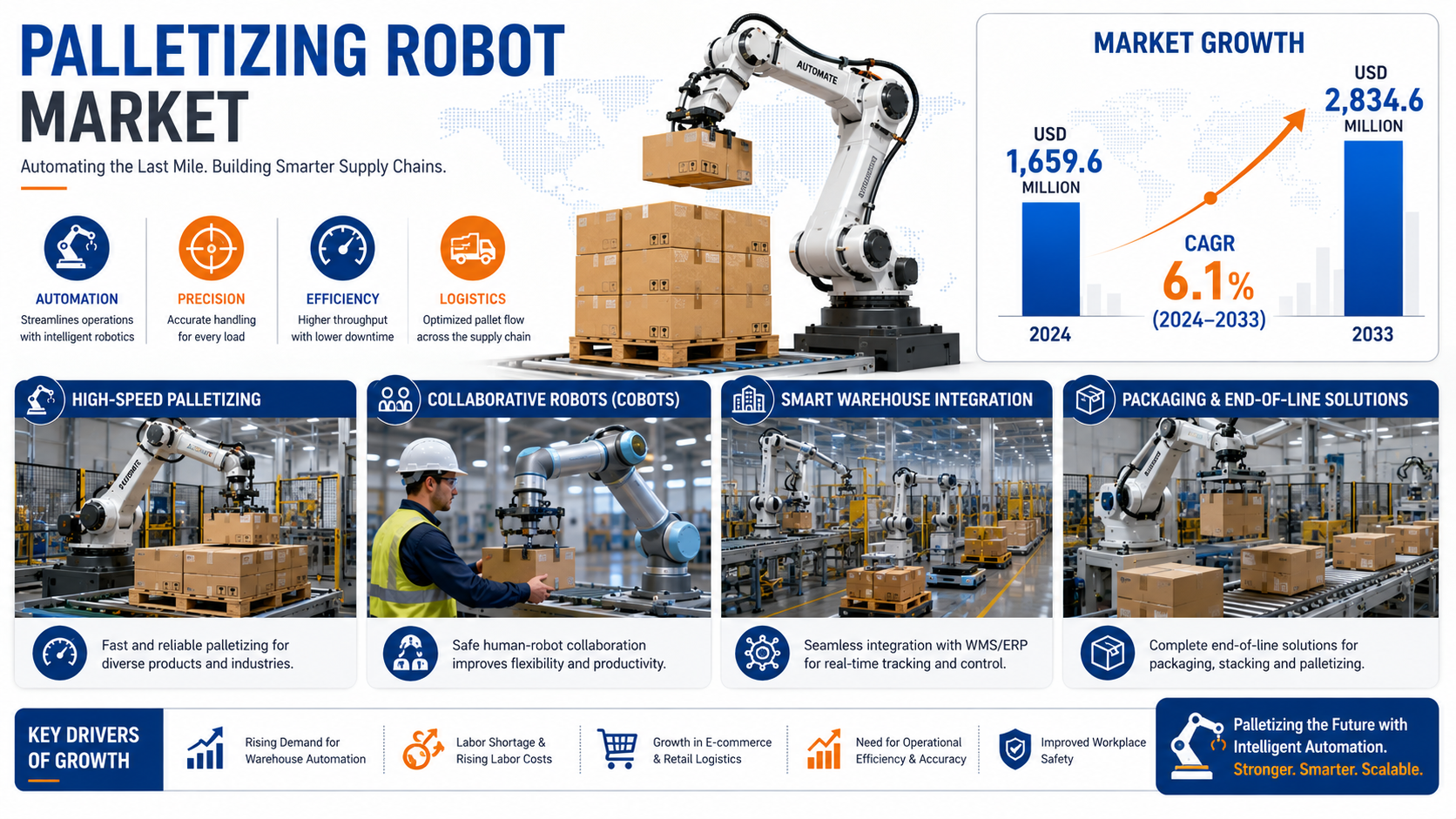

The global Palletizing Robot Market Size is gaining importance as manufacturers, logistics companies, and warehouse operators invest in automated material handling solutions to improve productivity and reduce repetitive manual operations.
According to Dimension Market Research, the global Palletizing Robot Market was valued at USD 1,659.6 million in 2024 and is projected to reach USD 2,834.6 million by 2033, registering a CAGR of 6.1% during the forecast period.
Increasing automation across packaging lines, manufacturing facilities, food processing operations, and distribution centers is supporting demand for robotic palletizing systems.
What Is the Palletizing Robot Market?
Palletizing robots are automated systems designed to arrange and stack products onto pallets for storage, transportation, or distribution.
These robots can handle cartons, cases, bags, bottles, containers, and other packaged goods.
A typical robotic palletizing system combines a robotic arm, specialized gripping equipment, control software, sensors, and supporting material handling infrastructure.
The primary objective is to improve stacking consistency, reduce repetitive lifting, and maintain efficient packaging operations.
Robotic palletizing can also support warehouse space utilization and reduce physical strain associated with manual handling.
However, system performance depends on product dimensions, payload requirements, operating speeds, packaging characteristics, and integration with production lines.
Why Is Demand for Palletizing Robots Increasing?
Manufacturers are seeking ways to improve throughput and reduce dependence on repetitive manual handling tasks.
Packaging lines frequently require consistent product movement at speeds that may be difficult to maintain through manual operations alone.
Robotic palletizers can support predictable stacking patterns and continuous material handling when appropriately integrated.
The growth of e-commerce and distribution networks creates additional opportunities because warehouses increasingly handle large volumes of packaged products.
Food and beverage manufacturers are important customers due to the repetitive movement of cartons, beverage cases, and packaged goods.
Pharmaceutical and consumer goods companies also require accurate palletizing processes to support product integrity and efficient distribution.
Labor availability, workplace ergonomics, and production efficiency remain significant factors influencing automation decisions.
Get a Free Customized Sample of This or Any Other Market Research Report
https://dimensionmarketresearch.com/request-sample/palletizing-robot-market/
Palletizing Robot Market Segmentation and Leading Categories
The market is segmented by component, robotic palletizer technology, payload capacity, application, and end user.
By Component
Robotic Arms dominate the component category with approximately 37.1% market share in 2024.
Robotic arms perform the physical movements needed to pick, position, and stack packaged products.
The report also covers End of Arm Tooling (EOAT), Control System, and Others.
EOAT solutions include specialized gripping technologies designed for different product shapes, materials, and weights.
Control systems coordinate robot motion, stacking sequences, sensors, and communication with surrounding automation equipment.
By Robotic Palletizer Technology
Articulated Robots lead with approximately 35.0% share in 2024.
These robots provide multiple axes of movement, supporting flexible palletizing arrangements.
Other categories include Cartesian (Gantry) Robots, SCARA Robots, Collaborative Robots (Cobots), Delta Robots, Hybrid Palletizing Robots, and Robotic Grippers.
Collaborative robots represent an important area of interest for operations that require flexible automation and appropriate interaction with human workers.
By Payload Capacity
The report includes Low Payload (Up to 100 kg), Medium Payload (101 to 500 kg), and High Payload (Above 500 kg).
Payload requirements influence robot configuration, gripping technology, operating speed, and installation costs.
By Application and End User
Applications include Case Palletizing, Bag Palletizing, Bottle Palletizing, and Drum Palletizing.
Important end-user industries include Food & Beverage, Pharmaceutical, Consumer Goods, Chemical, and Logistics & Warehousing.
These applications require different stacking patterns, material handling capabilities, and equipment specifications.
Technology Trends Transforming Robotic Palletizing
Artificial intelligence, machine vision, and improved motion control are influencing modern palletizing systems.
Machine vision can help robotic systems identify product positions and support accurate handling of different packaging configurations.
Advanced control software enables flexible pallet patterns, production monitoring, and coordination with other equipment.
Collaborative robotics is also relevant to smaller manufacturing facilities evaluating adaptable automation solutions.
However, collaborative operation requires suitable risk assessments and safety controls.
Integration with conveyors, warehouse management systems, and production planning platforms can improve overall equipment coordination.
The commercial value of these capabilities depends on system reliability, installation requirements, and measurable operating improvements.
Regional Market Outlook: North America Leads
North America accounts for approximately 39.2% of the global Palletizing Robot Market in 2024.
The region benefits from established manufacturing industries, warehouse automation investment, and demand for productivity improvements.
The US market was valued at USD 547.1 million in 2024 and is projected to reach USD 903.5 million by 2033, representing a CAGR of 5.7%.
Europe represents another important market because of its developed industrial automation ecosystem and manufacturing infrastructure.
Asia-Pacific provides opportunities as manufacturing businesses modernize production facilities and expand automated material handling systems.
Regional adoption depends on labor economics, production volumes, manufacturing investment, and available systems integration expertise.
Competitive Landscape and Strategic Opportunities
Major companies identified in the report include FANUC Corporation, Yaskawa Electric Corporation, Kawasaki Heavy Industries Ltd., Mitsubishi Electric Corporation, and ABB Ltd.
Competition focuses on robotic performance, reliability, flexibility, integration capabilities, and lifecycle support.
System integrators also play an important role by designing complete palletizing cells that combine industrial robots with conveyors, grippers, controls, and safety equipment.
Manufacturers increasingly require systems capable of handling varied packaging configurations without extensive downtime during product changes.
Suppliers offering efficient commissioning, adaptable software, and reliable maintenance services may strengthen customer relationships.
Market Challenges and Future Opportunities
High initial investment, integration complexity, technical skill requirements, and maintenance needs can limit adoption.
Smaller manufacturers may face particular difficulties when evaluating capital expenditure against expected productivity improvements.
Nevertheless, opportunities exist in flexible palletizing cells, collaborative robotics, machine vision integration, and scalable automation systems.
As manufacturing and logistics operations prioritize efficiency, robotic palletizing is expected to remain an important element of industrial automation strategies.
Explore the Complete Palletizing Robot Market Analysis
https://dimensionmarketresearch.com/checkout/palletizing-robot-market/
Frequently Asked Questions
1. What is the size of the Palletizing Robot Market?
The global market was valued at USD 1,659.6 million in 2024 and is projected to reach USD 2,834.6 million by 2033.
2. What is the expected CAGR of the Palletizing Robot Market?
The market is forecast to expand at a CAGR of 6.1% during the forecast period.
3. Which component dominates the Palletizing Robot Market?
Robotic Arms lead the component segment with approximately 37.1% market share in 2024.
4. Which region leads the Palletizing Robot Market?
North America leads with approximately 39.2% of global market revenue in 2024.
5. Which robotic technology holds the largest share?
Articulated Robots dominate the technology category with approximately 35.0% market share in 2024.
Conclusion
The Palletizing Robot Market reflects increasing investment in manufacturing automation, warehouse productivity, and efficient packaging operations.
Advances in robotic arms, machine vision, collaborative systems, and industrial control technologies are expanding the practical applications of automated palletizing.
Companies that deliver reliable, flexible, and economically viable systems may capture opportunities across food processing, pharmaceuticals, consumer goods, and logistics.
Related Market Research Insights
The Robotic Palletizer Market Size examines automated palletizing equipment and its applications across industrial production and packaging operations. Its findings provide complementary context for robotic material handling investment.
The US Robotic Palletizers Market Share explores the adoption of robotic palletizing solutions across American manufacturing and logistics facilities, including automation requirements and operational efficiency considerations.
The Europe Robotic Palletizers Market Growth evaluates regional demand for automated palletizing equipment and opportunities created by industrial modernization, warehouse automation, and advanced robotics.

