

Artificial Turf Market Forecast 2032: Growth Drivers, Opportunities, and Industry Trends

According to the latest report published by Data Bridge Market Research, the Artificial Turf Market
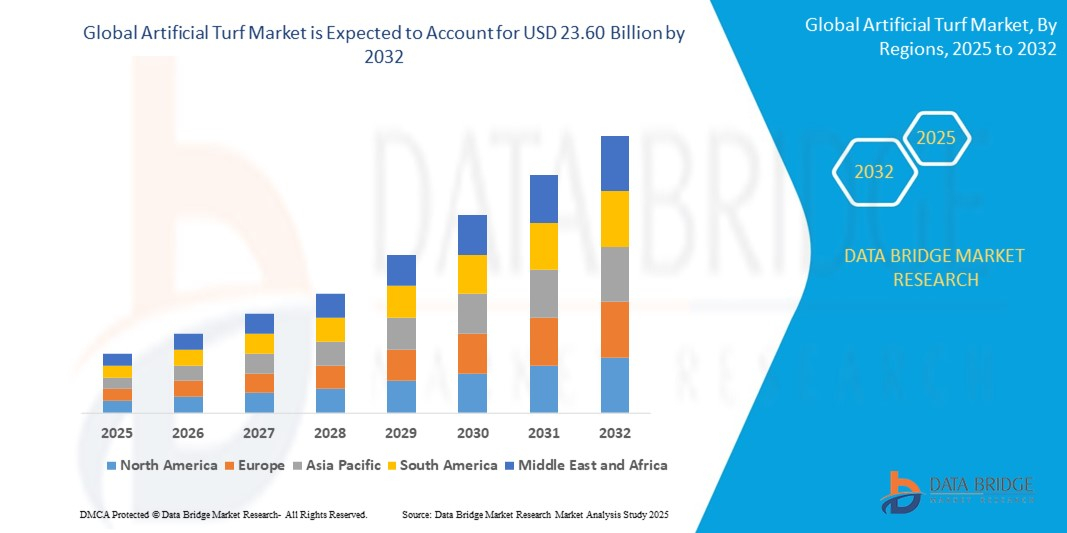
The global artificial turf market size was valued at USD 5.67 billion in 2024 and is expected to reach USD 23.60 billion by 2032, at a CAGR of 19.50% during the forecast period
Artificial Turf Market research report has been structured. The report assesses ongoing as well as the future performance of the market, in addition to brand-new trends in the market. In this marketing report, a methodical SWOT analysis & investment analysis is performed which forecasts forthcoming opportunities for the market players. A worldwide Artificial Turf Market report studies market attributes, industry structure, and competitive scenario, the problems, desire concepts, together with business strategies, market effectiveness, investment research, and new business challenges.
Stay informed with our latest keyword market research covering strategies, innovations, and forecasts. Download full report: https://www.databridgemarketresearch.com/reports/global-artificial-turf-market
Artificial Turf Market Segmentation and Market Companies
Segments
- On the basis of material, the global artificial turf market can be segmented into polyethylene, polypropylene, and others. Polyethylene is widely used in the manufacturing of artificial turf due to its durability and resistance to UV rays and other environmental factors. Polypropylene is also a popular choice among consumers for its cost-effectiveness and low maintenance properties.
- Based on application, the artificial turf market can be divided into contact sports, non-contact sports, landscaping, and leisure. Contact sports such as football and rugby require artificial turf that can withstand heavy usage and impact, while landscaping applications demand turf with aesthetic appeal and low maintenance requirements.
- Geographically, the global artificial turf market is segmented into North America, Europe, Asia-Pacific, South America, and the Middle East and Africa. North America dominates the market due to the high adoption rate of artificial turf in sports facilities and residential landscaping projects. Europe is also a significant market for artificial turf, driven by the growing trend of eco-friendly and sustainable landscaping solutions.
Market Players
- Shaw Industries Inc.
- Tarkett Group
- Victoria PLC
- SportGroup Holding
- SIS Pitches
- Act Global
- Global Syn-Turf, Inc.
- Artificial Grass
- TigerTurf
- ForestGrass
- Challenger Turf
- DuPont
- FieldTurf
- TurfStore
The global artificial turf market is expected to witness significant growth in the coming years due to the increasing demand for low-maintenance and cost-effective landscaping solutions. The market players are focusing on product innovation and strategic partnerships to expand their market presence and gain a competitive edge. The rise in sports activities and the growing trend of sustainable landscaping practices are driving the adoption of artificial turf across various applications. Technological advancements in synthetic grass manufacturing are also contributing to the market growth by improving the performance and durability of artificial turf products. Overall, the global artificial turf market is poised for steady growth, fueled by the increasing awareness about the benefits of artificial turf over natural grass.
The global artificial turf market is undergoing significant transformations driven by technological advancements and changing consumer preferences. One key trend shaping the market is the shift towards more sustainable and eco-friendly landscaping solutions. With increasing awareness about environmental conservation and water scarcity issues, artificial turf is gaining traction as a water-efficient alternative to natural grass. Market players are investing in research and development to enhance the sustainability profile of their products, focusing on recyclability, reduced water consumption, and eco-friendly manufacturing processes. This strategic emphasis on sustainability aligns with the growing demand for green building materials and environmentally responsible practices across various industries.
Another notable trend in the artificial turf market is the integration of IoT (Internet of Things) technologies to enable smart turf solutions. Manufacturers are incorporating sensors, data analytics, and connectivity features into artificial turf systems to monitor performance metrics, optimize maintenance schedules, and enhance user experience. Smart artificial turf solutions offer benefits such as predictive maintenance, real-time monitoring of field conditions, and personalized user insights. This trend is especially prominent in the sports sector, where data-driven decision-making and performance analysis are crucial for maximizing player safety and optimizing gameplay.
Furthermore, the market is witnessing a surge in the adoption of artificial turf in urban landscaping projects and commercial developments. As cities grapple with limited outdoor space and increasing urbanization, artificial turf provides a versatile and aesthetically pleasing solution for green spaces. From rooftop gardens to public parks to corporate campuses, artificial turf offers a low-maintenance, all-weather surface that enhances the visual appeal and functionality of outdoor areas. Market players are capitalizing on this trend by offering customizable turf designs, color variations, and installation options to cater to diverse urban landscaping requirements.
Additionally, the COVID-19 pandemic has influenced the artificial turf market dynamics by accelerating the demand for outdoor recreational spaces and sports facilities. As people seek safe outdoor environments for physical activity and social gatherings, artificial turf surfaces have gained popularity for their durability, cleanliness, and ease of maintenance. The pandemic has underscored the importance of resilient and adaptable landscaping solutions that can withstand evolving health and hygiene considerations. In response, market players are developing antimicrobial turf technologies, self-cleaning surfaces, and hygiene maintenance protocols to address the heightened sanitation requirements of post-pandemic environments.
In conclusion, the global artificial turf market is witnessing paradigm shifts driven by sustainability imperatives, technological innovations, urban development trends, and post-pandemic considerations. As market players continue to innovate and diversify their product offerings, the artificial turf industry is poised for sustained growth and evolution in the years to come. The convergence of environmental consciousness, digitalization, urbanization, and public health priorities is reshaping the artificial turf landscape, opening up new opportunities for market expansion and strategic differentiation.The global artificial turf market is experiencing a notable transformation driven by several key trends that are shaping the industry landscape. One significant trend is the increasing emphasis on sustainable and eco-friendly landscaping solutions. With a growing awareness of environmental issues and the need for water conservation, artificial turf is being recognized as a viable alternative to natural grass due to its water-efficient nature. Market players are investing in research and development efforts to enhance the sustainability aspects of their products, focusing on recyclability, reduced water usage, and eco-friendly manufacturing processes. This strategic focus on sustainability aligns well with the rising demand for green building materials and environmentally responsible practices across various sectors.
Another important trend in the artificial turf market is the integration of IoT technologies to enable smart turf solutions. By incorporating sensors, data analytics, and connectivity features into artificial turf systems, manufacturers are able to monitor performance metrics, optimize maintenance schedules, and improve user experience. Smart artificial turf solutions offer benefits such as predictive maintenance, real-time monitoring of field conditions, and personalized user insights, especially in the sports sector where data-driven decision-making is crucial for player safety and gameplay optimization.
Moreover, there is a noticeable uptick in the adoption of artificial turf in urban landscaping projects and commercial developments. As cities face challenges related to limited outdoor space and urbanization, artificial turf emerges as a versatile and visually appealing option for green spaces. From rooftop gardens to public parks to corporate campuses, artificial turf provides a low-maintenance, all-weather surface that enhances the aesthetic appeal and functionality of outdoor areas. Market players are leveraging this trend by offering customizable turf designs, a variety of color options, and flexible installation solutions to cater to the diverse needs of urban landscaping projects.
In light of the COVID-19 pandemic, the dynamics of the artificial turf market have been further influenced by an increased demand for outdoor recreational spaces and sports facilities. As individuals seek safe outdoor environments for physical activities and social interactions, artificial turf surfaces have gained popularity due to their durability, cleanliness, and ease of maintenance. The pandemic has highlighted the importance of resilient and adaptable landscaping solutions that can address evolving health and hygiene concerns. In response, market players are developing innovative technologies such as antimicrobial turf surfaces, self-cleaning capabilities, and enhanced hygiene maintenance protocols to meet the heightened sanitation requirements of post-pandemic environments.
In conclusion, the global artificial turf market is undergoing significant evolution driven by sustainability initiatives, technological advancements, urban development trends, and changing consumer preferences post-pandemic. As market participants continue to innovate and expand their product offerings, the artificial turf industry is poised for continuous growth and development in the foreseeable future. The convergence of environmental consciousness, digital innovations, urbanization trends, and public health considerations is reshaping the artificial turf sector, creating new opportunities for market expansion and strategic differentiation.
Frequently Asked Questions About This Report
What is the projected growth of the Artificial Turf Market in North America?
What is the market value of the global Artificial Turf Market industry as of the most recent pay cycle?
How is the Artificial Turf Market adoption rate changing in the public sector?
How is the shortage of skilled professionals affecting the Artificial Turf Market?
What is the impact of Human Augmentation on the Artificial Turf Market?
What is the growth potential of the [Niche Segment] within the Artificial Turf Market?
How is the Subscription Economy impacting Artificial Turf Market revenue?
Which distribution channel leads the global Artificial Turf Market?
What is the customer acquisition cost (CAC) in the Artificial Turf Market industry?
Browse More Reports:
Global Crowdsourced Security Market
Global Dentinogenesis Imperfecta Type 3 Market
Global Diesel Exhaust Fluid Market
Global Electric Surface Heaters Market
Global Fallopian Tube Cancer Treatment Market
Global Fibromyalgia Syndrome Market
Global Fluid and Lubricant Market
Global Fungicide Packaging Market
Global Funisitis Market
Global Gelatin Substitutes Market
Global Graphene Composites Market
Global Hip Osteoarthritis Therapeutics Market
Global Immunoassay Reagents and Devices Market
Global Ingestible Sensor Market
Global Lancet and Lancing Devices Market
Contact Us:
Data Bridge Market Research
Email:- corporatesales@databridgemarketresearch.com

