

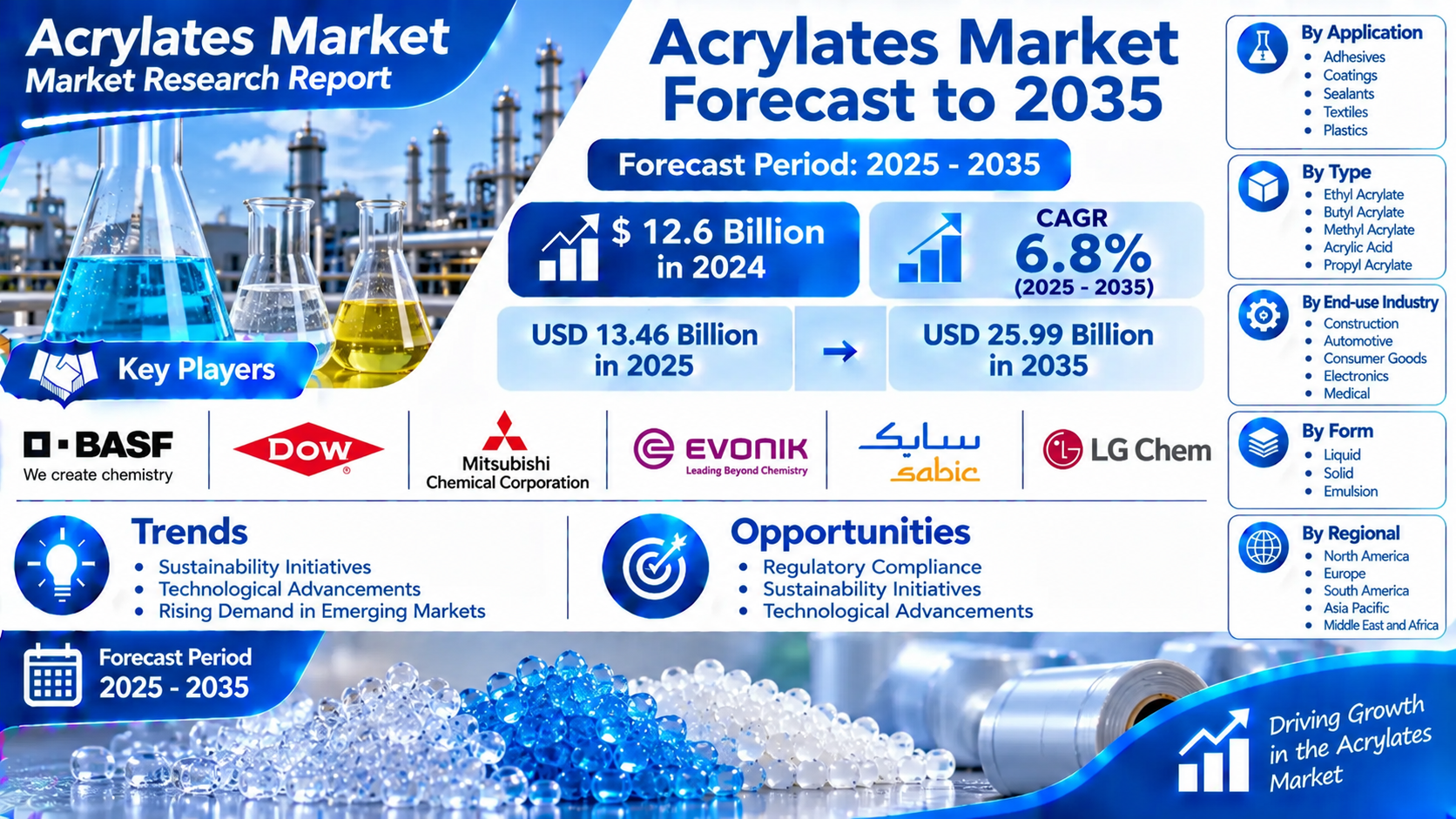

According to Market Research Future® (MRFR), the Acrylates Market is expected to grow from USD 13.46 billion in 2025 to USD 25.99 billion in 2035, advancing at a CAGR of 6.8% over the 2025–2035 forecast period. Following a market valuation of USD 12.6 billion in 2024, the industry is positioned for further expansion through its connections with construction, automotive, consumer goods, electronics, and medical sectors. Its application base spans adhesives, coatings, sealants, textiles, and plastics, while sustainability initiatives and technological advancements are influencing the market's development.
A Market Supported by Diverse Industrial Uses
The acrylates industry serves a broad collection of markets rather than relying on a single downstream sector. Its applications across adhesives, coatings, sealants, textiles, and plastics create several channels through which demand can develop. These uses connect the market with manufacturing activities, material production, and products supplied to industrial and consumer customers.
This diversity is significant to the industry's long-term outlook. Demand conditions in individual application segments may differ, but the combined presence of multiple markets gives suppliers a broad commercial base. Construction, automotive, consumer goods, electronics, and medical industries add further variety to the demand structure. As these end-use sectors respond to their respective market requirements, acrylate suppliers operate within an environment shaped by different product specifications and purchasing needs.
The financial outlook reflects this breadth. The market's value of USD 12.6 billion in 2024 is followed by a projected USD 13.46 billion in 2025. By 2035, the valuation is expected to reach USD 25.99 billion. The forecast CAGR of 6.8% indicates a sustained expansion over the ten-year period.
Application Mix: Adhesives, Coatings, and More
Adhesives are one of the principal application categories in the market. Their use in bonding products and materials across industrial and commercial settings makes this segment an important part of the acrylates demand base. Manufacturers serving adhesive applications must address the requirements of customers operating across different end-use industries.
Coatings constitute another key category. Their position in the application segmentation connects acrylates with products used for surface treatment and finishing. The coatings segment contributes to the market's industrial reach and reflects the importance of material solutions in manufacturing and product development.
Sealants, textiles, and plastics complete the listed application categories. Sealants represent a separate area of demand, while textiles and plastics link the industry with material-related production and a wide range of downstream products. The combination of these applications gives the market several routes for commercial expansion and helps explain its presence across different industrial value chains.
Product Portfolio and Market Segmentation
The acrylates market includes five specified types: Ethyl Acrylate, Butyl Acrylate, Methyl Acrylate, Acrylic Acid, and Propyl Acrylate. This product segmentation provides a structured view of the materials included in the market assessment. Different customer applications and production requirements contribute to the relevance of maintaining a varied product portfolio.
The form-based classification adds another layer to the market structure. Acrylates are covered in liquid, solid, and emulsion forms. These categories reflect the different formats in which products are supplied and used. The appropriate form depends on the requirements of the intended application and the processes followed by downstream manufacturers.
For suppliers, serving a market with several types and forms requires attention to customer needs across different application areas. The product structure also creates a framework for assessing competition and identifying areas where technology and product development may influence future market activity.
End-Use Industries Shape Demand
The end-use segmentation covers construction, automotive, consumer goods, electronics, and medical industries. Each sector contributes a distinct demand channel and places the acrylates market within a broad industrial landscape.
Construction and automotive are important areas of industrial activity represented in the segmentation. Consumer goods connect acrylates with products intended for everyday use, while electronics and medical industries extend the market into other specialized end-use categories. This range of customers means that market participants must consider varied requirements rather than depend on a uniform demand profile.
The relationship between applications and end-use industries is central to the market's structure. Adhesives, coatings, sealants, textiles, and plastics serve different purposes across downstream markets. As a result, developments in end-use industries can influence demand for particular acrylate applications and product types.
Sustainability and Technology Influence Market Direction
Sustainability initiatives are among the key trends identified for the market. Environmental considerations are increasingly relevant to industrial supply chains, encouraging chemical producers to consider how products and manufacturing activities respond to changing expectations. Sustainability is also listed as a market opportunity, highlighting its importance beyond a general industry trend.
Technological advancements form a second major trend. Innovation can help companies respond to changing application requirements and improve their ability to compete in a market with diverse product categories. Technology is also identified as an opportunity, suggesting that continued development may contribute to future commercial possibilities.
Rising demand in emerging markets completes the list of key trends. As industrial activity develops in these markets, demand may expand across the end-use sectors that rely on acrylate-based materials. This creates a potential avenue for companies seeking to extend their reach beyond established markets.
Regulatory and Commercial Opportunities
Regulatory compliance is identified as an opportunity for the acrylates industry. Compliance requirements are an important consideration for chemical manufacturers, influencing how companies manage products and operations across their markets. The ability to address applicable requirements remains relevant to maintaining customer relationships and market participation.
Sustainability initiatives and technological advancements provide additional opportunities. These areas overlap with the major trends shaping the industry, indicating that they are relevant both to current market direction and future business development. Companies that prioritize these areas may be better positioned to respond to changing customer and industry expectations.
The key players identified in the market are BASF SE, Dow Inc., Mitsubishi Chemical Corporation, Evonik Industries AG, SABIC, and LG Chem Ltd. Their participation reflects the presence of established chemical companies in the competitive landscape. Market activity is shaped by the ability of suppliers to serve different applications, product types, and end-use industries.
Regional Coverage and Industry Prospects
The regional assessment includes North America, Europe, South America, Asia Pacific, and the Middle East and Africa. These geographic categories capture the market's international scope and provide a basis for examining demand across varied industrial environments. The outlook in each region is linked to the presence and development of relevant downstream applications and end-use sectors.
Through 2035, the market is projected to expand at a CAGR of 6.8%, reaching USD 25.99 billion. Its diverse application base, multiple product types, and presence across five end-use industries provide a broad foundation for growth. Sustainability initiatives, technological advancements, regulatory compliance, and rising demand in emerging markets are expected to remain central considerations as companies pursue opportunities in the global acrylates industry.

