

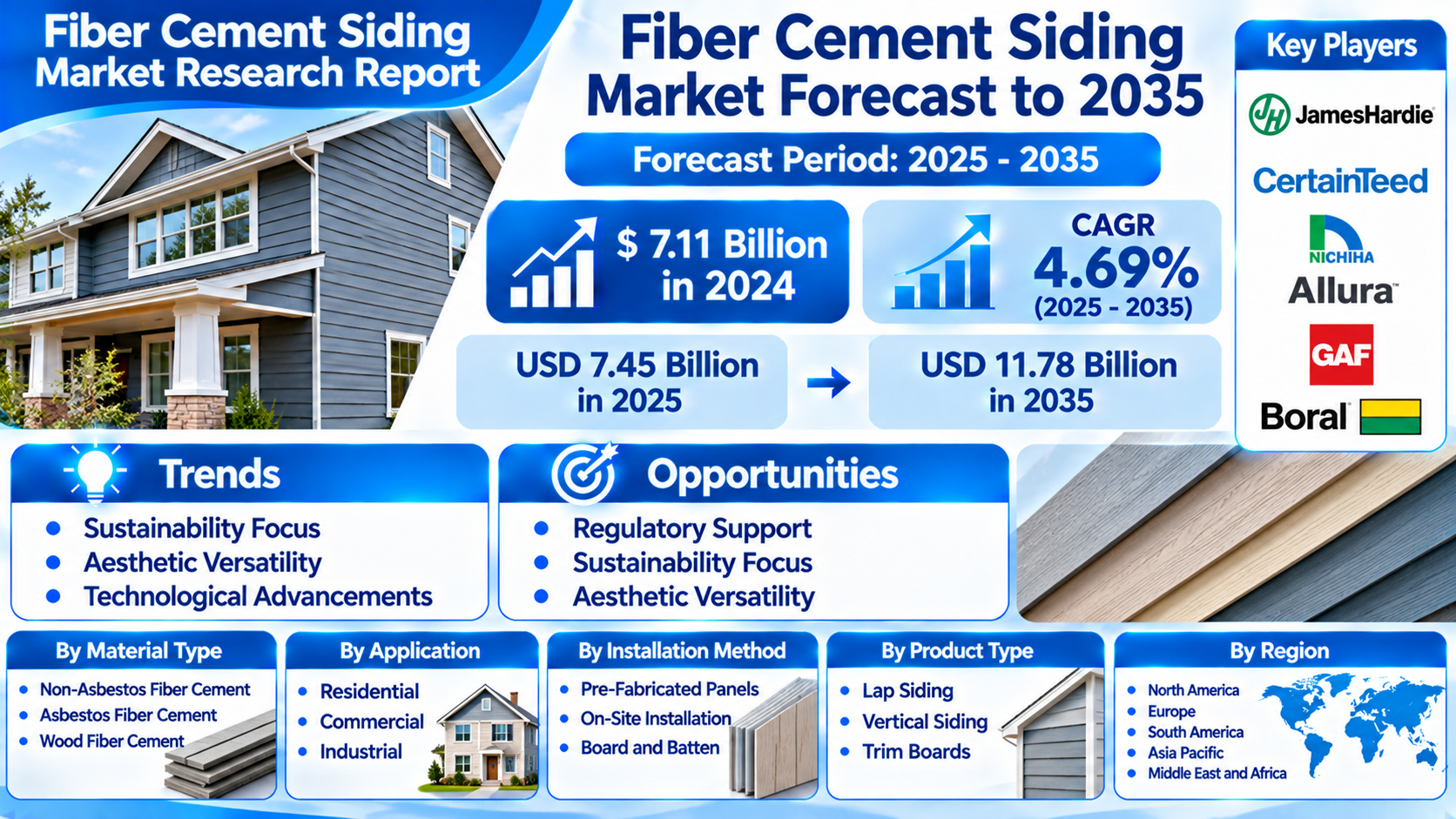

According to Market Research Future® (MRFR), the Fiber Cement Siding Market is projected to grow from USD 7.45 billion in 2025 to USD 11.78 billion by 2035, registering a compound annual growth rate (CAGR) of 4.69% during the forecast period from 2025 to 2035. The market was valued at USD 7.11 billion in 2024. Its development is influenced by sustainability priorities, demand for aesthetic versatility, and technological advancements. Regulatory support and growing interest in sustainable building materials also present opportunities across residential, commercial, and industrial construction.
Market Overview and Growth Outlook
Fiber cement siding occupies an important position in the building materials market, with demand spread across several construction applications and product categories. Its market structure includes different material types, installation methods, and siding formats, allowing the industry to serve varied project requirements. Residential, commercial, and industrial applications form the principal demand categories identified in the report.
The market's projected expansion from USD 7.45 billion in 2025 to USD 11.78 billion in 2035 reflects a steady growth outlook. The stated CAGR of 4.69% indicates continued development throughout the forecast period. The increase from USD 7.11 billion in 2024 to USD 7.45 billion in 2025 provides additional context for the industry's recent market valuation.
Three trends shape the market outlook: sustainability focus, aesthetic versatility, and technological advancements. These themes reflect the importance of environmental considerations, design preferences, and product development in the building materials sector. Regulatory support, sustainability focus, and aesthetic versatility are also identified as opportunities for future market development.
Sustainability and Changing Building Material Preferences
Sustainability is a central theme in the fiber cement siding market. The report identifies sustainability focus as both a major trend and a growth opportunity. This highlights the relevance of environmental considerations to material selection and construction decisions.
As construction stakeholders evaluate building materials, sustainability can influence purchasing priorities and product strategies. Manufacturers may need to respond to changing expectations through product development and improvements in their operations. The supplied market information identifies sustainability as an important factor but does not quantify its individual contribution to market growth.
Regulatory support is another opportunity identified in the report. Regulatory developments can influence the construction sector by shaping material requirements and industry practices. For fiber cement siding suppliers, the regulatory environment is therefore an important consideration when assessing market opportunities across different regions and end-use categories.
Aesthetic Versatility and Product Demand
Aesthetic versatility is identified as a key trend and an opportunity for the market. Exterior siding contributes to the appearance of buildings, making design considerations relevant to product selection. The report's segmentation by product type includes Lap Siding, Vertical Siding, and Trim Boards, reflecting the range of formats covered in the market.
These product categories serve different design and installation requirements. Lap siding, vertical siding, and trim boards provide options for construction projects with varying exterior specifications. Aesthetic preferences can therefore influence demand across the product portfolio.
The market's application base also supports a variety of project types. Residential construction represents one category, while commercial and industrial applications extend demand into other building environments. The importance of appearance may vary by project, but aesthetic versatility remains a stated theme across the overall market outlook.
Material Types and Product Categories
The report divides the market by material type into Non-Asbestos Fiber Cement, Asbestos Fiber Cement, and Wood Fiber Cement. These categories define the material segmentation used in the market assessment. Their inclusion provides a framework for evaluating the different material classifications represented in the industry.
Product type segmentation covers Lap Siding, Vertical Siding, and Trim Boards. These formats provide a separate perspective on the market's product portfolio. Together, material and product classifications show how the industry is structured across different types of building materials and siding products.
The supplied information does not provide individual segment shares or identify the fastest-growing material or product category. Accordingly, the market outlook can be assessed at the overall level without assuming that one segment accounts for a particular proportion of revenue.
Installation Methods and Construction Applications
Fiber cement siding installation methods include Pre-Fabricated Panels, On-Site Installation, and Board and Batten. These categories represent the installation approaches covered in the report. Their presence highlights the importance of construction methods in the market's segmentation.
The application categories are Residential, Commercial, and Industrial. Residential projects form a major part of the market's scope, while commercial and industrial construction provide additional areas of demand. These categories demonstrate the range of building environments in which fiber cement siding is considered.
Installation preferences and project requirements can influence the choice of product and method. Pre-fabricated panels, on-site installation, and board and batten approaches are therefore relevant to the industry's product and service landscape. The report details supplied do not quantify the relative adoption of these methods.
Technological Advancements in the Industry
Technological advancements are identified as one of the major trends shaping the fiber cement siding market. Developments in production and related processes can influence the industry's ability to serve changing construction requirements. Technology also connects with product development, manufacturing practices, and the range of available siding formats.
The market includes multiple material types, product categories, and installation methods. This diversity creates a broad operating environment for manufacturers seeking to serve different customer needs. Technological progress may support improvements across this landscape, although the supplied data does not specify particular innovations or quantify their effects.
Manufacturers must also consider how technology interacts with sustainability and aesthetic expectations. Product development takes place within a market where environmental priorities and exterior design preferences are both identified as important influences.
Regional Market Coverage
The report examines the fiber cement siding market across North America, Europe, South America, Asia Pacific, and the Middle East and Africa. These five regional categories provide the geographic framework for the global market assessment.
Regional demand is influenced by construction activity, building requirements, regulatory conditions, and material preferences. However, the supplied information does not include regional market valuations, country-level data, or comparative growth rates. It therefore does not establish a leading or fastest-growing region.
Competitive Landscape
The key players identified in the report are James Hardie, CertainTeed, Nichiha, Allura, GAF, and Boral. These companies form part of the competitive landscape examined in the market research.
Competition takes place across material types, siding formats, and installation categories. Manufacturers must consider changing construction requirements, sustainability priorities, aesthetic preferences, and technological developments when shaping their market strategies. The supplied information identifies the principal companies but does not provide individual market shares or comparative financial performance.
Future Opportunities Through 2035
The fiber cement siding market is projected to reach USD 11.78 billion by 2035, supported by a stated CAGR of 4.69% over 2025–2035. The market's opportunities are linked to regulatory support, sustainability focus, and aesthetic versatility. These factors complement the identified trends in environmental priorities, design preferences, and technological advancements.
Demand across residential, commercial, and industrial applications provides a broad foundation for market development. The availability of multiple material types, installation methods, and product categories further defines the industry's scope. As the market progresses toward 2035, manufacturers will need to respond to construction requirements and evolving expectations surrounding sustainable and visually versatile building materials.

