

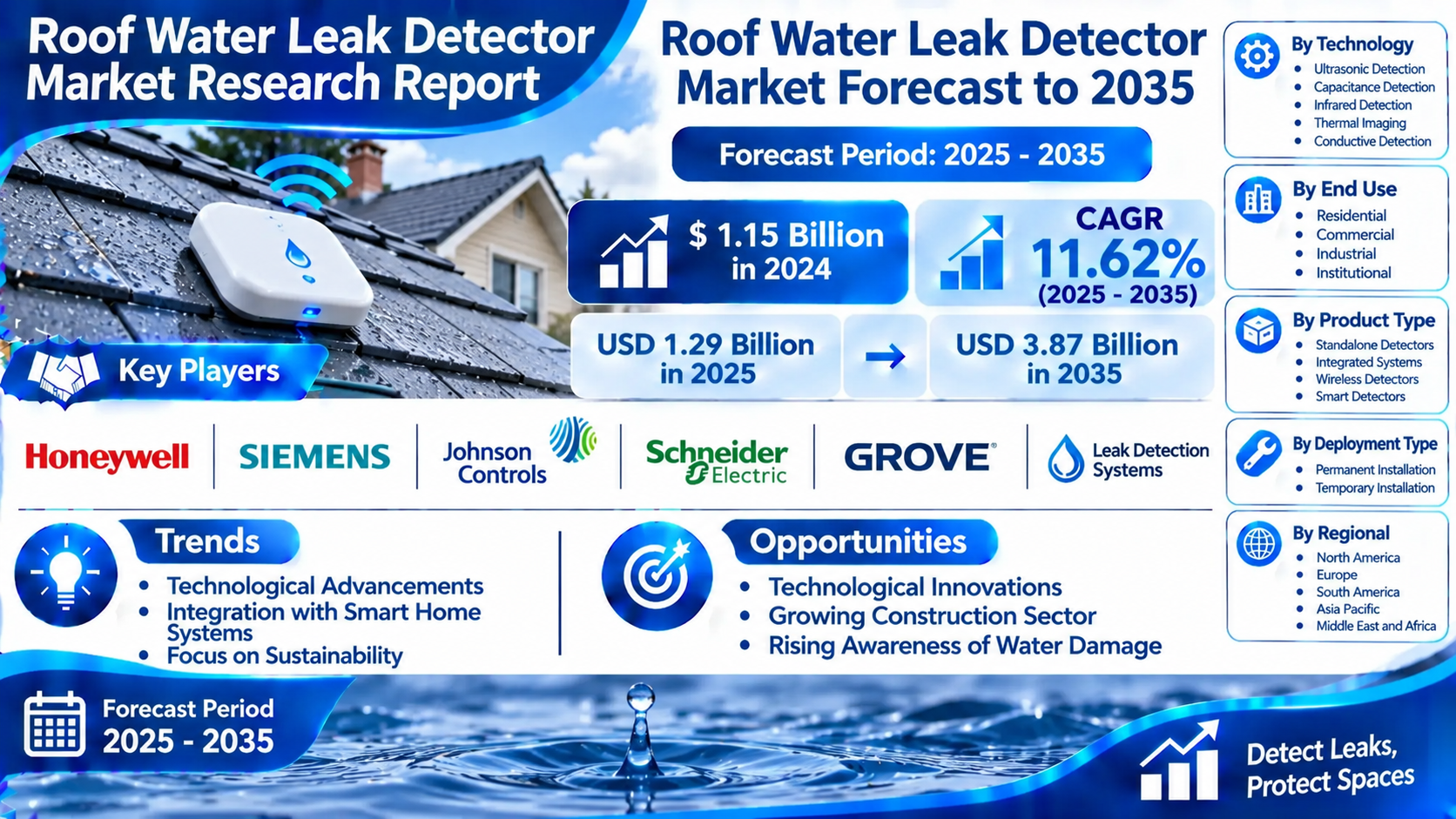

According to Market Research Future® (MRFR), the Roof Water Leak Detector Market is projected to grow from USD 1.29 billion in 2025 to USD 3.87 billion by 2035, registering a compound annual growth rate (CAGR) of 11.62% during the forecast period from 2025 to 2035. The market was valued at USD 1.15 billion in 2024. This expansion reflects increasing attention to roof water monitoring, technological advancements in detection systems, integration with smart home systems, and a growing focus on sustainability. Demand spans residential, commercial, industrial, and institutional properties.
Roof Water Leak Detector Market Overview
Roof water leak detectors are designed to identify water intrusion and support the monitoring of roof conditions. The market includes several detection technologies and product configurations, allowing the industry to serve different building types and deployment requirements. Ultrasonic detection, capacitance detection, infrared detection, thermal imaging, and conductive detection are the technologies covered in the market segmentation.
The forecast indicates that market value will triple between 2025 and 2035, increasing from USD 1.29 billion to USD 3.87 billion. The stated CAGR of 11.62% represents the expected annual growth rate over this period. The increase from USD 1.15 billion in 2024 to USD 1.29 billion in 2025 provides the starting context for this projected development.
Detection Technologies and Product Categories
Technology is a central dimension of the market. The report identifies ultrasonic detection, capacitance detection, infrared detection, thermal imaging, and conductive detection as the principal categories. These approaches form the technological foundation of the market's product offerings. The availability of multiple detection methods enables the market to address different monitoring requirements across building environments.
Technological Advancements are identified as a key trend. Continued innovation can influence the development of detection equipment and the way systems are incorporated into building monitoring arrangements. The opportunity associated with technological innovations further reinforces the importance of product development. However, the supplied information does not specify individual technology performance levels, adoption rates, or market shares.
The product-type segmentation includes standalone detectors, integrated systems, wireless detectors, and smart detectors. Standalone products represent one category, while integrated systems form another. Wireless and smart detectors add further options within the market. These classifications demonstrate that product differentiation is not limited to detection technology; system configuration and connectivity also shape the competitive landscape.
Demand Across Building End Uses
The market serves four end-use categories: residential, commercial, industrial, and institutional. Each represents a different building environment with distinct monitoring requirements. Residential applications are relevant to individual homes and housing developments, while commercial buildings form another important customer category. Industrial and institutional properties broaden the market's potential reach.
The integration of leak detection with smart home systems is one of the trends shaping the industry. This development is particularly relevant to connected residential environments, where monitoring devices can form part of wider home technology arrangements. Smart integration also corresponds with the market's inclusion of smart detectors and integrated systems as product categories.
The commercial, industrial, and institutional segments provide additional areas for deployment. These properties may have different building layouts and operational requirements, making the availability of several detection technologies and product configurations relevant. The report does not provide individual end-use valuations, so the relative size of these segments cannot be determined from the supplied figures.
Deployment Models and Installation Requirements
Deployment type is divided into permanent installation and temporary installation. Permanent systems are designed to remain in place as part of a building's monitoring arrangements, while temporary installations provide a separate deployment category. The distinction allows the market to cover different monitoring needs and installation approaches.
The choice between deployment models may depend on the building environment, monitoring objectives, and the nature of the installation. Together with the product-type categories, this segmentation shows that buyers can evaluate detectors according to both their technological approach and the way they are deployed.
Smart Integration and Sustainability Trends
Integration with Smart Home Systems is an important trend in the market. Connected building technologies are creating opportunities for detection systems to become part of broader monitoring environments. Smart detectors and integrated systems are directly reflected in the product segmentation, highlighting the relationship between connectivity trends and product development.
Focus on Sustainability is another identified trend. Water damage can affect building materials and property conditions, making early detection and monitoring relevant to building management. A sustainability-oriented approach can place greater emphasis on maintaining buildings and managing resources responsibly. The supplied market information identifies sustainability as a trend but does not quantify its direct contribution to market growth.
Growth Opportunities in Construction and Water Damage Awareness
The growing construction sector is a major opportunity identified in the report. As construction activity expands, new residential, commercial, industrial, and institutional buildings can create additional potential demand for roof monitoring products. The range of end-use categories gives the market exposure to several types of construction projects.
Rising awareness of water damage is another opportunity. Water intrusion can create concerns for building owners and property managers, making detection and monitoring relevant to property maintenance. Greater awareness may encourage consideration of systems that identify leaks and help users respond to potential problems.
Technological innovations provide a third opportunity. New developments in detection technologies, wireless products, smart detectors, and integrated systems can contribute to product differentiation. The extent of their impact will depend on market adoption and the requirements of different building users.
Regional Outlook and Competitive Landscape
The report covers North America, Europe, South America, Asia Asia-Pacific, and the Middle East and Africa. This regional segmentation provides a broad geographic view of the industry. No individual regional market sizes or rankings have been supplied, so the available figures do not establish which region leads the market.
Key players identified in the market include Honeywell, Siemens, Johnson Controls, Schneider Electric, GROVE, and Leak Detection Systems. These companies form part of the competitive landscape. Competition takes place across detection technologies, product types, and deployment models, with smart integration and technological innovation representing important areas of market development.
Roof Water Leak Detector Market Forecast to 2035
The market is expected to reach USD 3.87 billion by 2035, growing at a CAGR of 11.62% from 2025. Its expansion is associated with demand across residential, commercial, industrial, and institutional buildings, alongside developments in detection technology and connected systems. Construction sector growth and rising awareness of water damage provide additional opportunities. Technological advancements and sustainability considerations are also expected to remain important themes in the industry's development through 2035.

