

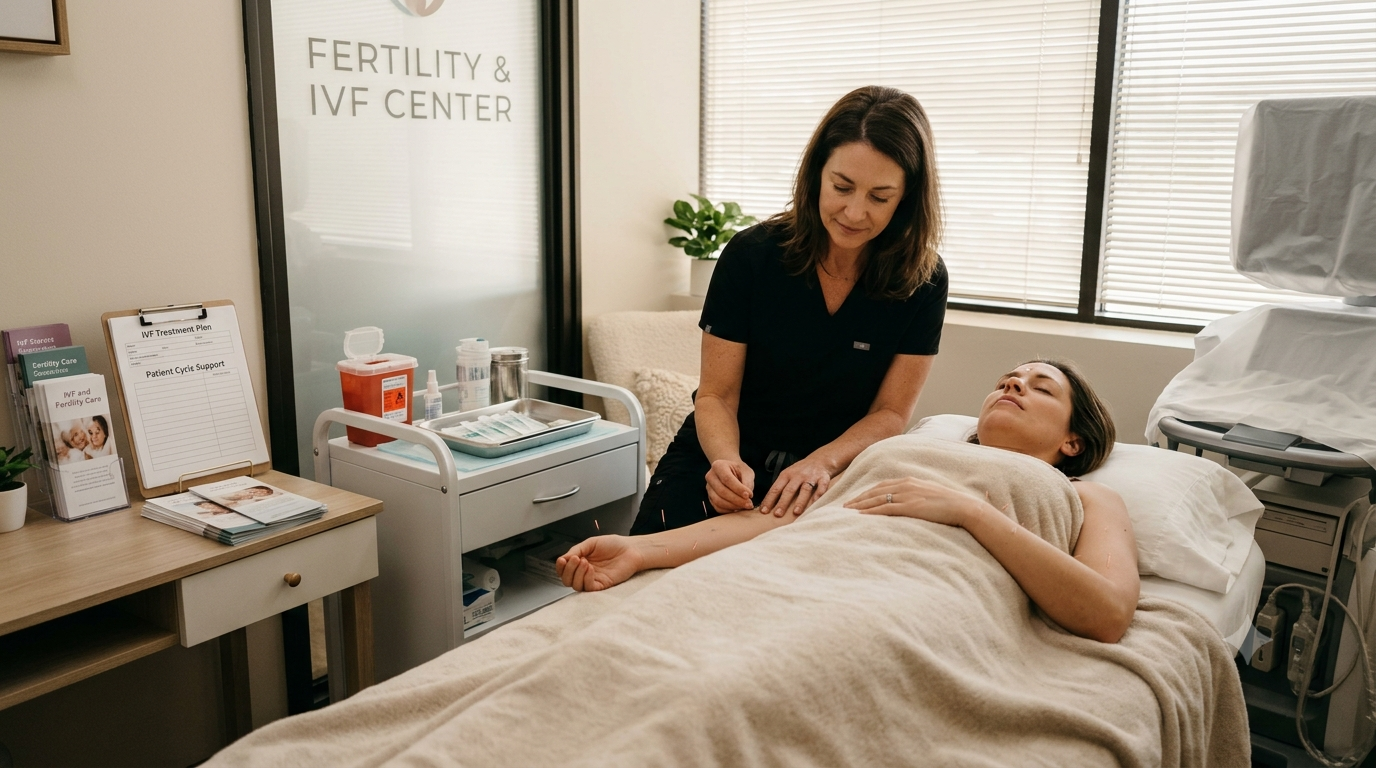
Acupuncture and IVF: How to Coordinate Complementary Treatment With Your Fertility Clinic
Planning an IVF cycle involves medication schedules, blood tests, ultrasound appointments, egg retrieval, and potentially embryo transfer. If you are considering complementary acupuncture and ivf support during your fertility treatment journey, the most important consideration is coordinating appointments with your fertility clinic rather than following a fixed schedule found online.
Some people explore acupuncture because they find the sessions relaxing or want additional support while managing the demands of assisted reproduction. Others hope it will improve implantation or increase their chances of having a baby. These expectations need to be separated because the evidence for improving IVF outcomes remains uncertain.
Acupuncture should never replace prescribed fertility medication, alter an IVF protocol, or delay a procedure. A coordinated approach allows you to discuss complementary treatment while keeping your reproductive specialist responsible for the medical decisions.
Why IVF Patients Consider Additional Support
IVF can be physically demanding and emotionally challenging. Even when a treatment plan is carefully organised, patients may experience uncertainty at different stages.
Common concerns include:
-
Worry about whether ovarian stimulation is producing an appropriate response.
-
Anxiety about injections and medication side effects.
-
Concern about the number of eggs retrieved.
-
Uncertainty about fertilisation and embryo development.
-
Stress while waiting for an embryo transfer.
-
Emotional pressure during the pregnancy test waiting period.
These concerns help explain why people investigate complementary wellness services.
Acupuncture is a traditional practice involving the insertion of fine needles at selected points. In an IVF setting, it may be considered for relaxation or general wellness support.
However, feeling more relaxed does not establish that a treatment has improved fertilisation, embryo quality, implantation, or live-birth rates.
Understanding the Different Stages of an IVF Cycle
Before deciding when to schedule complementary appointments, understand the main stages of IVF.
1. Initial assessment and preparation
The fertility clinic reviews medical history, reproductive investigations, previous treatment, and other relevant factors.
The clinic may recommend blood tests, ultrasound examinations, and additional investigations before establishing an individual treatment protocol.
If you are considering acupuncture, this is a suitable time to ask whether it is appropriate for your circumstances.
2. Ovarian stimulation
Medication is used to encourage the development of multiple ovarian follicles.
Patients usually attend monitoring appointments involving ultrasound scans and blood tests. The medical team uses these findings to assess the response and determine whether medication adjustments are required.
Complementary appointments should not interfere with monitoring or medication instructions.
3. Trigger medication and egg retrieval
Once the follicles have reached the stage determined by the fertility team, trigger medication is administered according to the prescribed schedule.
Egg retrieval is then performed using the clinic's procedure and anaesthesia or sedation arrangements.
This stage requires particular attention to appointment timing, procedural instructions, and recovery.
4. Fertilisation and embryo development
Retrieved eggs are fertilised in the laboratory. Depending on the treatment plan, the clinic may provide updates about fertilisation and embryo development.
Not every retrieved egg becomes a fertilised egg or develops into an embryo suitable for transfer.
5. Embryo transfer
An embryo may be transferred during the same treatment cycle or at a later date, depending on the medical plan.
Some embryos may be frozen for future transfer.
Patients should follow the clinic's instructions about medication, preparation, activity, and follow-up.
6. Pregnancy testing
A blood test is scheduled by the fertility clinic to assess whether pregnancy has occurred.
Testing too early with a home pregnancy test can create confusion, particularly when trigger medication containing hCG has been used.
The clinic's testing instructions should take priority.
When Should Acupuncture Be Scheduled During IVF?
There is no universally established acupuncture schedule that has been proven to improve IVF live-birth outcomes.
Different practitioners may propose different appointment arrangements. Some suggest sessions before stimulation, others during the treatment cycle, and some offer appointments around embryo transfer.
These approaches should not be interpreted as medically established requirements.
|
IVF stage |
Main medical priority |
Complementary treatment consideration |
|
Before stimulation |
Complete assessments and follow the clinic's plan |
Discuss suitability and treatment objectives |
|
During stimulation |
Medication and ultrasound monitoring |
Avoid interfering with monitoring or appointments |
|
Before egg retrieval |
Follow trigger and procedural instructions |
Obtain clearance from the clinical team |
|
After retrieval |
Follow recovery and medication guidance |
Discuss whether and when another session is appropriate |
|
Before embryo transfer |
Follow transfer preparation instructions |
Confirm suitability and timing with the clinic |
|
After transfer |
Follow medication and activity instructions |
Avoid unapproved treatments or changes to the care plan |
|
Pregnancy testing |
Complete the scheduled blood test |
Discuss any new treatment after the result |
The table provides a coordination framework, not a prescribed acupuncture protocol.
What Does Research Say About Acupuncture and IVF Outcomes?
Research has investigated whether acupuncture around IVF procedures influences pregnancy outcomes.
The results have not established a consistent improvement in live births.
A large randomised clinical trial published in JAMA in 2018 included 824 women who underwent IVF. The live-birth rate was 18.3% in the acupuncture group and 17.8% in the sham-acupuncture group. The difference was not statistically significant.
A Cochrane review also concluded that the available evidence did not establish an improvement in live-birth or pregnancy rates when acupuncture was performed around egg collection or embryo transfer.
More recent systematic reviews have explored different acupuncture methods and treatment schedules. Some report possible improvements in intermediate outcomes, such as clinical pregnancy or implantation. However, limitations in study quality, variation between treatment protocols, and uncertainty surrounding live-birth outcomes remain important.
The practical message is that acupuncture may be chosen as complementary wellness care, but it should not be sold as a proven method of making IVF successful.
Understanding the difference between IVF outcomes
|
Outcome |
What it means |
Why it matters |
|
Retrieved eggs |
Eggs collected during the procedure |
Indicates the response to stimulation |
|
Fertilisation rate |
Proportion of eggs successfully fertilised |
Provides information about laboratory fertilisation |
|
Embryo development |
Progression of fertilised eggs |
Helps determine transfer or freezing suitability |
|
Clinical pregnancy |
Pregnancy confirmed through ultrasound |
Indicates an established clinical pregnancy |
|
Live birth |
Delivery of a living baby |
A particularly important measure of treatment success |
An improvement in one intermediate outcome does not automatically establish an improvement in live births.
Five Mistakes to Avoid When Combining Complementary Care With IVF
Mistake 1: Booking appointments without checking the IVF calendar
IVF schedules can change following ultrasound monitoring and blood test results.
Booking an inflexible series of appointments may create unnecessary pressure.
Better approach: Discuss the expected schedule with both providers and keep medical appointments as the priority.
Mistake 2: Assuming acupuncture improves embryo implantation
There is no consistent high-quality evidence establishing that acupuncture around embryo transfer increases live-birth rates.
Better approach: Treat acupuncture as optional complementary care, not an implantation treatment.
Mistake 3: Changing medication based on complementary advice
Fertility medication is prescribed according to individual clinical findings.
Changing a dose or stopping medication without approval can disrupt the treatment plan.
Better approach: Direct all medication questions to the prescribing fertility specialist.
Mistake 4: Ignoring symptoms after egg retrieval
Severe abdominal pain, significant bloating, vomiting, breathing difficulties, faintness, or reduced urination after stimulation and retrieval require prompt medical assessment.
These symptoms may indicate complications, including ovarian hyperstimulation syndrome.
Better approach: Contact the fertility clinic immediately if concerning symptoms develop rather than attempting to manage them with acupuncture.
Mistake 5: Believing more appointments guarantee better results
There is no established number of sessions that guarantees IVF success.
Better approach: Discuss the purpose, frequency, cost, and suitability of appointments before starting.
A Practical Process for Coordinating IVF and Acupuncture
If you decide to explore complementary care, use this process.
Step 1: Obtain your IVF treatment calendar
Ask the fertility clinic about expected stimulation dates, monitoring, trigger medication, retrieval, transfer, and pregnancy testing.
Step 2: Explain your medical history
Discuss previous IVF cycles, reproductive diagnoses, current medication, previous complications, and other relevant health information.
Step 3: Ask the fertility specialist about suitability
Find out whether acupuncture is appropriate during your current cycle and whether any treatment stages require restrictions.
Step 4: Choose a qualified practitioner
Check professional licensing, experience, needle hygiene, treatment procedures, and willingness to coordinate with your medical team.
Step 5: Agree on flexible appointments
Avoid treating a particular appointment date as more important than the IVF clinic's instructions.
Step 6: Monitor your response
Consider whether appointments are helping your comfort and general well-being. Do not use feelings of relaxation as evidence that IVF outcomes have improved.
Step 7: Reassess after the cycle
Discuss whether continuing complementary care makes sense based on your experience, medical circumstances, and practical costs.
Two Practical IVF Scenarios
Example 1: A patient during ovarian stimulation
A patient begins ovarian stimulation and is attending regular ultrasound appointments. She has heard that acupuncture may improve IVF outcomes and wants to begin twice-weekly sessions.
Rather than immediately booking a package, she asks her fertility clinic whether the proposed appointments are appropriate.
The clinic explains the importance of medication timing, monitoring, and keeping the retrieval schedule flexible.
She then discusses these requirements with her acupuncture practitioner and considers whether occasional appointments for relaxation are practical.
Example 2: A patient approaching embryo transfer
Another patient has completed egg retrieval and is waiting for an embryo transfer date.
She is interested in receiving acupuncture immediately before and after the procedure because she has read online recommendations.
Her fertility specialist explains the transfer-day instructions and asks her not to introduce any unapproved intervention that could complicate the schedule.
She chooses to follow the clinic's plan and discusses whether complementary treatment can be considered at another time.
Both examples demonstrate that treatment coordination is more important than following a popular online schedule.
Illustrative Case Study: Managing a Changing IVF Schedule
Consider a hypothetical patient undergoing her first IVF cycle.
She initially expects stimulation to last a particular number of days and books several complementary appointments around that estimate.
However, her monitoring results lead the fertility team to adjust the schedule. Her trigger medication and egg retrieval are planned earlier than expected.
Instead of attempting to keep every original appointment, she contacts the acupuncture practitioner and rearranges the complementary sessions.
She also confirms that any future appointment will depend on the clinic's recovery instructions.
The outcome is not presented as an improvement in pregnancy probability. Rather, it illustrates a more practical approach to coordinating multiple services without allowing optional appointments to interfere with essential medical care.
The transferable lesson is simple: an IVF calendar is a medical plan that may change. Complementary appointments should remain flexible.
What to Ask an Acupuncture Practitioner Before an IVF Cycle
Swiss Acupuncture provides acupuncture services in Redmond, Washington, including a pregnancy and fertility service.
When considering a provider, ask:
-
Are you licensed to practise acupuncture in Washington State?
-
What is your experience working with people receiving fertility treatment?
-
What are the objectives of the proposed treatment?
-
How do you coordinate appointments around egg retrieval and embryo transfer?
-
What precautions are relevant during ovarian stimulation?
-
What side effects should I understand?
-
Do you use sterile, single-use needles?
-
Can appointments be adjusted if the fertility clinic changes the schedule?
You can also explore Swiss Acupuncture's fertility and pregnancy care services to understand the clinic's service offering and arrange a discussion about your individual needs.
The practitioner should communicate realistic expectations and respect the decisions of your reproductive healthcare team.
Your IVF Coordination Checklist
Before starting complementary appointments, confirm the following:
-
Your fertility clinic knows you are considering acupuncture.
-
Your medication schedule remains unchanged unless your doctor instructs otherwise.
-
Your proposed appointments do not interfere with scans or procedures.
-
Your practitioner knows about your fertility treatment.
-
You understand possible side effects and safety considerations.
-
You know when to contact your clinic about concerning symptoms.
-
You are comfortable with the financial and time commitment.
Conclusion
IVF requires careful coordination, particularly when medication, monitoring, retrieval, and embryo transfer are involved. Acupuncture can be considered as an optional complementary wellness service, but there is no consistent evidence that it improves IVF live-birth outcomes.
The safest approach is to discuss the idea with your fertility specialist, choose a qualified practitioner, and keep all complementary appointments flexible.
Your prescribed IVF protocol should always take priority. Additional treatment should support your overall well-being without creating unnecessary complications or unrealistic expectations.
Frequently Asked Questions
1. Can acupuncture be used during IVF?
Some patients choose acupuncture as complementary wellness care during IVF. Whether it is appropriate depends on individual circumstances, treatment timing, and medical advice. It should not replace prescribed medication or fertility procedures.
2. Does acupuncture improve IVF success rates?
Research has produced mixed results. Some studies report possible improvements in clinical pregnancy outcomes, but consistent improvement in live-birth rates has not been established.
3. Should I have acupuncture before embryo transfer?
There is no universally recommended appointment schedule proven to improve embryo transfer outcomes. Discuss the idea with your fertility specialist before arranging treatment.
4. Can acupuncture interfere with ovarian stimulation?
Acupuncture does not replace or control prescribed ovarian stimulation medication. However, treatment timing and individual medical circumstances should be reviewed with the fertility clinic.
5. Is acupuncture safe after egg retrieval?
Suitability depends on recovery, symptoms, and medical circumstances. Follow the clinic's post-procedure instructions and seek medical assessment for severe pain, significant bloating, vomiting, breathing difficulties, or other concerning symptoms.
6. Should I continue acupuncture after a positive IVF pregnancy test?
Discuss any further treatment with your obstetric or fertility healthcare provider. Pregnancy requires a reassessment of treatment suitability, practitioner experience, and appropriate precautions.

