

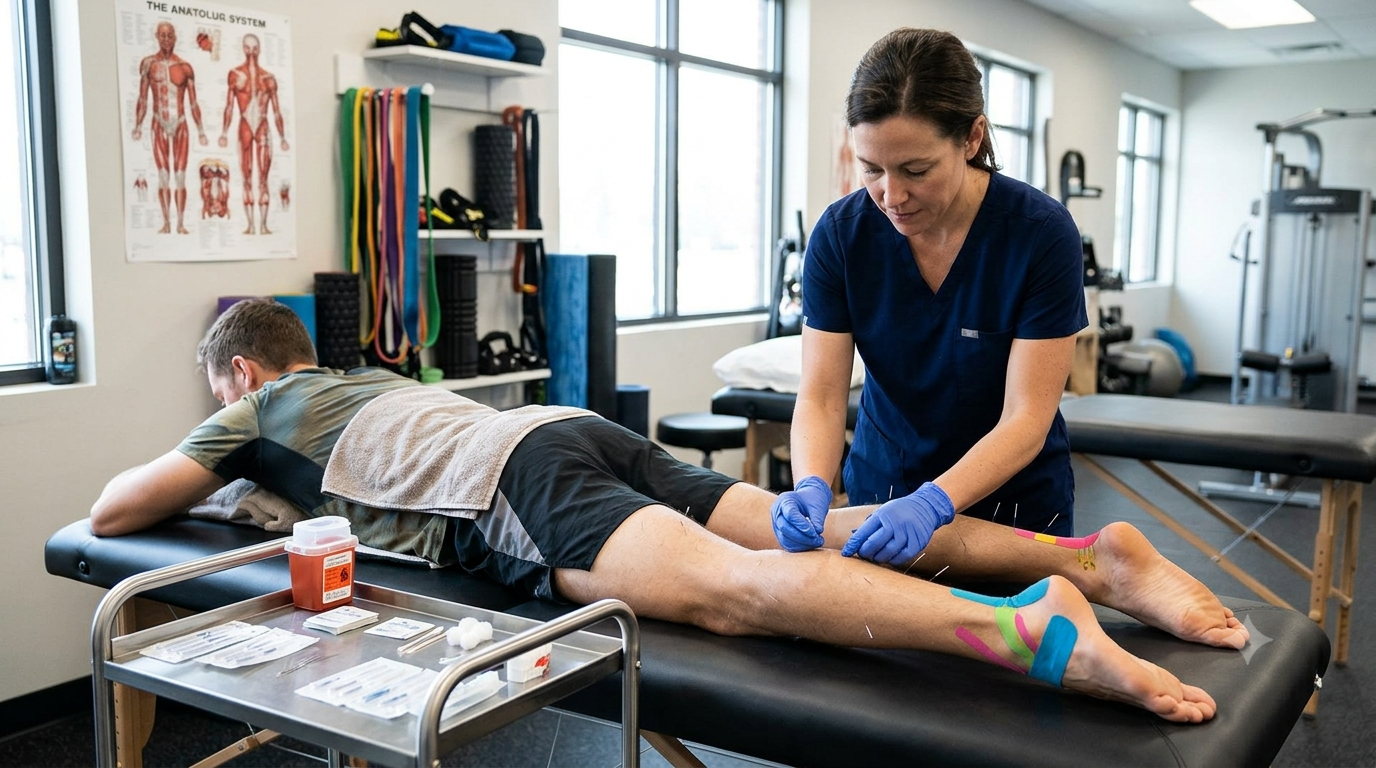
Acupuncture for Sports Performance: Can It Improve Flexibility, Recovery and Training Consistency?
Athletic performance depends on several factors working together, including strength, endurance, mobility, technique, nutrition, sleep, and recovery. Some athletes explore acupuncture for sports performance as a complementary approach to managing discomfort and supporting their overall training routine. However, it is important to understand that possible symptom benefits do not automatically translate into better competition results.
A runner may want to maintain training consistency, a weightlifter may be concerned about muscle soreness, and a tennis player may want to improve comfortable shoulder movement. These are different goals that require different strategies.
Acupuncture has been investigated for pain, flexibility, and certain physical performance measurements. The evidence is interesting, but it does not establish that acupuncture reliably increases athletic ability or provides a competitive advantage.
The most useful approach is to examine what researchers have studied, understand the limitations, and decide whether complementary treatment fits your individual goals.
What Actually Determines Sports Performance?
Before considering an additional treatment, it helps to understand the factors that influence athletic performance.
1. Strength and power
Strength is important in activities such as weightlifting, sprinting, jumping, and many team sports.
Power involves producing force quickly, making it relevant to explosive movements.
These abilities depend on appropriate training, neuromuscular adaptation, recovery, and individual characteristics.
2. Cardiovascular endurance
Endurance allows athletes to sustain physical activity over time.
Running, cycling, swimming, and many team sports place substantial demands on cardiovascular fitness.
An acupuncture appointment cannot replace progressive endurance training.
3. Mobility and flexibility
Mobility influences how comfortably and effectively an athlete can move through different positions.
Flexibility may be relevant to particular sports and movements, but more flexibility is not automatically better for every athlete.
4. Recovery between sessions
Training creates physical demands that need to be managed between workouts.
Sleep, nutrition, hydration, rest, and appropriate training progression all influence recovery.
5. Technique and coordination
Good technique allows athletes to perform sport-specific movements efficiently.
A swimmer, gymnast, runner, and footballer each require different movement skills.
An additional wellness treatment should not be confused with technical coaching or sport-specific training.
What Do Researchers Investigate About Acupuncture and Athletic Performance?
Research has examined several possible applications of acupuncture in sports medicine.
These include:
-
Muscle soreness after strenuous exercise.
-
Musculoskeletal pain.
-
Flexibility and range of motion.
-
Strength and power measurements.
-
Perceived recovery.
-
Physical comfort during training.
A 2022 review published in Current Sports Medicine Reports discussed acupuncture and dry needling for sports performance and recovery.
The review identified potential applications involving pain management, flexibility, and certain performance-related measurements. However, it also highlighted the need for higher-quality studies before more specific recommendations can be made.
A 2020 systematic review examined acupuncture for delayed-onset muscle soreness and reported potentially favourable findings for soreness and recovery.
More recent reviews have also investigated acupuncture-related approaches for exercise-induced soreness. Their findings suggest that some interventions may produce modest short-term reductions in soreness, although the clinical importance and generalisability of these effects remain uncertain.
These findings should not be interpreted as proof that acupuncture increases an athlete's maximum strength, endurance, or competition success.
Five Areas Athletes Should Understand
1. Muscle soreness after demanding training
Delayed-onset muscle soreness often develops after unfamiliar or strenuous exercise.
It may make movements such as climbing stairs, squatting, or reaching uncomfortable.
Research has investigated whether acupuncture can reduce this soreness.
Some findings suggest modest short-term symptom improvement, but ordinary recovery habits remain essential.
Acupuncture should not be used to ignore severe pain or suspected injury.
2. Flexibility and range of motion
Some studies have investigated whether needling treatments influence flexibility and movement.
This may be relevant to athletes who need particular ranges of motion for their sport.
However, an improvement in a flexibility measurement does not automatically improve athletic performance.
Flexibility should be developed according to the demands of the sport rather than pursued without a clear objective.
3. Musculoskeletal pain
Pain can interfere with training quality and movement.
Some athletes consider acupuncture as a complementary pain-management option.
However, pain may also indicate an injury that needs assessment.
Reducing discomfort without identifying the underlying cause can create problems if the athlete continues training through an unresolved condition.
4. Recovery routine
Athletes sometimes want additional support between demanding sessions.
An acupuncture appointment may provide a structured opportunity for relaxation, depending on the individual's experience.
Nevertheless, it should not replace sleep, appropriate nutrition, rest days, and workload management.
5. Physical performance measurements
Researchers have explored strength, power, and other performance indicators following acupuncture-related interventions.
Results vary across studies, and the evidence does not support promising a reliable performance enhancement to every athlete.
The distinction between a measurable short-term change and a meaningful competitive advantage is important.
Comparing Performance Goals With Realistic Treatment Expectations
|
Athletic goal |
What acupuncture research explores |
What athletes should not assume |
|
Reduce post-exercise soreness |
Possible short-term pain reduction |
That all muscle damage has healed |
|
Improve flexibility |
Changes in range of motion |
Guaranteed improvements in sport technique |
|
Manage muscular pain |
Complementary pain management |
That the underlying injury is resolved |
|
Improve strength |
Some preliminary performance measurements |
Guaranteed increases in lifting capacity |
|
Improve endurance |
Limited research into physiological outcomes |
That aerobic fitness will increase |
|
Support training consistency |
Whether symptom management helps comfort |
That appointments replace recovery habits |
This comparison can help athletes avoid choosing treatments based on exaggerated marketing claims.
How to Evaluate Whether Acupuncture Fits Your Performance Goals
Instead of starting treatment because it is popular among athletes, identify the specific problem you want to address.
Step 1: Define your performance objective
Be precise.
Are you trying to manage recurring soreness, improve comfortable movement, or address discomfort that affects training?
A clear objective makes it easier to evaluate whether treatment is appropriate.
Step 2: Review your training programme
Look at workout frequency, intensity, exercise selection, and recent changes in workload.
An athlete experiencing recurring fatigue may need adjustments to training rather than additional appointments.
Step 3: Rule out an injury
Persistent or worsening pain, swelling, weakness, or restricted movement should be assessed by an appropriate healthcare professional.
Do not assume that performance-related discomfort is simply part of training.
Step 4: Establish your recovery fundamentals
Review sleep, nutrition, hydration, rest periods, and training progression.
These should remain the foundation of your recovery strategy.
Step 5: Discuss complementary treatment
Ask a qualified practitioner whether acupuncture is appropriate for your specific concern.
Explain your sport, training schedule, previous injuries, and medical history.
Step 6: Set measurable expectations
If you are trying acupuncture for a particular symptom, decide how you will evaluate it.
For example, monitor discomfort after training, movement, or ability to complete normal sessions.
Do not treat an improvement in one measurement as proof of overall athletic enhancement.
Step 7: Review the value of continuing
Consider the results, financial cost, appointment time, and whether treatment is compatible with your wider training plan.
Mistakes Athletes Make When Chasing Better Performance
Mistake 1: Looking for shortcuts instead of improving training fundamentals
No complementary treatment can compensate for an inconsistent training programme.
Better approach: Establish suitable training progression, conditioning, sleep, and nutrition first.
Mistake 2: Confusing less pain with better performance
An athlete may experience less discomfort without demonstrating improvements in strength, speed, or endurance.
Better approach: Evaluate symptom relief and performance separately.
Mistake 3: Experimenting immediately before competition
A new treatment may produce unexpected soreness, bruising, or discomfort.
Better approach: Avoid introducing unfamiliar treatments immediately before an important competition.
Mistake 4: Ignoring recurring injuries
Athletes sometimes focus on reducing symptoms because they do not want to miss training.
Better approach: Investigate recurring symptoms and follow appropriate rehabilitation.
Mistake 5: Following another athlete's treatment schedule
A treatment routine that suits one athlete may not be suitable for another.
Better approach: Individualise treatment according to medical history, sport, and training demands.
Two Practical Performance Scenarios
Example 1: A distance runner preparing for a race
A distance runner is preparing for a long-distance event and increases weekly mileage.
The athlete begins experiencing substantial muscle soreness after demanding sessions.
Rather than immediately assuming that acupuncture will improve race performance, the runner reviews training progression, recovery days, sleep, and nutrition.
After discussing the symptoms with an appropriate healthcare professional, the runner considers whether acupuncture may be suitable as complementary support.
The main objective is to manage discomfort responsibly, not to expect an automatic increase in speed or endurance.
Example 2: A tennis player concerned about shoulder mobility
A tennis player notices that shoulder movement feels uncomfortable after repeated serving practice.
The player initially believes that additional flexibility treatment will improve serving performance.
An assessment reveals that the shoulder symptoms need further attention before increasing training intensity.
The athlete follows the recommended management plan and discusses whether complementary treatment is appropriate.
This approach prioritises shoulder health over an immediate performance target.
Illustrative Case Study: Measuring Progress Beyond How You Feel
Consider a hypothetical competitive cyclist preparing for a demanding training block.
The cyclist notices increasing muscular discomfort after longer rides and begins investigating additional recovery options.
Initial objective: Maintain training consistency while managing post-exercise discomfort.
Assessment: The cyclist reviews the training schedule and obtains appropriate advice about the recurring symptoms.
Recovery review: Sleep, nutrition, hydration, and rest periods are assessed.
Complementary treatment: The cyclist discusses whether acupuncture may be appropriate for symptom management.
Progress monitoring: The cyclist tracks soreness, training tolerance, movement, and completion of planned sessions.
Evaluation: The cyclist compares actual training progress rather than assuming that feeling more relaxed means physical performance has improved.
Transferable lesson: A useful performance strategy should be measured against specific goals. Treatment satisfaction, pain reduction, and competitive performance are separate outcomes.
This is a hypothetical example, not a documented athlete testimonial or verified treatment result.
How Swiss Acupuncture Can Support an Informed Wellness Decision
Athletes considering acupuncture should choose a provider who communicates clearly about treatment objectives, qualifications, possible side effects, and limitations.
Swiss Acupuncture, based in Redmond, Washington, provides acupuncture services and information about potential applications for different musculoskeletal and wellness concerns.
If you are considering a consultation, explain your training schedule, sport, previous injuries, and current symptoms.
You can explore Swiss Acupuncture's acupuncture services and wellness approach to learn more about the clinic and discuss whether treatment may be suitable.
Any performance-related expectations should remain realistic. A responsible practitioner should not guarantee faster recovery, increased strength, improved endurance, or better competition results.
Questions to Ask Before Making Acupuncture Part of Your Routine
|
Question |
Why it matters |
|
Are you licensed in Washington State? |
Confirms professional qualifications |
|
What is the purpose of the proposed treatment? |
Establishes a clear objective |
|
Can treatment complement my training programme? |
Supports practical scheduling |
|
Should I have an injury assessed first? |
Helps identify underlying problems |
|
What side effects are possible? |
Supports informed consent |
|
How will we measure progress? |
Prevents relying on vague promises |
|
Is treatment appropriate before competition? |
Helps avoid unnecessary experimentation |
Conclusion
Sports performance depends on consistent training, appropriate recovery, technique, nutrition, sleep, and physical conditioning. Acupuncture has been investigated for musculoskeletal pain, flexibility, and exercise-related soreness, but the available evidence does not establish a reliable performance-enhancing effect for every athlete.
It may be considered as complementary support when there is a clear symptom-related objective and appropriate medical guidance.
Before starting treatment, identify your actual performance challenge, rule out injuries, and establish realistic expectations. The most useful approach is one that supports your training routine without replacing the fundamentals of athletic development.
Frequently Asked Questions
1. Can acupuncture improve sports performance?
Research has investigated possible effects on flexibility, strength, pain, and recovery. However, findings are mixed, and there is insufficient evidence to promise a consistent improvement in competitive performance.
2. Can acupuncture help athletes recover after intense exercise?
Some research suggests acupuncture-related treatments may modestly reduce delayed-onset muscle soreness. However, results vary, and acupuncture should not replace appropriate recovery habits.
3. Does acupuncture increase muscle strength?
Some studies have examined strength and power measurements, but the evidence is not sufficient to establish reliable strength gains for athletes. Progressive resistance training remains essential.
4. Can acupuncture improve flexibility?
Some research has explored changes in range of motion and flexibility. Any potential improvement should be evaluated according to the individual's sport and movement requirements.
5. Should athletes receive acupuncture before competitions?
There is no universal schedule that guarantees better competition performance. Athletes should avoid experimenting with unfamiliar treatments immediately before important events and discuss timing with their practitioner.
6. Is acupuncture suitable for all types of athletes?
Suitability depends on medical history, symptoms, injuries, sport demands, and treatment objectives. Athletes with persistent pain or suspected injuries should obtain appropriate assessment before considering complementary treatment.

