

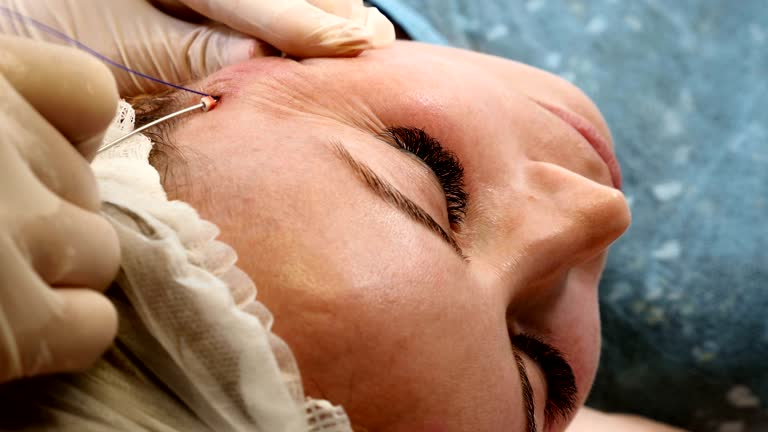

Barbed sutures play an important role in certain types of Thread Lift in Dubai because their structure is designed to engage soft tissue and provide temporary mechanical support. Unlike smooth threads, which are generally used for subtle support and collagen-related applications, barbed sutures have small projections that interact with surrounding tissue. This interaction can help reposition selected facial areas without surgically removing excess skin.
The effectiveness of a barbed thread depends on more than the presence of projections. Thread design, insertion direction, placement depth, facial anatomy, and the amount of tissue laxity all influence the outcome. Understanding how these components work together helps patients develop realistic expectations before considering treatment.
What Are Barbed Sutures in a Thread Lift in Dubai?
Barbed sutures are absorbable medical threads manufactured with small projections along part or all of their structure. These projections are commonly called barbs or cogs. They are designed to engage surrounding tissue when the thread is positioned beneath the skin.
The thread can then provide temporary support to selected soft tissue. The degree of support depends on the thread's construction, the number and arrangement of its barbs, and the anatomical area being treated.
Understanding the Structure of a Barbed Thread
A barbed thread typically consists of a central filament with projections extending from its surface. Different products use different barb patterns and configurations.
Some threads have projections arranged in one direction, while others use alternative patterns designed to engage tissue in a particular way. These variations influence how the thread interacts with the surrounding structures.
Important design features include:
-
Thread material and thickness
-
Barb size and shape
-
Barb direction and distribution
-
Thread length and configuration
-
Product-specific insertion requirements
These details are important because not every barbed thread has the same mechanical characteristics or clinical indication.
How Barbs Engage Tissue and Create Mechanical Support
The lifting effect of a barbed suture comes from its interaction with surrounding soft tissue. After insertion, the projections are designed to engage tissue along the thread's pathway.
When the practitioner applies the intended positioning technique, the thread may support selected tissue in a planned direction. This can create a temporary improvement in facial contour.
Tissue Engagement Along the Thread
The barbs provide multiple points of contact with surrounding tissue. Rather than relying only on the central filament, the thread uses these projections to establish mechanical engagement.
The quality of this engagement depends on the tissue being treated and the specific thread design. Tissue thickness, elasticity, and local anatomy can influence how effectively the thread provides support.
Distributing Support Across a Treatment Area
A properly planned lifting pathway aims to distribute support across the intended tissue rather than concentrating excessive tension at one point.
The practitioner considers the direction of facial tissue movement, the location of the entry point, and the desired contour change. This helps determine where the thread should be positioned.
A suitable treatment plan should avoid excessive pulling because unnecessary tension may contribute to dimpling, irregularities, or discomfort.
Thread Lift in Dubai: Why Barb Direction Matters
The direction of the barbs influences how a thread interacts with surrounding tissue. Different thread systems may use different barb arrangements, so the practitioner must follow the specific product instructions.
The planned direction of insertion also matters. Facial lifting is not simply a matter of pulling the skin upwards. The practitioner must consider the natural movement and structure of each facial region.
Unidirectional and Bidirectional Barb Designs
Some thread products use barbs oriented predominantly in one direction, while others have configurations designed to engage tissue from more than one direction.
These designs have different mechanical characteristics and insertion requirements. Neither configuration should be considered universally superior.
The appropriate design depends on the treatment area, product specifications, and clinical objective.
Matching the Lifting Vector to Facial Anatomy
A lifting vector is the planned direction in which tissue is supported or repositioned. The vector may differ between the cheek, lower face, and jawline.
For example, the practitioner may plan a different pathway for early jowl concerns than for selected midface areas. This is because the underlying tissue structures and aesthetic objectives are not identical.
A well-considered vector aims to improve the intended contour while maintaining natural facial proportions.
Which Facial Areas May Be Treated With Barbed Sutures?
Barbed threads may be considered for selected areas where temporary mechanical tissue support is appropriate. Treatment suitability depends on the specific product and the patient's anatomy.
Jawline and Early Jowl Formation
Changes in lower-face tissue position can affect jawline definition. In suitable patients, barbed threads may help support selected tissue and create a modest improvement in contour.
They do not remove significant skin excess or correct every cause of lower-face heaviness.
Midface and Cheek Support
The cheek area contains several tissue compartments that contribute to facial shape. A practitioner may assess whether a barbed thread system is appropriate for selected midface concerns.
The plan should account for skin thickness, tissue position, facial volume, and the desired degree of support.
Other Facial Treatment Areas
Some thread systems may be designed for additional areas, such as the brow or neck. However, suitability is product-specific and depends on the anatomical structures involved.
Patients should not assume that a thread intended for one facial region can safely or effectively be used in another.
The Role of Placement Depth in Mechanical Lifting
Even a well-designed thread may not provide the intended effect if it is placed incorrectly. Placement depth must be selected according to the product, treatment area, and relevant tissue anatomy.
Why Superficial Placement Can Cause Problems
When a thread is positioned too close to the skin surface, it may become visible or palpable. Superficial placement can also contribute to dimpling, irregular contours, or discomfort.
The practitioner must understand the tissue layers and follow the product-specific placement guidance.
Why Anatomical Assessment Is Essential
Facial anatomy varies between patients. Tissue thickness, fat distribution, previous procedures, and natural asymmetry can all influence the safest treatment pathway.
A medical assessment helps identify relevant anatomical considerations before the procedure is planned.
What Happens After Barbed Threads Are Placed?
Once the threads are positioned, the treated tissue may initially show a visible contour change. Some swelling and temporary irregularity can also occur as the area settles.
The early appearance should not be treated as the final result.
Initial Tissue Support
The barbs provide mechanical engagement after placement. The degree of immediate support depends on the thread design and how it interacts with the tissue.
The practitioner may assess the treated area before completing the procedure to ensure that the result is balanced and that excessive tension has not been created.
Healing and Tissue Response
During recovery, the body responds to the inserted material. Absorbable threads gradually break down, and the surrounding tissue may undergo a healing response.
Some thread systems are associated with collagen-related changes, but the extent of this response varies. It should not be interpreted as a guaranteed replacement for the mechanical support provided by the thread.
Factors That Influence the Results of a Thread Lift in Dubai
Barbed sutures do not produce identical results in every patient. Several factors influence how the tissue responds and how long the visible improvement remains.
These include:
-
Degree of facial laxity
-
Skin thickness and elasticity
-
Facial fat distribution
-
Thread material and barb configuration
-
Insertion pathway and placement depth
-
Practitioner technique
-
Individual healing and ageing patterns
Patients with significant excess skin may not achieve their desired outcome with thread support alone. A surgical assessment may be more appropriate when laxity is advanced.
Possible Risks and Complications
A thread lift is a medical procedure, and barbed sutures carry potential risks. Common temporary effects include bruising, swelling, tenderness, and mild discomfort.
Other possible complications include:
-
Skin dimpling or unevenness
-
Visible or palpable threads
-
Asymmetry
-
Thread migration or extrusion
-
Infection
-
Persistent discomfort
-
Injury to nearby nerves or blood vessels
The likelihood of complications depends on patient factors, product design, anatomical location, and procedural technique. Patients should receive clear information about warning signs and follow-up arrangements.
Clinic Note
Barbed sutures create mechanical support through their interaction with surrounding soft tissue. The thread design, insertion direction, and placement depth must work together. More tension or more barbs do not automatically produce a better result; appropriate anatomical planning is essential.
Frequently Asked Questions
Do barbed sutures create an immediate lifting effect?
They are designed to provide mechanical tissue engagement after placement, so an initial contour change may be visible. Swelling and healing can influence the early appearance, and the result may change as the area settles.
Are barbed threads the same as mono threads?
No. Barbed threads contain projections designed to engage tissue mechanically. Mono threads are smooth and are generally used for subtle support and collagen-related applications.
Can barbed sutures remove loose skin?
No. They may temporarily support selected soft tissue, but they do not surgically remove excess skin. Patients with substantial skin laxity may require assessment for other options.
Does every barbed thread produce the same lifting result?
No. Results vary according to thread construction, material, placement, facial anatomy, and individual healing response.
Can barbed threads cause dimpling?
Temporary dimpling or skin irregularities can occur. Persistent or worsening changes should be assessed by the treating practitioner.
Discuss Barbed Thread Options at Tajmeels Clinic
Understanding how barbed sutures engage tissue can help patients make more informed decisions about facial lifting procedures. However, the suitability of a thread depends on individual anatomy, the degree of laxity, and the intended treatment outcome.
At Tajmeels Clinic, patients can discuss their facial concerns and learn whether a thread-based procedure is appropriate through an individual consultation. Treatment planning should focus on realistic improvement, anatomical suitability, and patient safety.

