

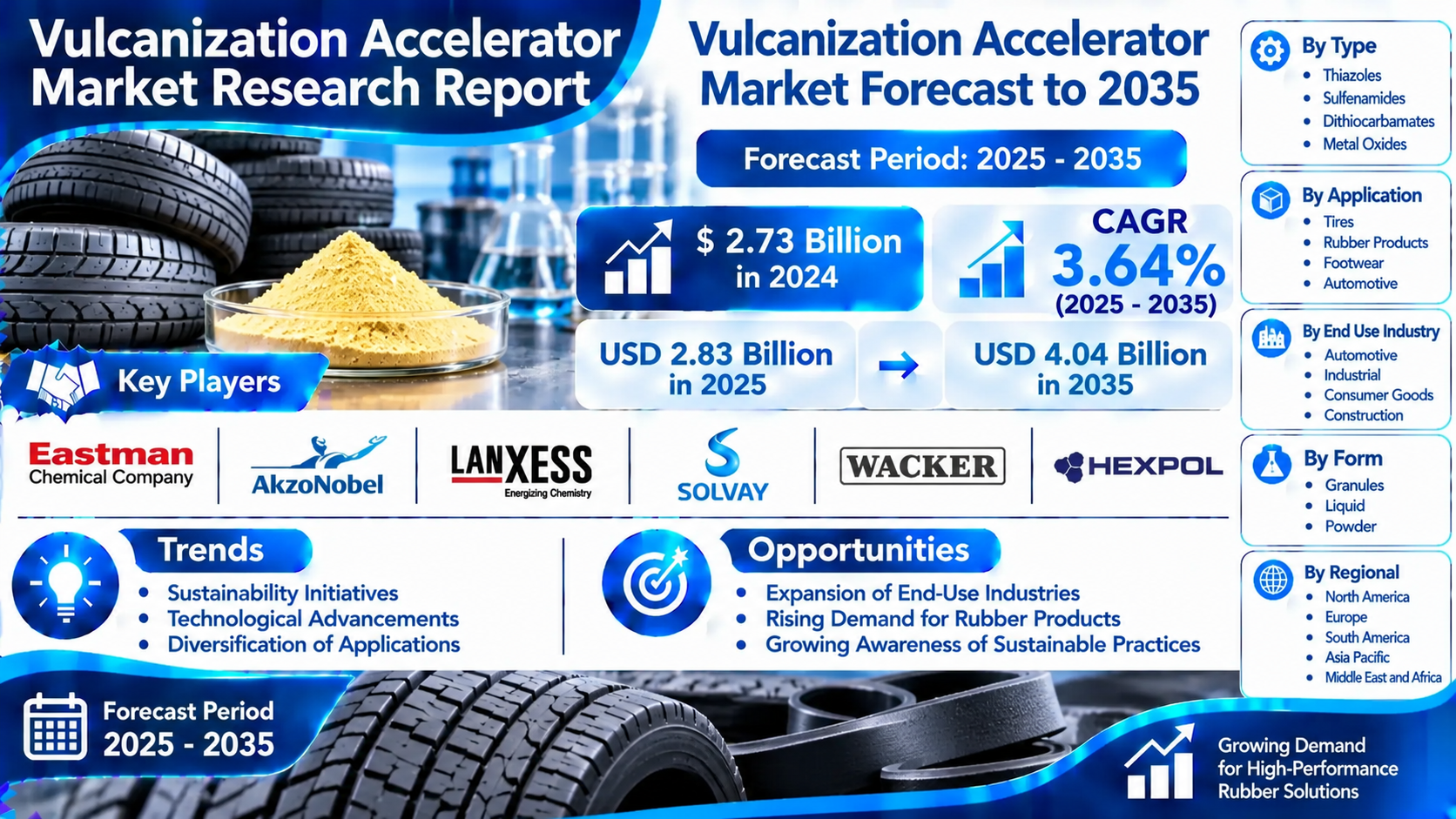

According to Market Research Future® (MRFR), the Vulcanization Accelerator Market is projected to increase from USD 2.83 billion in 2025 to USD 4.04 billion by 2035, registering a compound annual growth rate (CAGR) of 3.64% during the forecast period from 2025 to 2035. The market was valued at USD 2.73 billion in 2024. Its outlook is shaped by demand for rubber products across tires, automotive components, footwear and other rubber-based applications, alongside sustainability initiatives, technological advancements and the diversification of end-use industries.
Market Overview and Growth Outlook
Vulcanization accelerators are part of the rubber manufacturing landscape, with the market covering several chemical categories and product forms. The report segments the industry by type into thiazoles, sulfenamides, dithiocarbamates and metal oxides. It also classifies products by form, including granules, liquid and powder. These categories reflect the variety of products represented in the market and provide a framework for understanding its supply structure.
The market's projected growth indicates a steady expansion over the forecast period. Its valuation is expected to rise from USD 2.83 billion in 2025 to USD 4.04 billion in 2035. The CAGR of 3.64% represents the anticipated average annual growth rate during these ten years. The 2024 market size of USD 2.73 billion provides an earlier benchmark for assessing the industry's reported trajectory.
Rising demand for rubber products is identified as a key opportunity. Rubber is used across multiple industries, and the market's application segmentation includes tires, rubber products, footwear and automotive. This range connects accelerator demand to several manufacturing and consumer markets. Expansion across these areas can create opportunities for suppliers serving different product categories and industrial customers.
Product Types and Market Segmentation
Thiazoles, sulfenamides, dithiocarbamates and metal oxides are the four types identified in the market segmentation. Each category represents a distinct part of the industry's product landscape. The availability of multiple accelerator types gives manufacturers and buyers different product categories to consider according to their application and formulation requirements.
Product form is another dimension of market classification. Granules, liquid and powder are the specified forms. This segmentation highlights the different physical formats in which products are represented in the market. Product form can be relevant to handling, storage and manufacturing preferences, although the supplied market information does not provide detailed comparisons or individual growth rates for these categories.
The diversity of types and forms creates a broad product structure. Suppliers operating in the market must address the requirements associated with different rubber manufacturing activities. Product development and customer preferences may influence how demand is distributed among the identified categories over time.
Application and End-Use Industry Demand
The market's application segments include tires, rubber products, footwear and automotive. Tires represent a defined application category, while the broader rubber products segment captures additional uses. Footwear and automotive further extend the market's reach into consumer and industrial manufacturing activities.
End-use industry segmentation includes automotive, industrial, consumer goods and construction. These categories demonstrate that demand is not limited to a single sector. Automotive and industrial activities are represented alongside consumer goods and construction, providing multiple channels for market development. The distinction between application and end-use industry is important: applications describe the specified product-use categories, while end-use industries identify the wider sectors represented in the market.
Expansion of end-use industries is identified as an opportunity for market participants. As demand develops across these sectors, manufacturers may have opportunities to serve a wider customer base. Rising demand for rubber products reinforces this potential, linking the market's outlook to the performance and requirements of industries that use rubber-based materials.
Sustainability and Technological Advancements
Sustainability initiatives are among the key trends shaping the vulcanization accelerator market. Growing awareness of sustainable practices is also identified as an opportunity. These themes indicate that environmental considerations are becoming increasingly relevant to market participants and their business priorities.
Manufacturers may need to consider sustainability as part of product development and operational planning. The extent to which this trend affects product selection and purchasing decisions can vary across applications and end-use industries. The supplied market information identifies sustainability as a central theme but does not specify particular technologies, regulatory requirements or quantified environmental outcomes.
Technological advancements form another important trend. Innovation can help companies respond to evolving manufacturing requirements and customer expectations. In a market with several accelerator types and product forms, technological development may influence product offerings and the ability of suppliers to address different application needs.
Diversification and Regional Market Landscape
Diversification of applications is a further trend identified in the report. The market's coverage of tires, rubber products, footwear and automotive illustrates the range of applications represented. Its end-use segmentation across automotive, industrial, consumer goods and construction provides additional breadth. This diversification can create multiple avenues for demand, while also requiring suppliers to understand the needs of different customer groups.
Regionally, the market is segmented into North America, Europe, South America, Asia Pacific, and the Middle East and Africa. These regions form the geographic framework for the market assessment. The supplied information does not provide regional market shares, country-level rankings or comparative growth rates. Consequently, a leading or fastest-growing region cannot be identified from the available figures.
Competitive Landscape and Future Opportunities
The key players identified in the vulcanization accelerator market include Eastman Chemical Company, AkzoNobel N.V., Lanxess AG, Solvay S.A., Wacker Chemie AG and Hexpol AB. These companies form part of the competitive landscape in an industry characterized by varied product categories and a broad range of end-use applications.
The main opportunities include expansion of end-use industries, rising demand for rubber products and growing awareness of sustainable practices. These factors complement the market's identified trends in sustainability, technological advancement and application diversification. Companies may seek to address these opportunities by aligning their product offerings with changing customer requirements and the needs of different rubber-consuming industries.
The vulcanization accelerator market is forecast to reach USD 4.04 billion by 2035, supported by a CAGR of 3.64% over 2025–2035. Its outlook reflects demand across multiple applications and end-use sectors, while sustainability and technological development remain important considerations. The ability of market participants to respond to evolving industrial requirements and expanding rubber product demand will influence the industry's progress through the forecast period.

