

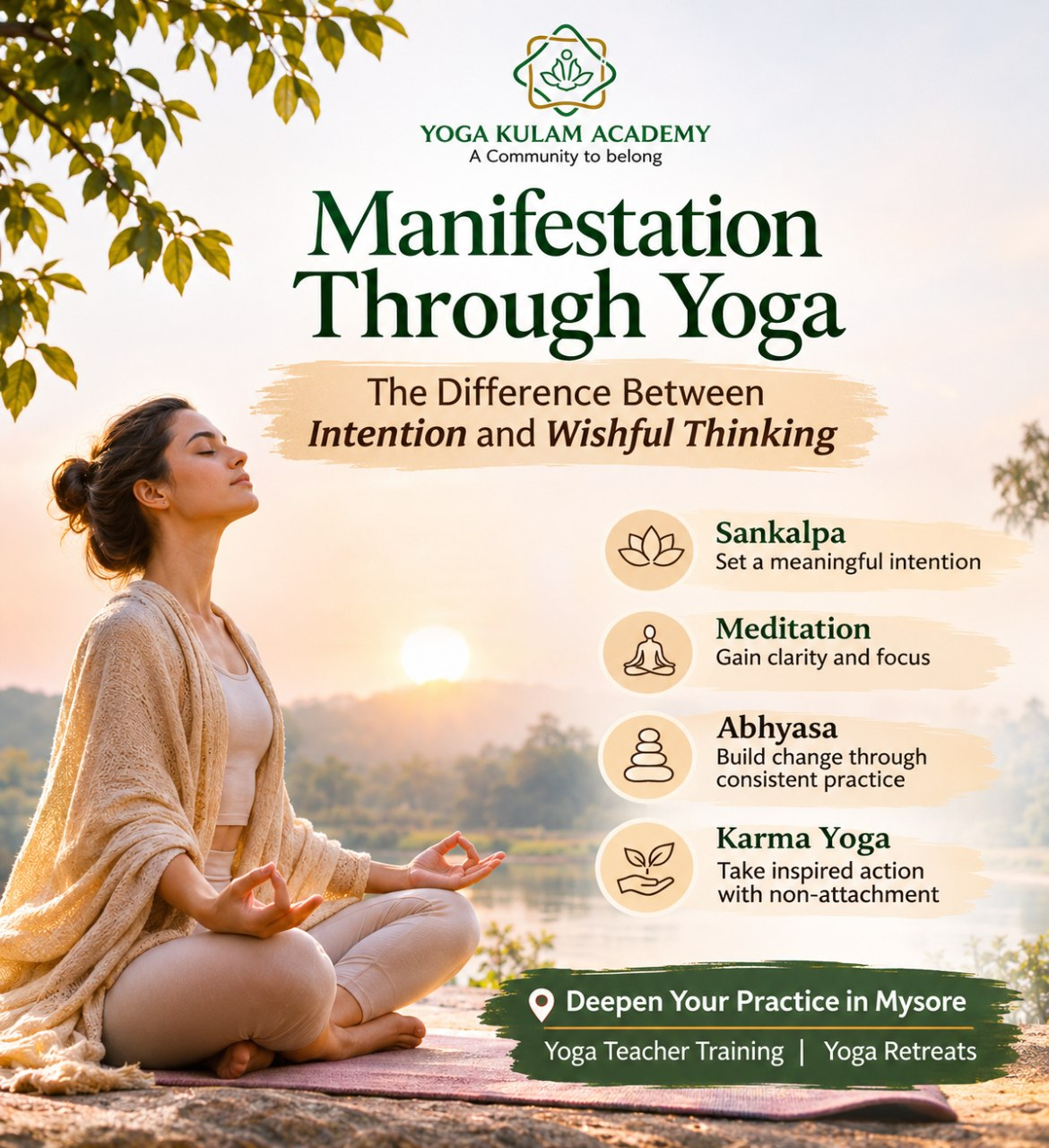
Manifestation Through Yoga: The Difference Between Intention and Wishful Thinking

Exploring Sankalpa, Meditation, Karma Yoga, and How Conscious Action Supports Meaningful Personal Growth
Imagine sitting quietly on your yoga mat, thinking about something you want to achieve.
Perhaps you want to become healthier, develop greater confidence, change careers, or create a more balanced lifestyle.
You close your eyes, visualise the outcome, and repeat a positive affirmation.
But what happens when you open your eyes?
Does imagining a successful future make it happen, or does meaningful change require something more?
Manifestation has become a popular subject in modern wellness. Social media frequently suggests that thinking positively, repeating affirmations, or visualising desired outcomes can attract success.
Traditional yoga offers a different perspective.
Rather than promising that thoughts alone can change external circumstances, yogic practices encourage intention, awareness, disciplined effort, and reflection.
The difference between intention and wishful thinking is simple: intention provides direction, while meaningful action helps turn that direction into reality.
Understanding this distinction can make manifestation a more practical and thoughtful concept.
What Does Manifestation Actually Mean?
Manifestation is commonly described as bringing desired outcomes into reality through thoughts, beliefs, intentions, or visualisation.
Different people interpret the concept differently.
For some, it represents a spiritual belief about the relationship between consciousness and reality.
For others, it is simply a method of identifying goals and maintaining motivation.
The difficulty begins when manifestation is presented as a guarantee.
Thinking positively does not ensure financial success, perfect health, or a particular relationship outcome.
External circumstances, opportunities, personal choices, and factors beyond our control all influence what happens.
Yoga philosophy provides an alternative approach by emphasising how we respond to our intentions rather than promising control over every result.
Sankalpa: The Yogic Practice of Setting an Intention
One of the concepts frequently associated with yogic intention-setting is Sankalpa.
In many contemporary yoga and Yoga Nidra traditions, Sankalpa refers to a meaningful personal resolve or intention.
Unlike a casual wish, it is often expressed as a clear commitment connected to personal values.
For example, someone might develop an intention to practise consistently, communicate more thoughtfully, or approach difficult situations with patience.
The purpose is not simply to repeat an attractive statement.
It is to create a direction that can influence everyday choices.
Students exploring authentic yoga teacher training Mysore India may encounter Sankalpa alongside meditation, Yoga Nidra, and traditional philosophical concepts.
However, interpretations vary between yoga traditions, so it is important not to present one modern definition as universal.
Why Wishful Thinking Is Not the Same as Intention
Consider two people who want to develop a regular yoga practice.
The first repeatedly imagines becoming a disciplined practitioner but does not make time for yoga.
The second sets an intention to practise for twenty minutes each morning and gradually develops a manageable routine.
Both begin with a desire.
But only the second connects that desire with consistent behaviour.
This illustrates the difference between wishing and intentional action.
Visualising a goal may help some people clarify what they want, but imagination alone cannot replace preparation, learning, and effort.
An effective intention should encourage practical decisions.
It may influence how you organise your schedule, respond to obstacles, or maintain motivation when progress is slow.
What Karma Yoga Teaches About Action
Karma Yoga provides an interesting philosophical perspective on manifestation.
In the Bhagavad Gita, action and attachment to outcomes are important themes.
A widely discussed teaching encourages individuals to perform their duties without becoming excessively attached to the results.
This does not mean goals are meaningless.
It means that our responsibility lies primarily in the actions we take, while outcomes may depend on circumstances beyond our control.
Imagine preparing for an important examination.
You can study carefully, practise consistently, and make reasonable preparations.
But you cannot guarantee the exact result.
Karma Yoga invites reflection on how to remain committed without allowing anxiety about the outcome to dominate the process.
This approach can make goal-setting more sustainable.
How Meditation Supports Clearer Intentions
Meditation is frequently included in discussions about manifestation.
Some popular explanations suggest that meditation can attract desired experiences by changing the energy of the universe.
Such claims are not established scientific facts.
However, meditation may support attention, emotional awareness, and stress management.
These abilities can be useful when making decisions.
For example, a person considering a major career change may benefit from taking time to reflect rather than acting impulsively.
A calm period of observation may help them distinguish between a temporary emotional reaction and a meaningful long-term goal.
Students participating in Hatha Ashtanga yoga teacher training Mysore may study meditation alongside physical practice and pranayama.
These subjects provide opportunities to explore concentration and self-observation as part of broader yoga education.
The Role of Abhyasa: Consistent Practice
Traditional yoga philosophy places considerable importance on Abhyasa, or sustained practice.
This principle reminds us that meaningful development usually requires repetition.
You cannot develop strong teaching skills through a single class.
You cannot build physical endurance simply by imagining yourself becoming stronger.
And you cannot expect complex habits to change immediately because you have written down an intention.
Improvement often involves small actions repeated over time.
For example, someone wanting greater emotional balance may begin with a short daily meditation practice.
Another person hoping to improve physical strength might follow a progressive exercise routine.
The intention provides direction.
Repeated action creates opportunities for learning and development.
Why Non-Attachment Does Not Mean Giving Up
The concept of Vairagya, commonly translated as non-attachment or dispassion, is another important part of classical yoga philosophy.
It is sometimes misunderstood as abandoning ambition.
But non-attachment does not necessarily require giving up meaningful goals.
Instead, it encourages practitioners to examine their relationship with desire and outcomes.
You can work toward a professional qualification without believing that your entire worth depends on receiving it.
You can develop a yoga practice without becoming frustrated every time progress feels slow.
You can pursue a goal while recognising that circumstances may change.
This perspective offers an important balance between intention and acceptance.
Can Visualisation Be Useful?
Visualisation is not inherently unrealistic.
Mental imagery is used in several settings, including sport, performance preparation, and psychological interventions.
Imagining the steps involved in completing a task may help some individuals prepare for action.
However, visualisation is most useful when connected to realistic planning.
For example, someone preparing to teach yoga could mentally rehearse how to introduce a class, explain a posture, or respond to student questions.
That rehearsal may support preparation, but it cannot replace practical experience.
The difference is whether visualisation encourages engagement with reality or becomes a substitute for it.
Why Your Environment Matters
Personal intentions do not develop in isolation.
The people around you, your daily routine, and your learning environment can influence your behaviour.
Someone hoping to establish a regular yoga practice may find it easier within a supportive community.
Structured classes can provide consistency.
Teachers can offer feedback, while other students can create opportunities for shared learning.
A yoga retreat in mysore may provide time away from everyday responsibilities for reflection, meditation, and personal practice.
However, a retreat cannot guarantee transformation.
Its value depends partly on how participants apply their experiences after returning to ordinary life.
What Yoga Teacher Training Reveals About Intention
Yoga teacher training provides a practical example of the relationship between intention and effort.
A student may begin with the intention of becoming a knowledgeable instructor.
But achieving that goal involves studying anatomy, practising asanas, exploring philosophy, developing communication skills, and learning how to guide others.
Motivation alone is insufficient.
Structured education and repeated practice are necessary.
Those researching certified yoga teacher training India Mysore should examine whether a program offers comprehensive learning rather than relying only on inspirational promises.
A certificate marks completion of particular educational requirements.
It does not guarantee teaching confidence, professional success, or personal transformation.
Those outcomes depend on continued learning and other circumstances.
Choosing a Yoga School That Supports Meaningful Learning
A good yoga school should help students connect their intentions with realistic learning opportunities.
Some students want to teach professionally.
Others hope to deepen their personal practice or explore yoga philosophy.
The right program depends on these goals.
When comparing the top yoga schools in Mysore for teacher training, consider the curriculum, instructor experience, practical teaching opportunities, and certification pathway.
Ask whether the school encourages questions and individual development.
Students searching for the Best 200 hour yoga teacher training mysore should remember that meaningful progress involves more than completing a fixed number of hours.
The quality of instruction, active participation, and continued practice all matter.
A Practical Way to Apply Sankalpa in Everyday Life
You do not need a complicated manifestation ritual to begin exploring intention-setting.
Start by identifying one meaningful goal.
Ask yourself why it matters.
Consider whether the goal reflects your values or simply comes from comparison with others.
Next, identify a realistic action you can take.
If your intention is to develop a consistent yoga practice, choose a manageable schedule.
If you want to improve concentration, consider reducing distractions during a specific daily activity.
If your goal is to study yoga philosophy, begin with accessible reading and structured guidance.
Review your progress periodically.
Be willing to adjust your approach when circumstances change.
The intention should guide your actions without becoming another source of pressure.
Exploring Yoga Philosophy at Yogakulam Academy
At Yogakulam Academy, residential yoga teacher training in Mysore includes Hatha Yoga, Ashtanga, pranayama, meditation, philosophy, anatomy, and teaching methodology.
These subjects provide opportunities to explore traditional yoga beyond physical postures.
Students interested in the best Yoga Teacher Training Mysore experience can use their personal learning goals to evaluate whether a structured program is appropriate.
Understanding philosophical concepts such as sustained practice, self-study, and non-attachment may also influence how students approach their education.
More information about Yogakulam Academy's courses is available at www.yogakulam.com.
Final Thoughts
Manifestation can be an appealing idea because it encourages people to imagine meaningful possibilities.
But traditional yoga offers a reminder that intention and imagination are not enough on their own.
Sankalpa can provide direction.
Meditation may support awareness.
Abhyasa encourages consistent practice.
Karma Yoga highlights the importance of action, while non-attachment helps us approach outcomes more thoughtfully.
Together, these concepts suggest a practical relationship between intention, behaviour, and acceptance.
You cannot control every result through positive thinking.
But you can become more deliberate about the actions you take.
Real transformation does not begin when you expect the universe to fulfil your wishes. It begins when your intentions become reflected in the way you live, practise, and act.

