


The Unhackable Future: Inside the Quantum Communication Industry
A New Paradigm for Secure Information Exchange
In an age where data breaches are rampant and sophisticated cyber-attacks threaten national security and economic stability, the search for truly secure communication has become a global imperative. The emerging Quantum Communication industry represents a revolutionary leap forward, promising a future of "unhackable" information exchange. Unlike classical communication, which encodes data in bits (0s or 1s), quantum communication harnesses the bizarre and counterintuitive principles of quantum mechanics, such as superposition and entanglement. This specialized industry is focused on developing the hardware and software necessary to encode, transmit, and receive information using individual quantum particles, typically photons (particles of light). Its most prominent application is Quantum Key Distribution (QKD), a method for sharing cryptographic keys with a level of security guaranteed by the laws of physics, not just by the mathematical complexity that underpins current encryption methods. This industry is at the cutting edge of physics and engineering, laying the groundwork for a new generation of ultra-secure networks for governments, financial institutions, and critical infrastructure, heralding a new era in secure communication.
The Core Principles: Superposition, Entanglement, and the No-Cloning Theorem
The power and security of quantum communication are rooted in three fundamental principles of quantum physics. The first is superposition, which states that a quantum bit, or "qubit," can exist in a combination of both 0 and 1 states simultaneously. This allows for the encoding of more information onto a single particle. The second, and perhaps most famous, principle is quantum entanglement. This is a strange phenomenon where two or more quantum particles become linked in such a way that their fates are intertwined, no matter how far apart they are separated. Measuring a property of one entangled particle instantly influences the corresponding property of the other. The third and most critical principle for security is the no-cloning theorem. This fundamental law of physics states that it is impossible to create an identical copy of an unknown quantum state. This is the bedrock of quantum security: if an eavesdropper attempts to intercept and measure a quantum signal (e.g., a stream of photons being used to create a key), the very act of measuring will disturb the quantum state of the particles. This disturbance is immediately detectable by the legitimate recipients, who will know their communication channel has been compromised and can discard the key, a security guarantee that has no equivalent in the classical world.
Key Components and Architecture of a Quantum Network
A quantum communication system, particularly a Quantum Key Distribution (QKD) network, is composed of several highly specialized components. It starts with a quantum light source, typically a laser that is attenuated to the point where it emits single photons or weak coherent pulses. These photons are then prepared in specific quantum states (e.g., polarization states) by a quantum state encoder. The photons travel from the sender (often called "Alice") to the receiver ("Bob") through a quantum channel. This channel can be a dedicated optical fiber cable or even free space, with photons being transmitted between ground stations or from ground to satellite. At the receiving end, a quantum state decoder, which includes components like beam splitters and polarization filters, measures the quantum state of the incoming photons. Highly sensitive single-photon detectors are used to register the arrival of each individual photon. The raw data from these detections is then processed by classical software in a phase called post-processing, which includes error correction and privacy amplification, to distill a final, perfectly secret, and shared cryptographic key. This key can then be used to encrypt data sent over a conventional, classical internet channel with absolute security.
The Primary Application: Quantum Key Distribution (QKD)
While the long-term vision of quantum communication includes the creation of a full "quantum internet," the primary and most commercially viable application today is Quantum Key Distribution (QKD). The security of almost all modern digital communication relies on public-key cryptography, where security is based on the mathematical difficulty of factoring large numbers. However, it is widely believed that the future development of large-scale quantum computers will be able to easily break these current encryption standards, a looming threat often referred to as the "quantum apocalypse." QKD offers a direct solution to this future threat. It is not a method for encrypting the data itself, but a provably secure method for two parties to generate and share a secret key. This key is then used with a classical one-time pad or a symmetric encryption algorithm like AES-256 to encrypt the actual data. Because the security of the key exchange is guaranteed by the laws of physics (the no-cloning theorem), it is immune to any future advances in computing power, including quantum computers. This makes QKD an essential technology for "crypto-agility" and for securing long-term data that needs to remain confidential for decades to come, such as government secrets, intellectual property, and medical records.
Top Trending Reports:
Categories
- Artificial Intelligence (AI)
- Technology
- Business
- Education
- Science
- Lifestyle
- Healthcare
- Entertainment
- Politics
- Environment
- Travel
- Finance
- Automobile
- News
- Art
- Causes
- Crafts
- career
- Dance
- Drinks
- Film
- Fitness
- Food
- Games
- Gardening
- Health
- Home
- Literature
- Music
- Networking
- Other
- Party
- Religion
- Shopping
- Sports
- Theater
- Wellness
Read More
The Italy Peripheral Nerve Stimulators Market is expected to experience significant development as advances in neuromodulation technology create new possibilities for pain management and patient care. Market Research Future estimates that the industry could grow from USD 18.3 million in 2024 to USD 247.8 million by 2035, representing an estimated CAGR of about 26.729% during 2025–2035....

Penis enlargement is a topic that many men explore when looking for ways to improve confidence, appearance, and personal satisfaction. With advancements in medical aesthetics, individuals now have access to professional guidance and safer approaches compared to unreliable methods. Understanding the available possibilities, realistic expectations, and importance of expert care helps individuals...

The MED sector plays a significant role in supporting modern water-treatment and desalination operations by providing energy-efficient, multi-stage thermal distillation systems that produce high-purity water at scale. Operators are increasingly incorporating heat-recovery and process-optimization technologies that improve energy efficiency and reduce operating costs. The growing scale of...
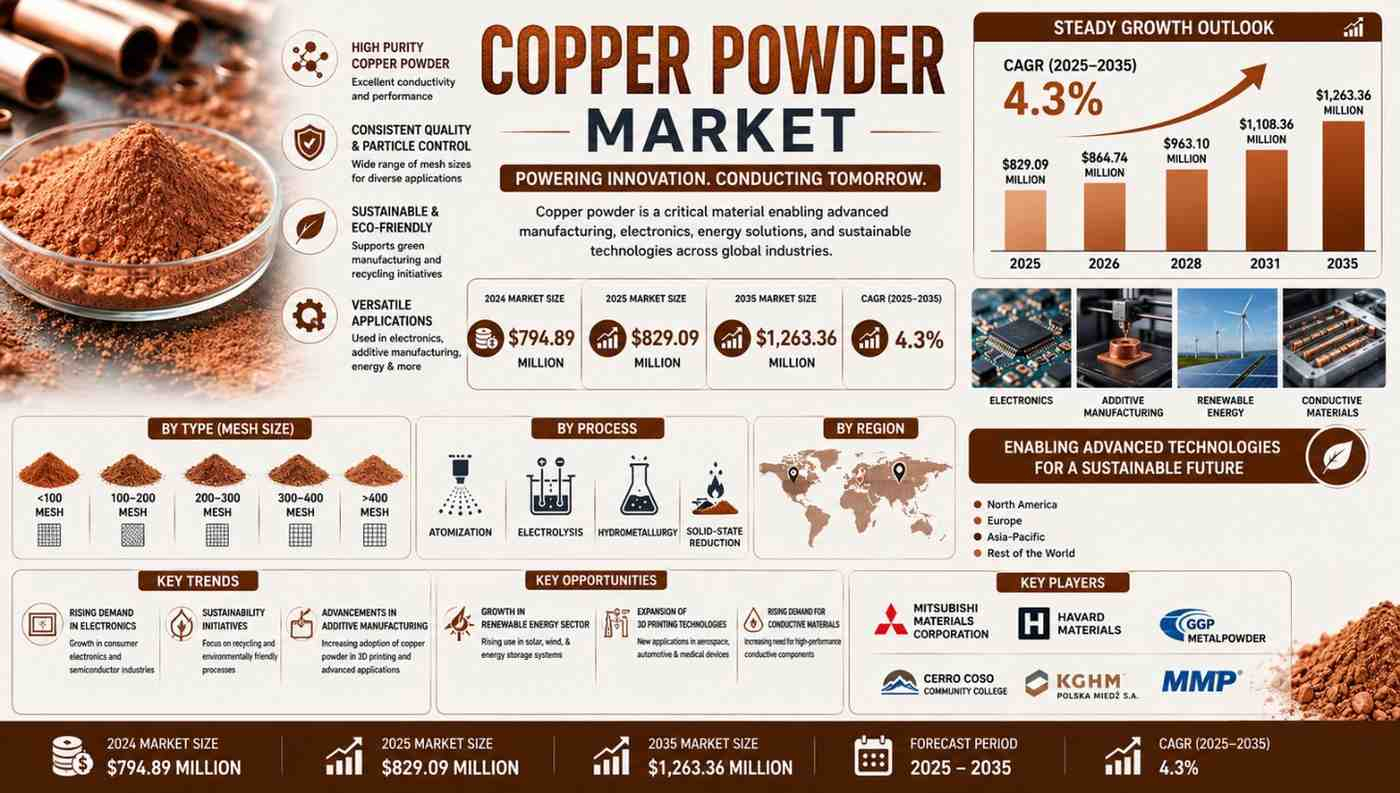
According to Market Research Future®, the Copper Powder Market Growth is anticipated to increase from USD 829.09 million in 2025 to USD 1,263.36 million by 2035, registering a CAGR of 4.3% during the forecast period. The global copper powder market is expanding steadily as manufacturers seek high-performance conductive materials to support innovation across electronics, renewable energy,...
Rockwool Market Summary As per Market Research Future® analysis, the Rockwool Market Size was projected to reach USD 35.90 Billion by 2035, growing at a CAGR of 6.23% from 2025 to 2035. This growth will provide significant opportunities for the market during the forecast period, driven by increasing demand, technological...
