


India Carbon Black Market Size, Share & Growth Forecast 2026–2035
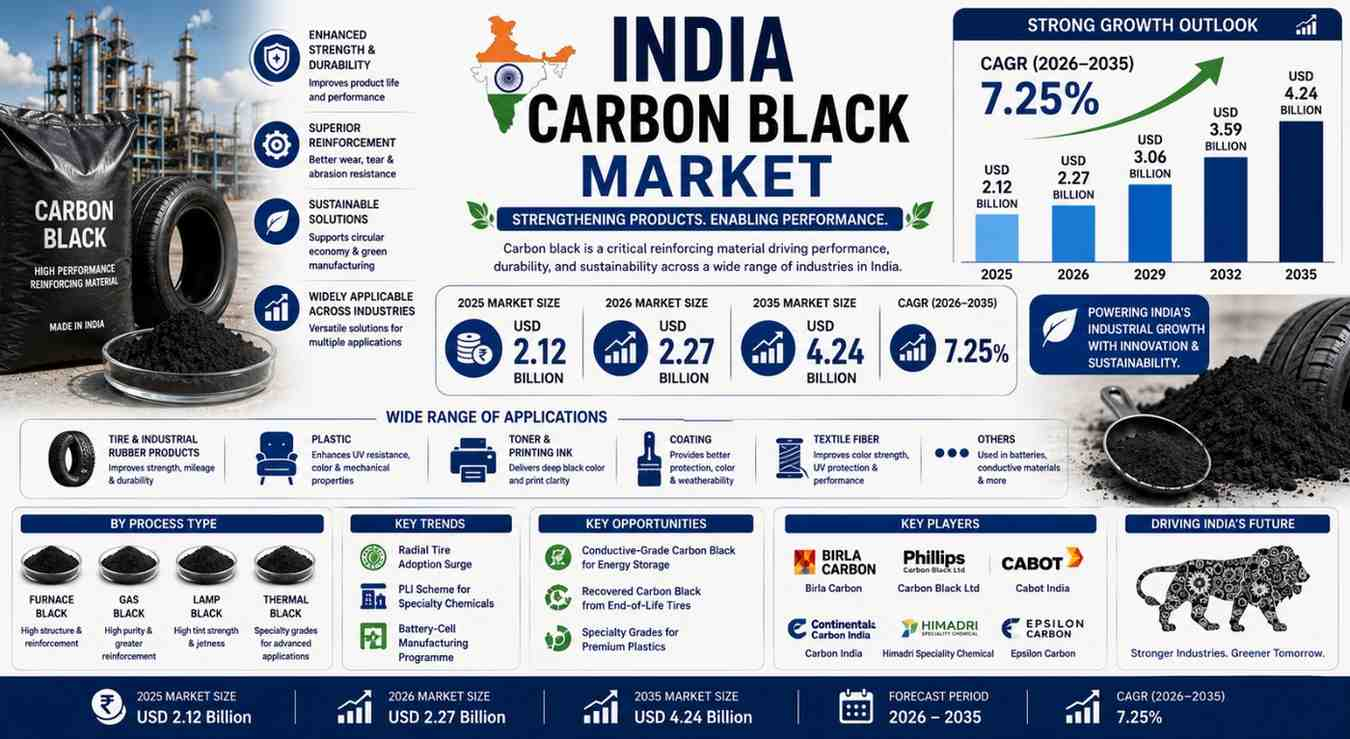
According to Market Research Future®, the India Carbon Black Market Analysis reached USD 2.12 billion in 2025 and is projected to grow to USD 4.24 billion by 2035, registering a CAGR of 7.25% during the forecast period from 2026 to 2035. India's carbon black industry is entering a new phase of expansion as rapid growth in automotive manufacturing, tire production, infrastructure development, and specialty chemicals creates sustained demand for reinforcement-grade and specialty carbon black. Government-backed initiatives such as the Production-Linked Incentive (PLI) Scheme for specialty chemicals and the National Infrastructure Pipeline are accelerating industrial investments while encouraging domestic production. Simultaneously, technological innovations in conductive carbon black for lithium-ion batteries, recovered carbon black derived from end-of-life tires, and premium grades designed for engineering plastics are reshaping the competitive landscape. Industry leaders including Birla Carbon, Phillips Carbon Black Ltd, Cabot India, Continental Carbon India, Himadri Speciality Chemical, and Epsilon Carbon continue expanding manufacturing capacity while investing in sustainable production technologies and advanced product development to strengthen their positions in India's rapidly evolving carbon black market.
Market Overview
Carbon black is one of the most important industrial materials used across modern manufacturing because of its ability to reinforce rubber, improve electrical conductivity, enhance pigmentation, and increase resistance to ultraviolet radiation and wear. In India, carbon black has become an essential raw material for numerous industries including automotive, tire manufacturing, plastics, coatings, inks, textile fibers, electronics, and energy storage.
The market consists of multiple production technologies including Furnace Black, Gas Black, Lamp Black, and Thermal Black. Furnace Black continues to dominate the industry due to its superior reinforcing properties, cost efficiency, and suitability for high-volume tire production.
India's expanding manufacturing ecosystem, supported by industrial modernization, infrastructure investment, export-oriented production, and favorable government policies, continues creating strong long-term demand for carbon black products. As industrial applications become more sophisticated, manufacturers are increasingly focusing on specialty grades that deliver enhanced performance across emerging technologies.
2025 Market Performance
The India carbon black market attained USD 2.12 billion in 2025, reflecting healthy demand across multiple industrial sectors.
Tire and industrial rubber products remain the largest application segment because carbon black significantly improves mechanical strength, abrasion resistance, durability, heat management, and overall product lifespan. The continued expansion of passenger vehicle production, commercial transportation, agricultural machinery, and replacement tire demand has reinforced this segment's leadership.
The plastics industry has emerged as another major growth contributor. Carbon black is increasingly incorporated into engineering plastics, packaging materials, construction products, automotive components, electrical equipment, and consumer goods to improve ultraviolet stability, conductivity, coloration, and mechanical performance.
Steady demand from coatings, toner, printing inks, textile fibers, and industrial applications further strengthens the overall market structure.
2035 Market Outlook
The India carbon black market is forecast to reach USD 4.24 billion by 2035, driven by industrial expansion, technological innovation, and increasing domestic manufacturing.
Government investment in transportation infrastructure, logistics corridors, urban development, and industrial facilities is expected to stimulate demand for rubber products, cables, coatings, plastics, and construction materials that utilize carbon black.
The rapid development of India's electric mobility ecosystem and domestic battery manufacturing industry is also expected to diversify demand beyond conventional tire applications.
Growing exports of specialty chemicals and advanced industrial materials will further strengthen long-term growth prospects.
Technology and Product Innovation
Innovation has become a major competitive factor within the carbon black industry as manufacturers develop products for increasingly sophisticated applications.
Conductive-grade carbon black is witnessing rising demand due to its use in lithium-ion batteries, battery electrodes, supercapacitors, and energy storage systems. These specialty materials improve electrical conductivity and battery performance while supporting India's expanding electric vehicle and renewable energy industries.
Manufacturers are also utilizing automation, artificial intelligence, digital process monitoring, predictive maintenance, and advanced quality control systems to improve production efficiency and product consistency.
Significant investments are being directed toward specialty carbon black formulations designed for engineering plastics, high-performance polymers, advanced coatings, and electronic applications where superior dispersion, purity, and conductivity are essential.
Emerging Industry Trends
The rapid adoption of radial tires remains one of the strongest trends supporting carbon black demand. Modern radial tires require premium reinforcement-grade carbon black to achieve better fuel efficiency, durability, safety, and lower rolling resistance.
Government support through the Production-Linked Incentive Scheme continues encouraging investments in specialty chemical manufacturing, strengthening domestic supply chains and reducing import dependence.
Battery-cell manufacturing programs are creating entirely new application areas for conductive carbon black, positioning the industry to benefit from India's long-term electric mobility strategy.
Sustainability is another defining trend, with manufacturers increasingly focusing on cleaner production technologies, energy efficiency, emission reduction, and responsible resource utilization.
Growth Opportunities
One of the most significant future opportunities lies in recovered carbon black produced from end-of-life tires. Recycling technologies allow manufacturers to recover valuable carbon black while reducing landfill waste, conserving raw materials, and supporting circular economy objectives.
Growing demand for premium engineering plastics across automotive, aerospace, healthcare, consumer electronics, and industrial manufacturing is creating additional opportunities for specialty carbon black producers.
The expansion of energy storage systems, electric vehicles, and renewable energy infrastructure is expected to generate sustained demand for conductive-grade carbon black over the next decade.
Export opportunities are also improving as Indian manufacturers continue enhancing production quality, technological capabilities, and international competitiveness.
Competitive Landscape
The India carbon black market is characterized by strong competition among established manufacturers that prioritize innovation, operational efficiency, sustainability, and specialty product development. Companies including Birla Carbon, Phillips Carbon Black Ltd, Cabot India, Continental Carbon India, Himadri Speciality Chemical, and Epsilon Carbon continue investing in capacity expansion, advanced manufacturing technologies, environmentally responsible production systems, and research initiatives aimed at developing high-value carbon black products.
Strategic partnerships with automotive manufacturers, battery producers, plastics companies, and industrial customers are enabling market participants to strengthen their competitive positions while expanding their presence across emerging application segments.
Future Outlook
The India carbon black market is expected to maintain robust growth through 2035 as automotive production, industrial manufacturing, infrastructure development, and specialty chemicals consumption continue expanding. Technological innovation, sustainable manufacturing, conductive carbon black for energy storage, and recovered carbon black solutions will play increasingly important roles in shaping future market dynamics.
As India strengthens its manufacturing capabilities and advances toward cleaner industrial production, carbon black manufacturers that emphasize product innovation, environmental responsibility, digital manufacturing, and application-specific solutions will be well positioned to capitalize on the country's expanding industrial opportunities.
Categories
- Artificial Intelligence (AI)
- Technology
- Business
- Education
- Science
- Lifestyle
- Healthcare
- Entertainment
- Politics
- Environment
- Travel
- Finance
- Automobile
- News
- Art
- Causes
- Crafts
- career
- Dance
- Drinks
- Film
- Fitness
- Food
- Games
- Gardening
- Health
- Home
- Literature
- Music
- Networking
- Other
- Party
- Religion
- Shopping
- Sports
- Theater
- Wellness
Read More
The Rectal Electrode Market is gaining importance across colorectal surgery, urogynecology, pediatric urology, and pelvic health management. These electrodes enable healthcare professionals to monitor or stimulate targeted areas during diagnostic and therapeutic procedures, supporting more controlled interventions and improved clinical decision-making. The growing prevalence of colorectal...

NEWARK, Del., August 20, 2026 — The global Popcorn Market is poised for steady expansion as consumers increasingly reposition popcorn from a cinema-occasion snack to a convenient, health-conscious option for everyday snacking. According to Future Market Insights (FMI), the market is projected to grow from USD 7.48 billion in 2026 to USD 14.43 billion by 2036,...

The liquid biopsy sector plays a significant role in supporting modern precision oncology by providing non-invasive alternatives to traditional tissue biopsies for cancer detection, monitoring, and treatment selection. Diagnostics companies are increasingly incorporating next-generation sequencing and advanced bioinformatics that improve test sensitivity and clinical utility. The growing shift...
The global car wash machine market is experiencing steady growth, driven by rising vehicle ownership and increasing demand for automated cleaning solutions. According to Market Research Future, the Car Wash Machine Market was estimated at USD 3.21 billion in 2024 and is projected to grow from USD 3.368 billion in 2025 to USD 5.444 billion by 2035, exhibiting a compound annual growth...

Medical Coatings Market According to the latest report published by Data Bridge Market Research, the Medical Coatings Market Medical Coatings Market size was valued at USD 2.17 billion in 2025 and is expected to reach USD 9.68 billion by 2033, at a CAGR of 20.50% during the forecast period. The market growth is largely fueled by the increasing demand for...
