


SOC Managed Service: The Critical Security Choice for Indian IT Businesses
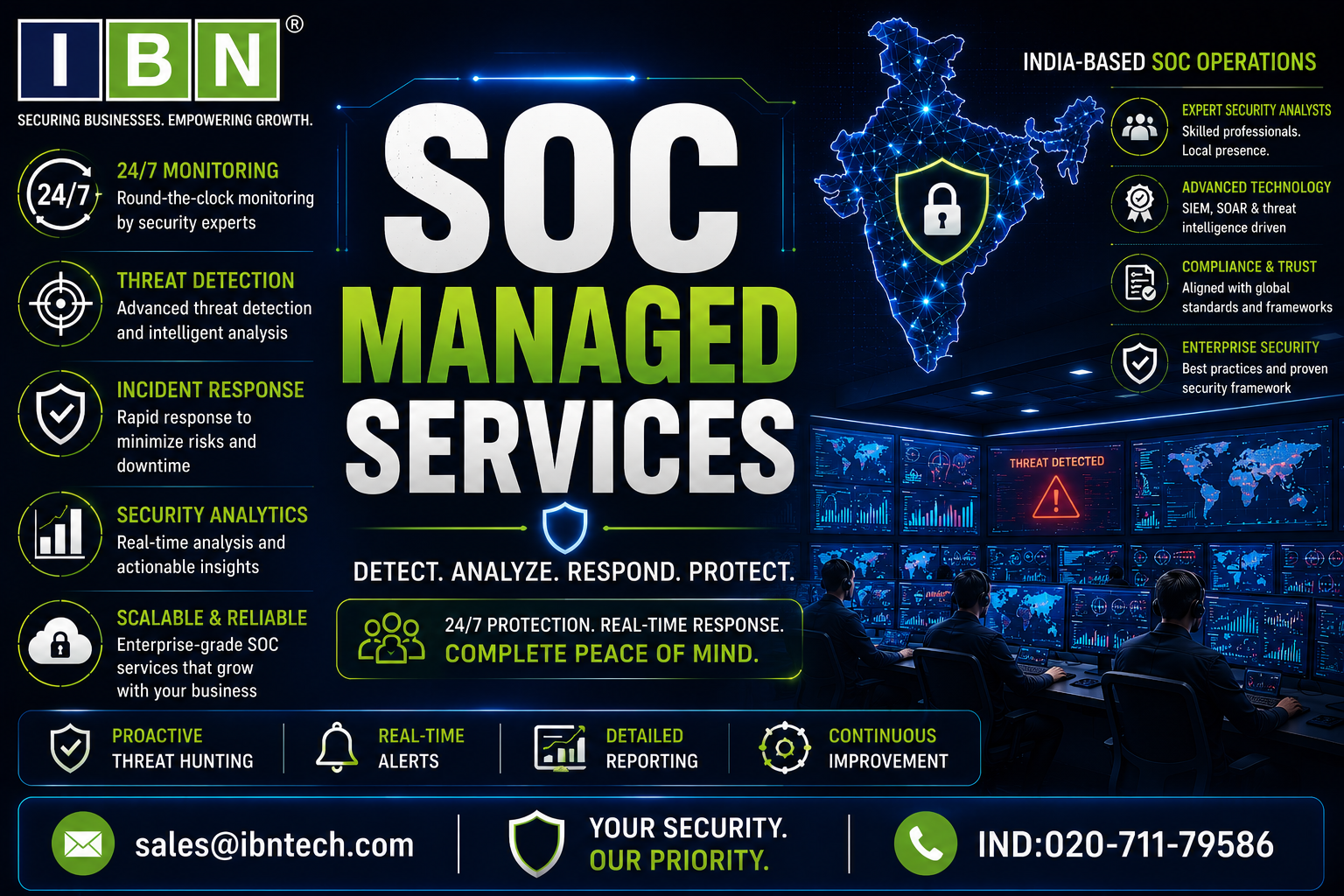
Why Indian IT Businesses Are Rethinking Security With a SOC Managed Service
Indian IT businesses operate in highly connected technology environments where applications, cloud infrastructure, endpoints, networks, identities, and business systems continuously generate security activity. Monitoring this environment effectively requires more than deploying security tools and reviewing alerts when time allows.
A soc managed service provides an externally supported security operations model that can help organisations monitor security events, analyse alerts, identify suspicious activity, and coordinate escalation. For IT businesses managing complex environments, this approach can complement internal teams and create a more structured security-monitoring function.
The key consideration is not simply whether an organisation needs a SOC. It is whether its current security operations can provide consistent visibility and timely analysis as the technology environment expands.
What Is a SOC Managed Service and Why Does It Matter?
A SOC managed service is a security operations model in which specialised security personnel and technologies support ongoing monitoring, alert analysis, threat identification, and incident-handling processes for an organisation.
For Indian IT businesses, the model can provide a structured layer between security technology and day-to-day security operations, helping teams turn security events into actionable information.
A managed SOC can be particularly relevant when internal teams need broader monitoring coverage or additional operational support without building every SOC function internally.
How Managed SOC Pricing Should Be Evaluated
When businesses investigate managed soc pricing, the most useful comparison is not simply the quoted service cost. Organisations should first understand what the service includes and how the pricing model relates to their actual monitoring requirements.
Factors that may influence the commercial structure include the scope of monitoring, number and type of systems involved, volume of security data, service coverage, operational responsibilities, reporting requirements, and the level of support expected.
A low headline price may not represent the same scope as a broader managed service. Conversely, paying for capabilities that do not match the organisation's requirements may create unnecessary expenditure.
IT leaders should therefore compare service scope and operational responsibilities alongside the commercial proposal.
Why IT Security Monitoring Becomes Difficult to Manage Internally
IT environments rarely remain static. New applications are introduced, infrastructure changes, employees join or leave, systems are migrated, and security configurations evolve.
Every change can create additional security events that require attention.
An internal team may already be responsible for infrastructure, application security, access management, vulnerability management, compliance activities, and incident handling. Adding continuous security-event analysis to the same workload can make monitoring difficult to maintain consistently.
Another challenge is alert context. A single security event may appear harmless when viewed independently but become more meaningful when combined with other activity.
A structured security operations process helps teams move beyond simply collecting alerts toward understanding which events require investigation.
Where a SOC Managed Service Fits Into the IT Environment
A managed SOC can work alongside an organisation's existing IT and security functions rather than replacing them entirely.
Security events can be monitored through appropriate technologies, reviewed by security personnel, and escalated according to agreed procedures. Internal teams can then participate in investigations and response activities according to defined responsibilities.
The operating model should establish clear ownership.
For example, the managed security team may be responsible for monitoring and initial alert analysis, while internal IT or security personnel may own business decisions, system changes, or response actions.
The exact division depends on the organisation's requirements and service agreement.
What Indian IT Businesses Should Evaluate Before Selecting a Service
Choosing a managed SOC requires more than reviewing a service brochure.
Organisations should assess whether the provider's operating model fits their technology environment and internal processes.
How a SOC Managed Service Can Support IT Security Operations
A soc managed service can provide a structured process for monitoring security activity and escalating events that require attention. However, its usefulness depends on appropriate monitoring scope, clear responsibilities, effective alert analysis, and communication with internal teams.
Before selecting a service, IT businesses should examine:
- What systems and security events are included in monitoring
- How alerts are analysed and prioritised
- How suspicious activity is escalated
- What information is provided to internal teams
- How reporting is handled
- Which responsibilities remain with the customer
- How changes to the technology environment are incorporated
- How the service supports existing security processes
This evaluation helps organisations assess the operating capability behind the service rather than focusing only on the technology.
Benefits for Indian IT Organisations
A well-structured managed SOC model can provide several operational advantages.
Continuous monitoring support: Security activity can be monitored as part of an ongoing operational process rather than relying entirely on periodic reviews.
Greater security visibility: Relevant events from different parts of the technology environment can be brought into a structured monitoring workflow.
Additional security expertise: External security personnel can complement internal IT and security capabilities.
More organised alert handling: Defined processes can help separate events that require investigation from routine security activity.
Operational scalability: Monitoring processes can be reviewed as the organisation's technology environment changes.
These benefits depend on the service scope, implementation, monitoring quality, and cooperation between the provider and internal teams.
A Practical Use Case for an Indian IT Business
Consider an IT services organisation supporting multiple applications and infrastructure environments for its business operations.
Its internal technology team may receive security events from endpoints, network infrastructure, authentication systems, and applications. Reviewing these events individually can make it difficult to identify relationships between activities.
With a managed SOC model, relevant security events can be incorporated into a defined monitoring workflow. Analysts can examine activity, identify events requiring investigation, and escalate relevant findings to the organisation's internal team.
The value is not simply having another security dashboard. It is establishing a repeatable process for turning security information into security action.
SOC Managed Service Evaluation Checklist
Before engaging a provider, Indian IT businesses should consider the following:
- Define the security monitoring objectives.
- Identify systems and environments that require monitoring.
- Document expected alert-handling procedures.
- Establish internal and external responsibilities.
- Define escalation contacts and communication processes.
- Review reporting requirements.
- Understand the service scope behind the commercial proposal.
- Determine how changes to monitored systems will be handled.
- Check how the service fits existing incident-management procedures.
- Review the service periodically as business and technology requirements evolve.
This checklist can help IT decision-makers assess operational fit before committing to a managed SOC model.
Security Governance and Compliance Considerations
Security monitoring should form part of an organisation's broader security governance framework.
Indian IT businesses should consider applicable information-security requirements, contractual obligations, internal policies, data-protection responsibilities, and audit expectations when designing their monitoring processes.
A SOC managed service does not automatically make an organisation compliant. Instead, monitoring and security-event analysis can support wider control activities by improving visibility and helping teams investigate relevant events.
The organisation should also establish clear policies governing access to security information, incident escalation, documentation, and responsibilities.
Building a Sustainable Security Operations Model
Security monitoring becomes more valuable when it is treated as an ongoing operational capability rather than a collection of disconnected security tools.
For Indian IT businesses, the decision to adopt a SOC managed service should consider the organisation's technology complexity, internal expertise, monitoring requirements, operational workload, governance needs, and expected service scope.
A suitable managed model can complement internal teams by providing structured monitoring and security-event analysis while allowing the organisation to retain control over its broader security decisions.
For Indian IT businesses looking to strengthen continuous monitoring and security operations, a soc managed service can provide a practical framework for improving visibility, organising alert analysis, and supporting a more consistent approach to cybersecurity.
Contact Us:
IND- 02067680404
IBN Technologies Ltd.
E-mail: - sales@ibntech.com
Categories
- Artificial Intelligence (AI)
- Technology
- Business
- Education
- Science
- Lifestyle
- Healthcare
- Entertainment
- Politics
- Environment
- Travel
- Finance
- Automobile
- News
- Art
- Causes
- Crafts
- career
- Dance
- Drinks
- Film
- Fitness
- Food
- Games
- Gardening
- Health
- Home
- Literature
- Music
- Networking
- Other
- Party
- Religion
- Shopping
- Sports
- Theater
- Wellness
Read More
According to the latest report published by Data Bridge Market Research, the Cloud Testing Market The global cloud testing market was valued at USD 13.07 billion in 2024 and is expected to reach USD 34.76 billion by 2032. During the forecast period of 2025 to 2032 the market is likely to grow at a CAGR of 13.00%, primarily driven by the increasing adoption of...
The Automotive Airbag Electronics Market is experiencing steady growth driven by rising global emphasis on vehicle safety systems and stringent regulatory standards for passenger protection. Airbag electronics play a critical role in modern vehicles by controlling airbag deployment through sensors, control units, and crash detection algorithms. These systems ensure rapid and...

Commercial buildings depend on stairways to provide convenient movement between different levels. Offices, retail spaces, apartment buildings, warehouses, and other properties may have staircases that experience frequent daily use. Over time, regular traffic, moisture, impact, and general wear can affect steps, railings, landings, and other components. Maintaining these areas can help property...

The potassium iodide sector plays a significant role in supporting public health and industrial applications by providing a stable, widely used compound in radiation-protection medications, dietary iodine supplementation, and analytical chemistry. Manufacturers are increasingly focusing on high-purity formulations that meet stringent pharmaceutical and food-grade quality standards. The growing...
The Cell Slide Market is expected to benefit from continued innovation in pathology, diagnostic testing, microscopy, and laboratory automation. As healthcare organizations process larger volumes of clinical samples, the need for efficient and dependable slide-based workflows is likely to increase. A key future opportunity lies in the integration of cell slides with digital pathology platforms....
