


Most people in the jewelry industry follow a familiar script: find a manufacturer overseas, mark up the price, and build a brand around the packaging. John Medeiros did not follow that script. What he built instead took decades longer and looked nothing like a conventional launch story. It started when he was twelve years old, working production lines after school in the jewelry district of Providence, Rhode Island, learning the mechanics of the trade before he could fully articulate why it mattered.
The Early Years That Shaped John Medeiros
He arrived in America from the Azores at age nine. Within a few years he was already inside the industry, not studying it from the outside. Working those production lines gave him something most designers never get: a working knowledge of how jewelry actually holds together or falls apart. Not conceptually. Physically. He understood tolerances. He knew where pieces failed. He saw what corners looked like when they got cut.
That grounding is rarer than it sounds. Many people enter jewelry design through art school or aesthetics. Medeiros entered through manufacturing, which means he always knew what his ideas would actually cost to build and whether they'd survive regular wear. That knowledge, developed over years before anyone called him a brand, ended up being the quiet engine behind everything he later made.
Building Expertise Before Building a Brand
In 1985 he started Tahoe Jewelry, providing intricate polishing and stone-setting services to the precious metals industry and prominent designers, including Gucci. He wasn't designing his own line yet. He performed the technical work that luxury brands required, which they couldn't easily outsource elsewhere without sacrificing precision.
That phase taught him something the other side of the industry doesn't always see: what it costs to do things properly, versus what high-end labels charge their customers. He spent his nights sketching. Not because he was in a rush to launch, but because the ideas were accumulating faster than the right moment to release them. He kept going until the designs matched what was in his head.
It took years. That kind of patience tends to produce a different result than a fast launch.
The Launch of a Vision in 2000
When the John Medeiros Jewelry Collection finally came out in 2000, it was shaped by a single founding belief: that high-quality, handcrafted, long-lasting jewelry should be accessible to and enjoyed by all. That's not a tagline that got workshopped in a branding session. It's the logical conclusion of watching the gap between production cost and retail price for most of his adult working life.
The collection is produced from concept to completion on site in East Providence, Rhode Island. In 2000, most brands were already moving production overseas. Staying local wasn't the easy call, and it wasn't the cheap one. It meant slower growth. It also meant that every piece that left the building had been through the same hands, the same checks, the same standards from one end of the process to the other.
How Craftsmanship Became the Brand's Identity
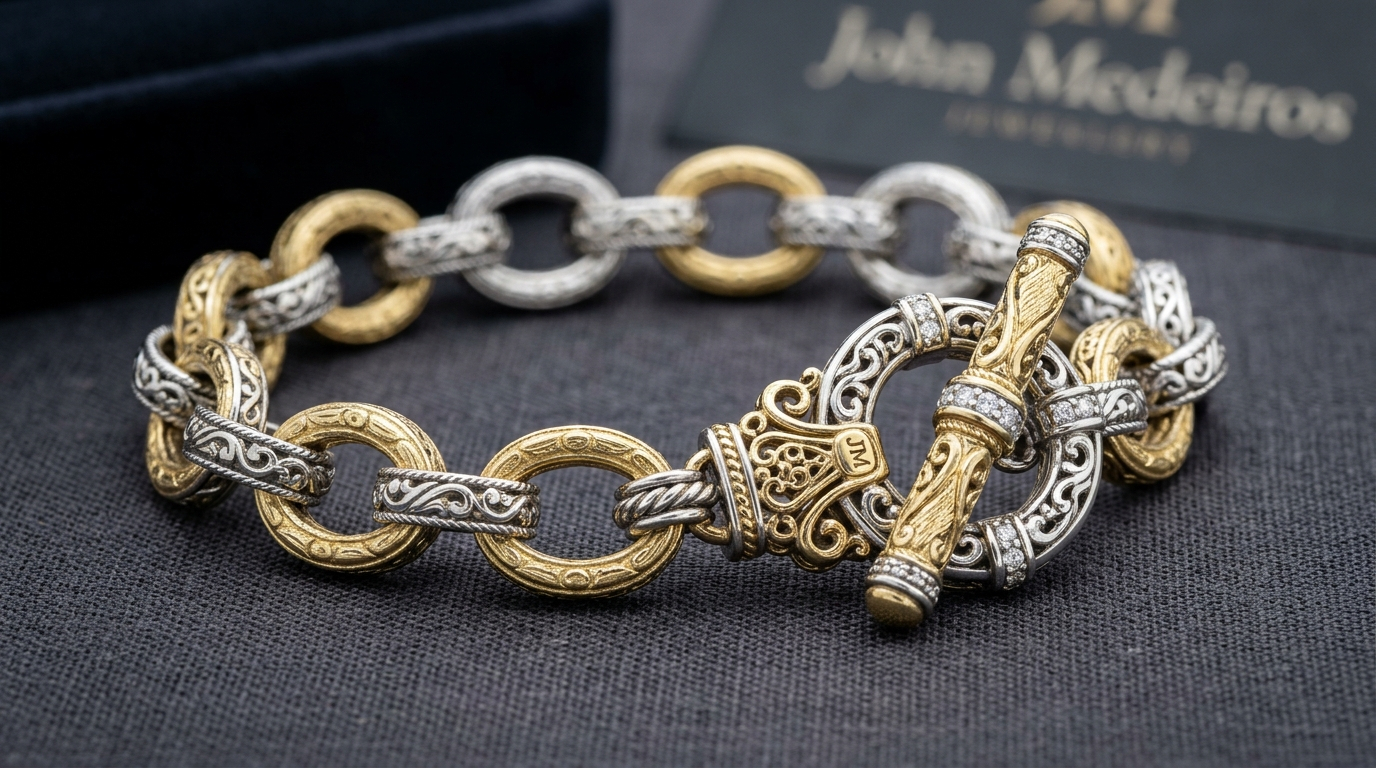
The materials tell most of the story. Each piece is electro-plated with rhodium, a platinum derivative that's harder, brighter, and longer-lasting than standard finishes. The stones are cubic zirconia cut by diamond cutters and set by hand during the casting process. The 14-karat gold overlay delivers a look and finish that rivals precious metal jewelry without the price that goes with it.
Every piece is hand-tooled on the front, sides, and back. The clasps are original designs, engineered to prevent material fatigue, and built to blend into each piece rather than sit on top of it. That's the fine jewelry approach. Applied to something a regular person can actually afford.
Most of this work is invisible to the customer, which is probably the point. You don't notice good engineering. You just notice that the piece still looks right two years later.
What Keeps the Brand Distinct Today
Forty-plus years into the trade, the production model hasn't changed much. Every piece is cast, assembled, and finished in-house. Nothing gets outsourced. Each necklace, bracelet, and earring is inspected before it ships. That's not marketing language borrowed from the artisan trend of the last decade. It's how the operation has worked since before that trend existed.
Rhode Island was the jewelry capital of the United States for over a century, home to generations of skilled artisans producing work that set the standard for the industry nationwide. Keeping production in East Providence means the brand carries that regional tradition forward at a time when most have abandoned it. Whether that matters to any given customer probably depends on the customer. But it's not a coincidence.
Distribution is kept to independent retail stores around the country, which says something about how the brand wants to be represented. It's a slower way to grow. It also means the people selling the pieces tend to actually know what they're selling.
The Philosophy That Makes It Work
The core argument the brand makes is simple: quality and affordability don't have to be opposites. That sounds obvious until you spend time in the jewelry market and see how consistently those two things get pulled apart. Fast fashion jewelry that tarnishes in a season on one end, fine jewelry priced out of most budgets on the other. The John Medeiros collection occupies the ground in between, not by cutting corners on quality, but by making smart choices about materials and keeping production in-house where costs stay controlled.
It's not a complicated idea. Executing it consistently for more than twenty years is the harder part.
The story of John Medeiros comes down to a craftsman who knew his trade before he ever thought about branding, built a reputation doing work for other people first, and launched something of his own only when he had something real to offer. Whether you find that inspiring or just methodical probably says more about you than about him. But the jewelry is still being made the same way, in the same place, by the same process. That part is harder to argue with.

