

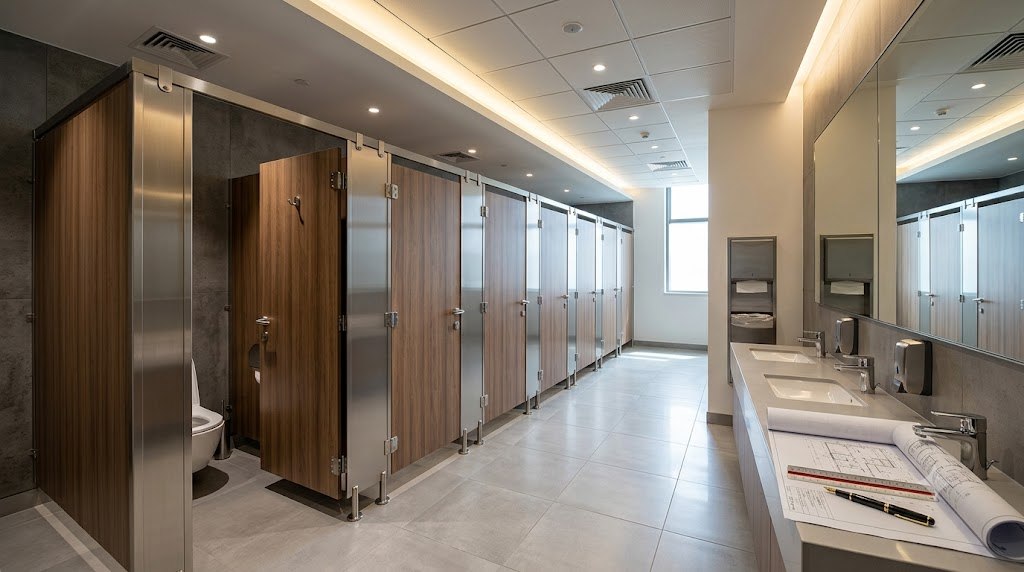
How to Choose Reliable Toilet Partition Manufacturers for Commercial Projects

Selecting the right toilet partition system is an important decision for any commercial or institutional building. Washrooms in offices, shopping centres, hotels, hospitals, schools, airports, factories, and other high-traffic facilities need partitions that can withstand regular use while maintaining a clean and professional appearance.
This is why choosing the right toilet partition manufacturers should involve more than simply comparing prices. The manufacturer you select can influence the quality of the partition system, material performance, installation, customization options, and long-term usability of the washroom.
Understand Your Commercial Washroom Requirements
Before approaching manufacturers, define the requirements of your project. The ideal partition system can vary depending on the building type, number of users, available space, design requirements, and expected level of traffic.
For example, an office washroom may require a professional appearance and efficient use of space, while a school, factory, airport, or shopping centre may require a system designed for frequent and demanding use.
Consider factors such as:
- Number of toilet cubicles required
- Available washroom dimensions
- Expected daily usage
- Privacy requirements
- Door and partition configuration
- Colour and finish preferences
- Hardware requirements
- Cleaning and maintenance needs
- Installation requirements
- Project budget and timeline
Having these details ready makes it easier to discuss your project with potential manufacturers and obtain a suitable solution.
Evaluate the Partition Material
Material selection is one of the most important factors when comparing toilet partition suppliers and manufacturers. Commercial washroom partitions are available in different materials, and each option can have different characteristics in terms of durability, appearance, maintenance, and application.
HPL or High-Pressure Laminate is commonly considered for commercial washroom applications because it offers a practical combination of durability and design flexibility. Compact laminate systems can also be suitable for environments where strong and moisture-resistant partition construction is required.
When discussing materials with a manufacturer, ask about the specifications of the board, thickness, surface finish, edge treatment, hardware, and overall construction rather than evaluating the product only by its appearance.
Check Manufacturing Quality
A reliable manufacturer should be able to explain how its partition systems are produced and assembled. Consistent manufacturing is important because commercial washroom projects often involve multiple cubicles that need to maintain uniform dimensions, finishes, and hardware.
Ask potential manufacturers about:
- Material specifications
- Board thickness
- Panel construction
- Hardware quality
- Edge finishing
- Door strength and alignment
- Surface finish
- Quality-control procedures
- Manufacturing capacity
Clear technical information can help project managers, architects, contractors, and facility owners make a more informed purchasing decision.
Look for Customisation Options
Commercial washrooms do not always follow standard dimensions. Columns, plumbing locations, wall positions, entrances, and other building conditions can affect the final layout.
For this reason, customisation can be an important consideration when selecting toilet partition manufacturers.
Depending on the project, manufacturers may provide different configurations for cubicle sizes, panel layouts, doors, colours, finishes, and hardware. A manufacturer capable of working with project-specific measurements can make the planning and installation process more convenient.
However, customisation should not compromise the structural requirements or practical functionality of the partition system.
Consider Privacy and Space Utilisation
A good toilet partition layout needs to provide suitable privacy while making efficient use of the available floor area.
Before finalising the design, consider the position of doors, partitions, walls, urinals, washbasins, and circulation areas. The cubicle layout should allow users to enter and exit comfortably without creating unnecessary congestion.
Manufacturers and washroom solution providers can often assist with layout planning based on the available dimensions. Sharing an accurate floor plan or site measurements can help in developing a practical partition arrangement.
Compare Hardware and Accessories
The panels are only one part of a toilet partition system. Hinges, locks, brackets, handles, adjustable legs, channels, and other hardware also affect the usability and appearance of the finished installation.
When comparing manufacturers, ask what hardware is included in the proposed system and whether suitable options are available for your application.
Hardware should be appropriate for the expected usage of the washroom. In high-traffic commercial environments, frequently used doors and locks may require particular attention during product selection.
Review Installation Support
Even a well-designed partition system needs proper installation. Incorrect measurements, poor alignment, unsuitable fixing methods, or improper hardware installation can affect the final appearance and performance of the washroom.
When evaluating manufacturers, find out whether they provide installation guidance, site support, technical drawings, or installation services.
For larger commercial projects, coordination between the manufacturer, contractor, architect, and site team can help reduce installation-related issues.
Ask About Project Lead Times
Commercial construction projects operate according to schedules. Delays in washroom partition supply can affect other finishing and handover activities.
Before placing an order, discuss the expected manufacturing and delivery timeline. Ask whether the manufacturer can handle the required quantity within the project's schedule.
It is also useful to confirm important project details in advance, including approved drawings, measurements, finishes, hardware, delivery requirements, and installation arrangements.
Compare Quotes Beyond the Price
Price is naturally an important factor, but the lowest quotation may not always represent the complete project value.
When comparing quotations from different toilet partition manufacturers, check what is included in each proposal. Two quotations may appear similar while offering differences in material specifications, hardware, accessories, transportation, installation, or after-sales support.
A useful comparison should consider:
- Material specifications
- Panel thickness
- Hardware and accessories
- Customisation
- Manufacturing quality
- Delivery schedule
- Installation support
- Warranty or service terms
- Overall project requirements
A detailed comparison can help avoid unexpected costs later in the project.
Check the Manufacturer's Product Range
A manufacturer with a broader washroom product range may be able to provide coordinated solutions for different areas of a commercial facility.
Depending on the project, this can include toilet cubicles, washroom partitions, urinal partitions, shower cubicles, and other modular restroom solutions.
Working with a manufacturer that understands multiple washroom requirements can simplify procurement and coordination, particularly for large commercial or institutional projects.
Ask the Right Questions Before Ordering
Before selecting a manufacturer, prepare a list of technical and commercial questions. This helps ensure that important requirements are discussed before production begins.
Some useful questions include:
- What material is being used for the partition panels?
- What panel thicknesses and finishes are available?
- Can the system be customised according to the site dimensions?
- What hardware and accessories are included?
- What is the expected production timeline?
- Is installation support available?
- How are measurements and drawings approved?
- What are the delivery arrangements?
- What service or warranty terms apply?
- Can the manufacturer handle the required project quantity?
The answers can provide a clearer understanding of whether a supplier is suitable for the project.
Why Manufacturer Selection Matters
Toilet partitions are part of the daily user experience of a commercial building. They need to fit the washroom layout, support regular use, provide appropriate privacy, and complement the overall interior.
Choosing an experienced manufacturer can also make project coordination easier by bringing manufacturing, customisation, material selection, and installation considerations together.
For this reason, commercial buyers should evaluate manufacturers based on the complete solution rather than focusing on one factor such as price or appearance.
Conclusion
Choosing reliable toilet partition manufacturers requires careful consideration of material quality, manufacturing standards, customisation, hardware, installation support, delivery schedules, and overall project requirements.
Start by defining your washroom requirements and site conditions. Then compare manufacturers based on technical specifications and the complete scope of supply. Request clear quotations, discuss project timelines, and confirm important details before production.
For commercial projects, Toilet Cubicle India provides HPL toilet cubicles, washroom partitions, urinal partitions, shower cubicles, and modular washroom solutions for different commercial and institutional applications. Visit https://toiletcubicleindia.net/ to explore available washroom partition solutions.

