Shrink Sleeve Labels Market Trends Driven by Growing Demand for Flexible and High-Impact Labeling Solutions
Environmental regulations are becoming one of the most important forces influencing packaging design. Shrink sleeve labels provide strong branding and packaging flexibility, but their materials and inks must be compatible with increasingly demanding recycling requirements. This is driving innovation in films, adhesives, inks, and sleeve removal technologies.
The Shrink Sleeve Labels Market is projected to grow from USD 15.20 billion in 2025 to USD 28.96 billion by 2035, representing a CAGR of 6.66%. Extended Producer Responsibility requirements, recyclable substrates, wash-off inks, and increasing consumer expectations around sustainable packaging are reshaping the competitive environment.
PET and PET-G represent an important material category, accounting for 34.1% of market revenue in 2025. These materials benefit from established packaging supply chains and opportunities to improve recycling compatibility. Meanwhile, alternative materials such as polyolefins and PLA are attracting attention because some grades can provide favorable separation characteristics.
PVC remains an established material because of its shrink performance and installed production base, but regulatory pressure is encouraging converters and brands to investigate alternatives. Material reformulation can involve testing, shrink-curve validation, printing trials, and compatibility checks with existing application equipment.
Ink technology is also evolving. Wash-off inks can help separate printed material from PET containers during recycling. Such systems are particularly valuable for beverage bottles because contamination can reduce the quality and economic value of recycled PET.
Design-for-recycling is becoming part of procurement decisions. Brand owners increasingly evaluate not just appearance and cost but also how labels behave during sorting, washing, and reprocessing. This is creating opportunities for converters that can provide documented recyclability performance.
Europe is leading these developments because of its strong regulatory framework. The region accounted for 27.6% of market revenue in 2025. Packaging regulations requiring recyclability at scale are encouraging companies to redesign existing sleeve systems before future compliance deadlines.
Asia-Pacific provides a different growth dynamic. The region is expanding rapidly as packaged beverage consumption rises, while countries such as India are strengthening extended producer responsibility requirements. This combination of volume growth and regulatory change is encouraging investment in recyclable sleeve technologies.
Energy consumption is another sustainability consideration. Traditional shrink sleeves require heat tunnels, which can increase energy use during application. Stretch sleeves offer an alternative because they can be applied without heat, making them attractive for certain water, dairy, and beverage applications.
The future competitive landscape will therefore depend increasingly on sustainability performance. Converters that can provide attractive graphics while meeting recyclability, energy, and material requirements are likely to gain stronger relationships with global brands.
The Shrink Sleeve Labels Market is consequently moving toward a model where packaging performance and environmental compatibility are equally important. Continued innovation in films, inks, application systems, and recycling technologies will shape the industry's development through 2035.
Categories
- Artificial Intelligence (AI)
- Technology
- Business
- Education
- Science
- Lifestyle
- Healthcare
- Entertainment
- Politics
- Environment
- Travel
- Finance
- Automobile
- News
- Art
- Causes
- Crafts
- career
- Dance
- Drinks
- Film
- Fitness
- Food
- Games
- Gardening
- Health
- Home
- Literature
- Music
- Networking
- Other
- Party
- Religion
- Shopping
- Sports
- Theater
- Wellness
Read More
The realm of dentistry is undergoing a remarkable transformation, primarily driven by technological advancements. According to , the In-Office Chairside 3D Printing In Dentistry Market Size is projected to expand significantly from an estimated USD 1.314 million in 2024 to USD 9.284 million by 2035, reflecting a compound annual growth rate (CAGR) of 19.45%. This growth is indicative...

The terrestrial laser scanning market is expanding steadily as technological advancements improve scanning accuracy, speed, and data processing capabilities. Innovations in LiDAR technology, automated point cloud processing, AI-powered analytics, and integration with BIM and GIS platforms are enabling faster and more efficient surveying and asset management. According to Business Market...
Angiographic Catheter Market According to the latest report published by Data Bridge Market Research, the Angiographic Catheter Market angiographic catheter market size was valued at USD 1.72 billion in 2024 and is expected to reach USD 3.89 billion by 2032, at a CAGR of 10.74% during the forecast period This growth is driven by factors such as...
The Laboratory Chemicals Market is witnessing steady expansion as pharmaceutical research, biotechnology, diagnostics, academic research, and industrial testing continue to generate demand for high-quality laboratory chemicals. According to Market Research Future, the global market was valued at USD 30.87 billion in 2025 and is projected to reach USD 48.31 billion by 2035, registering a...
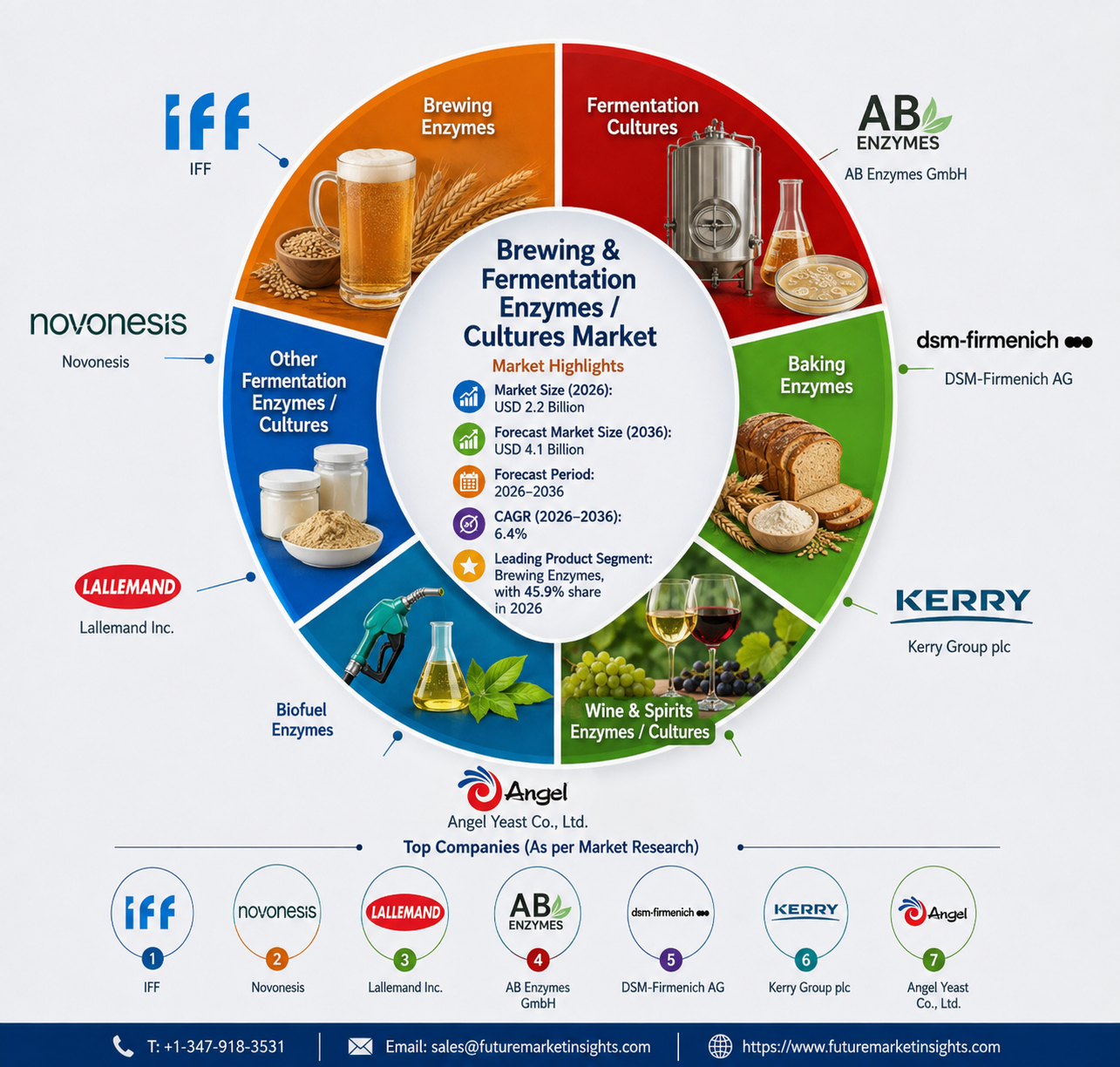
NEWARK, Del., August 10, 2026 — The global Brewing & Fermentation Enzymes / Cultures Market is expected to witness steady growth as brewers and fermented-food processors increasingly focus on mash conversion control, fermentation efficiency, and consistent batch outcomes. According to Future Market Insights (FMI), the market is projected to grow from USD 2.2 billion in...