


Masters in Business Analytics | GlobalNXT University

Masters in Business Analytics Advance Your Career in Malaysia
Businesses today rely on data to understand customers, improve operations, manage risks, and make informed decisions. As organisations collect increasing amounts of information, professionals who can interpret data and turn it into practical business insights are becoming increasingly valuable.
A masters in business analytics can help graduates and working professionals develop the analytical, technical, and strategic skills needed to solve complex business problems. For students in Malaysia looking to strengthen their qualifications or move into data-focused roles, postgraduate study may provide a valuable step towards long-term career development.
GlobalNXT University is a point of contact for prospective students who want to explore postgraduate business education. By reviewing programme details, entry requirements, and study arrangements, you can determine whether business analytics aligns with your academic background and professional ambitions.
Why Choose a Masters in Business Analytics?
Business analytics brings together business knowledge, data analysis, and technology to support better decisions. Rather than relying only on intuition or historical experience, organisations use data to identify patterns, measure performance, and evaluate potential opportunities.
Develop Data-Driven Decision-Making Skills
A business analytics programme may introduce students to statistical analysis, data visualisation, predictive modelling, and business intelligence. These skills can help professionals examine information, identify trends, and communicate findings in ways that support management decisions.
For example, a retailer may analyse customer purchasing patterns to improve stock planning, while a financial services company may use data to assess risk and monitor performance.
Connect Business Strategy with Technology
Business analytics is not just about numbers. It also involves understanding the business problem, selecting appropriate analytical methods, and presenting results that decision-makers can use.
Students may learn how data supports strategic planning, marketing performance, operational efficiency, and financial forecasting. The specific subjects depend on the university's curriculum, so it is important to review the official programme structure.
Prepare for an Evolving Job Market
Malaysia's business environment includes sectors such as banking, telecommunications, manufacturing, retail, logistics, and technology. Many organisations in these industries use data to improve productivity and understand customer behaviour.
Postgraduate analytics study can help learners build relevant skills for data-oriented work. However, employment opportunities depend on practical experience, technical ability, the qualification earned, and individual employer requirements.
What Will You Study in a Business Analytics Master's Programme?
The content of a masters in business analytics varies by institution, qualification, and mode of study. Before applying, examine the course modules and assessment methods to understand what you will learn.
Data Analytics and Statistics
Students may explore statistical techniques used to interpret datasets, test assumptions, identify relationships, and support evidence-based conclusions. These foundations can be useful when working with business performance information or customer data.
Business Intelligence and Data Visualisation
Business intelligence focuses on transforming data into information that managers can understand and act on. Courses may cover dashboards, reporting tools, visual communication, and performance indicators.
The ability to explain analytical findings clearly is important because insights only create value when stakeholders can understand their implications.
Predictive Analytics and Decision Support
Some programmes introduce predictive methods that use historical data to estimate possible future outcomes. These techniques may support demand forecasting, customer segmentation, risk assessment, and resource planning.
Not every course offers the same technical depth. Check whether the programme includes practical projects, specialist software, or coding requirements if these are important to your goals.
Masters in Business Analytics vs Master Business Administration Finance
Students considering postgraduate business education may also search for a master business administration finance programme. Although both options can support professional development, they generally focus on different skills and career interests.
A business analytics master's typically emphasises data interpretation, quantitative methods, analytical tools, and evidence-based decision-making. It may suit learners interested in using data to solve business problems.
An MBA with a finance focus generally places greater emphasis on management, corporate finance, financial strategy, budgeting, investment decisions, and leadership. It may be more suitable for professionals seeking broader management responsibilities with a finance specialisation.
Before choosing, consider your preferred work, existing experience, and long-term objectives. Review the curriculum of each programme rather than relying on its title alone. Entry requirements, recognition, and career pathways should also be compared carefully.
Career Opportunities After Business Analytics Study
A postgraduate qualification in business analytics may support applications for roles that combine business understanding with analytical skills. Potential opportunities include:
Business Analyst
Business analysts help organisations understand operational challenges, document requirements, evaluate processes, and recommend improvements. Analytical thinking and communication are important for connecting business needs with practical solutions.
Data Analyst
Data analysts examine datasets, prepare reports, identify patterns, and present findings to relevant teams. Employers may look for experience with spreadsheets, SQL, data visualisation platforms, or other analytical tools.
Business Intelligence Analyst
Business intelligence analysts help organisations monitor performance through reports, dashboards, and data-driven insights. Their work may support sales planning, customer analysis, operational monitoring, and management reporting.
Analytics and Strategy Roles
With relevant experience, graduates may pursue roles that involve forecasting, performance measurement, strategic planning, or decision support. Senior positions often require additional workplace experience and demonstrated technical expertise.
A degree does not guarantee employment or a particular salary, so students should consider practical projects, internships, and professional skill development alongside academic study.
How to Choose the Right Programme in Malaysia
Selecting a postgraduate course requires more than comparing programme names. Use these factors to evaluate your options:
-
Entry requirements: Check academic qualifications, relevant work experience, and English-language requirements, where applicable.
-
Course structure: Review modules, project work, assessment methods, and the balance between business and technical content.
-
Study format: Confirm duration, timetable, delivery mode, and whether the course fits around your work commitments.
-
Fees and additional costs: Request clear information about tuition, payment arrangements, and other expenses.
-
Recognition and accreditation: Verify the awarding institution, qualification status, and applicable accreditation through official sources.
-
Career relevance: Look for practical learning that matches the skills required in your intended industry.
Explore Postgraduate Study with GlobalNXT University
If you are considering a masters in business analytics, contact GlobalNXT University to enquire about current programme availability, curriculum, admission criteria, fees, and study arrangements.
Ask for official details about the qualification awarded, its recognition, available learning support, and any practical project requirements. Confirming these details directly can help you assess whether the programme suits your academic background and professional plans.
Frequently Asked Questions
1. Who should study a masters in business analytics?
It may suit graduates and professionals interested in data-driven decision-making, business intelligence, analytics, and strategic problem-solving. Specific admission requirements vary by programme.
2. Do I need a technical background?
Not necessarily. Some programmes accept students from business or related backgrounds, while others expect prior knowledge of mathematics, statistics, or computing. Check the course prerequisites.
3. Is business analytics different from an MBA in finance?
Yes. Business analytics generally focuses on data and analytical methods, while an MBA with a finance focus usually emphasises financial strategy and broader management skills.
4. What careers can follow a business analytics master's?
Possible pathways include business analyst, data analyst, business intelligence analyst, and analytics-related roles. Employment depends on skills, experience, and employer requirements.
5. How can I apply through GlobalNXT University?
Contact GlobalNXT University to confirm current course availability, eligibility criteria, application documents, fees, and deadlines before submitting your application.
Take the Next Step with GlobalNXT University
Choosing a masters in business analytics can be a valuable way to develop data interpretation, problem-solving, and strategic decision-making skills. For students and professionals in Malaysia, the right postgraduate programme should align with their career goals, existing qualifications, and preferred learning arrangements.
Contact GlobalNXT University to enquire about available programmes, entry requirements, and application procedures. Review the curriculum and qualification recognition carefully, then take the next step towards building your expertise in business analytics.
Categories
- Artificial Intelligence (AI)
- Technology
- Business
- Education
- Science
- Lifestyle
- Healthcare
- Entertainment
- Politics
- Environment
- Travel
- Finance
- Automobile
- News
- Art
- Causes
- Crafts
- career
- Dance
- Drinks
- Film
- Fitness
- Food
- Games
- Gardening
- Health
- Home
- Literature
- Music
- Networking
- Other
- Party
- Religion
- Shopping
- Sports
- Theater
- Wellness
Read More
The Diesel Exhaust Fluid Market is covered by Business Market Insights with 2025 as the base year and 2026–2033 as the forecast period. The public material captured for this batch did not expose all three headline values required for a verified numerical opening, so no market-size figure or CAGR is inferred. Senior management should treat this market as a portfolio-allocation problem. The...

According to the latest report published by Data Bridge Market Research, the AI-Driven Revenue Cycle Management (RCM) Services Market CAGR Value The AI-Driven Revenue Cycle Management (RCM) Services Market was valued at USD 2.43 billion in 2025 and is projected to reach USD 9.83 billion by 2033, growing at a CAGR of 19.10% from 2026 to 2033 AI-Driven Revenue Cycle Management...

The Pharmaceutical Cartridges Market is expected to benefit from ongoing changes in pharmaceutical treatment and drug delivery practices. As more therapies are developed for injection, the need for packaging that supports medication stability, sterility, and reliable administration continues to grow. Self-administered treatments are an important area of opportunity. Injection pens and other...
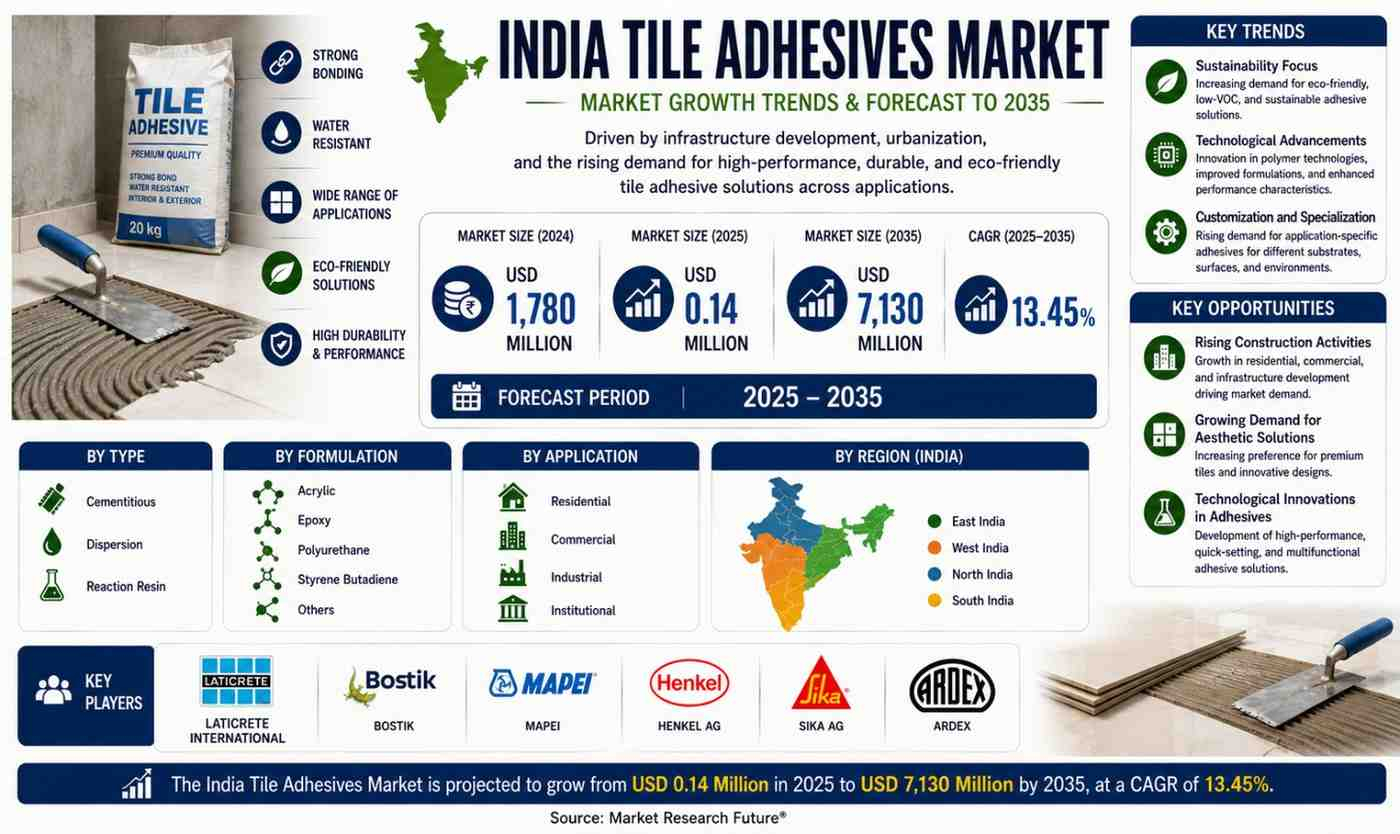
According to Market Research Future®, the India Tile Adhesive Market Outlook was valued at USD 1,780 million in 2024 and is projected to grow from USD 2,140 million in 2025 to USD 7,130 million by 2035, registering a CAGR of 13.45% during the forecast period. The India tile adhesive market is rapidly evolving as modern construction practices, premium building materials, and large-scale...
The global Vehicle Electronic Parking Brake (EPB) Market is on a robust growth trajectory, fueled by the increasing demand for advanced safety features, vehicle automation, and the rapid adoption of electric vehicles. According to a comprehensive report by WiseGuy Reports, the market, valued at USD 2,452.7 Million in 2025, is projected to grow to USD 4,500 Million by 2035, at a...
