AI in Finance 2026: Top Skills Employers Want to Hire
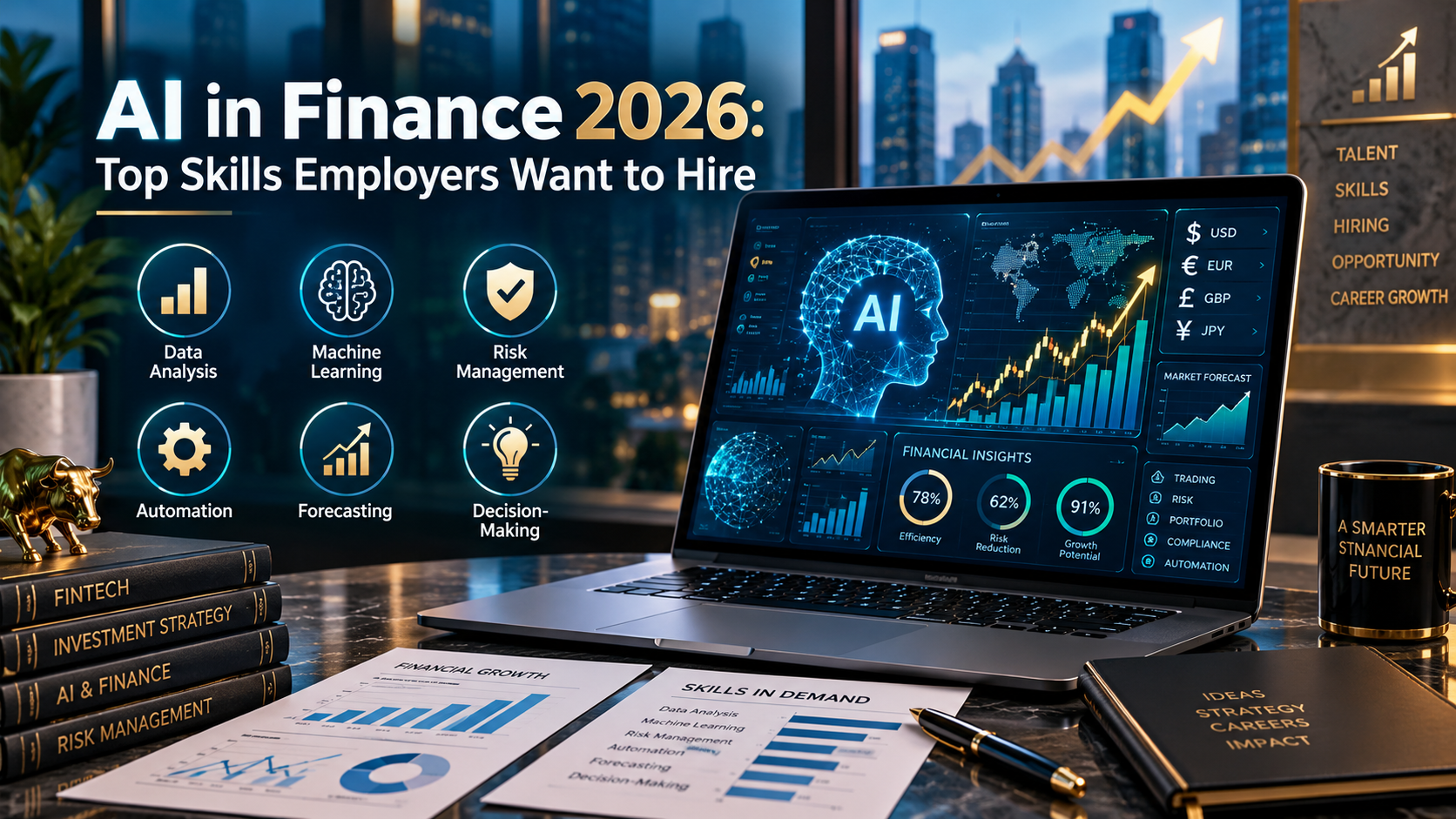
Artificial intelligence is transforming the finance industry in 2026, changing how organizations analyze investments, manage risks, detect fraud, and make financial decisions. Banks, investment firms, insurance companies, and financial technology businesses increasingly need professionals who understand both artificial intelligence and traditional financial principles.
The most valuable AI in finance skills include Python programming, machine learning, financial data analysis, generative AI, risk modeling, and ethical decision-making. However, technical knowledge alone is insufficient. Employers also prioritize communication, critical thinking, and practical financial expertise. Understanding these requirements can help professionals develop relevant skills and improve their career opportunities.
For a better understanding, check out Cert Empire’s YouTube tutorial.
Why Are AI Skills Important in Finance in 2026?
Financial institutions use artificial intelligence to process large datasets, identify market patterns, automate repetitive tasks, and support investment decisions.
According to CFA Institute's 2026 employer research, financial organizations increasingly value candidates who combine AI knowledge, programming abilities, financial modeling, and professional judgment.
Important applications include:
-
Detecting suspicious financial transactions
-
Automating financial reporting
-
Supporting credit risk assessments
-
Analyzing investment portfolios
-
Forecasting financial performance
-
Improving customer service through AI assistants
These applications create opportunities for professionals who can interpret AI-generated information and apply it responsibly.
Top AI in Finance Skills Employers Want
Several technical and professional competencies are particularly relevant to AI-related finance careers.
1. Python Programming and Financial Automation
Python is widely used for financial analysis, automation, and machine learning development.
Financial professionals use Python to process datasets, calculate investment metrics, and create analytical workflows.
Important Python skills include:
-
Working with Pandas and NumPy
-
Cleaning financial datasets
-
Automating repetitive calculations
-
Creating data visualizations
-
Developing financial forecasting models
Candidates who combine Python knowledge with accounting or investment analysis can demonstrate practical value to employers.
2. Machine Learning and Predictive Analytics
Machine learning enables computer systems to identify patterns and generate predictions from historical information.
In finance, these techniques support fraud detection, credit scoring, customer segmentation, and investment research.
Relevant skills include classification, regression, model evaluation, and identifying overfitting.
Professionals should also understand why financial predictions can fail when market conditions change.
3. Financial Data Analysis and SQL
Financial institutions manage extensive transactional, market, and customer datasets.
Employers value professionals who can retrieve, organize, validate, and interpret this information.
Important competencies include:
-
SQL database queries
-
Microsoft Excel financial modeling
-
Data cleaning and validation
-
Statistical analysis
-
Power BI or Tableau visualization
-
Financial performance reporting
Combining data analysis with business understanding helps professionals turn information into useful financial insights.
4. Generative AI and Prompt Engineering
Generative AI tools can summarize documents, assist research, explain financial information, and improve reporting workflows.
Prompt engineering involves creating clear instructions and evaluating the resulting outputs.
Finance professionals must verify generated information before using it in investment recommendations or regulated business processes.
Understanding confidentiality, data security, and AI limitations is equally important.
5. AI Risk Management and Responsible Finance
AI systems can introduce operational, ethical, and regulatory risks.
Financial institutions therefore need professionals who understand model governance, explainability, data protection, and human oversight.
Relevant competencies include:
-
Model risk assessment
-
Bias detection
-
Data privacy management
-
Regulatory awareness
-
Model performance monitoring
-
Responsible AI governance
These skills are particularly useful in banking, insurance, compliance, and investment management.
AI Finance Skills Comparison by Career Role
Different finance careers require different combinations of AI and traditional technical skills.
|
Career Role |
Important AI Skills |
Financial Expertise |
|
Financial Data Analyst |
Python, SQL, visualization |
Financial reporting |
|
Quantitative Analyst |
Machine learning, statistics |
Mathematical finance |
|
Risk Analyst |
Predictive modeling, AI governance |
Credit and market risk |
|
Investment Analyst |
Generative AI, data analysis |
Valuation and portfolio analysis |
|
Fraud Detection Analyst |
Classification models, analytics |
Financial transactions |
|
AI Finance Consultant |
Automation, AI implementation |
Business strategy |
The most suitable specialization depends on experience, industry interests, and long-term professional goals.
Which AI Finance Jobs Offer Career Opportunities?
AI skills support several existing financial roles while creating opportunities involving advanced analytics and automation.
Financial and Investment Analysts
Financial analysts increasingly use automated tools to process company information, evaluate investment opportunities, and build forecasts.
Strong financial modeling and interpretation skills remain essential because AI outputs require professional validation.
Quantitative Analysts and Data Scientists
Quantitative professionals develop mathematical models and analyze financial information.
These positions often require programming, probability, statistics, and machine learning knowledge.
Candidates with mathematics, economics, finance, or computer science backgrounds may find these specializations relevant.
Financial Risk and Compliance Specialists
Risk professionals use analytical systems to evaluate exposure, identify suspicious activity, and support regulatory compliance.
AI knowledge can improve their ability to assess automated decisions and recognize model limitations.
How CFA Knowledge Supports AI Finance Careers
Understanding investment principles remains important even when analytical tasks become automated.
The CFA Program develops knowledge of financial reporting, valuation, economics, portfolio management, and professional ethics.
These subjects complement AI capabilities because investment professionals must interpret financial outputs and evaluate business implications.
Candidates interested in developing investment-related qualifications can explore CFA Institute certification exam preparation resources from Cert Empire alongside official curriculum materials.
A finance qualification does not replace programming or AI experience, but combining these competencies can support professional development.
How to Develop AI Skills for Finance Jobs
Professionals can follow a structured approach to build relevant technical capabilities.
-
Strengthen financial fundamentals: Study accounting, valuation, financial statements, and risk concepts.
-
Learn Python and SQL: Practice working with financial datasets and databases.
-
Explore machine learning: Understand common algorithms and their financial applications.
-
Build practical projects: Develop forecasting dashboards or transaction analysis models.
-
Study responsible AI: Learn about model bias, privacy, security, and governance.
-
Create a professional portfolio: Document projects, methodologies, and measurable results.
-
Prepare for interviews: Practice explaining technical decisions and financial implications.
Practical projects help employers evaluate abilities beyond certificates or course completion records.
Challenges of Using AI in Finance
Although AI offers efficiency benefits, financial organizations must manage significant limitations.
Common challenges include:
-
Poor-quality or incomplete datasets
-
Unreliable model predictions
-
Data privacy and confidentiality risks
-
Changing market conditions
-
Limited model explainability
-
Regulatory compliance requirements
Professionals who recognize these limitations can help organizations implement AI more responsibly.
Best Practices for Building an AI Finance Career
Developing technical knowledge should remain a continuous process.
Follow relevant industry developments, strengthen communication skills, and practice explaining complicated findings in straightforward language.
Focus on projects demonstrating financial understanding rather than collecting unrelated technical credentials.
Employers value professionals who can connect analytical results with practical business decisions.
Conclusion
AI in finance is creating new skill requirements across investment management, banking, risk analysis, and financial technology. Python, machine learning, data analysis, generative AI, and responsible AI governance are valuable competencies in 2026.
However, financial knowledge, critical thinking, and communication remain essential. Professionals who combine technical expertise with sound financial judgment can better prepare for evolving finance careers.
FAQs
What AI skills are most important for finance jobs in 2026?
Python, SQL, machine learning, financial data analysis, generative AI, and model risk management are important technical skills. Financial judgment and communication are also valuable.
Do finance professionals need coding skills for AI jobs?
Not every finance position requires programming. However, Python and SQL are particularly useful for analytical, quantitative, and automation-focused careers.
Can AI skills help financial analysts advance their careers?
Yes. AI knowledge can support financial research, automation, forecasting, and data interpretation. Career advancement also depends on experience and demonstrated performance.
Is CFA certification useful for AI finance careers?
CFA knowledge can complement AI skills through financial analysis, valuation, investment management, and ethics. Technical AI abilities must be developed separately.
Read More: Free AZ-900 Practice Test: Questions and Study Guide for 2026
Categories
- Artificial Intelligence (AI)
- Technology
- Business
- Education
- Science
- Lifestyle
- Healthcare
- Entertainment
- Politics
- Environment
- Travel
- Finance
- Automobile
- News
- Art
- Causes
- Crafts
- career
- Dance
- Drinks
- Film
- Fitness
- Food
- Games
- Gardening
- Health
- Home
- Literature
- Music
- Networking
- Other
- Party
- Religion
- Shopping
- Sports
- Theater
- Wellness
Read More
The Medical Waste Containers Market size is expected to reach US$ 3.7 Billion by 2033 from US$ 2.4 Billion in 2025. The market is estimated to record a CAGR of 5.56% from 2026 to 2033. Senior management should treat this market as a portfolio-allocation problem and concentrate resources where the company can build a defendable position. The market context also includes procedure growth,...

The Brain Health Supplement Market is gaining attention as consumers increasingly focus on cognitive wellness, memory support, mental performance, and healthy aging. Brain health supplements include vitamins, minerals, herbal extracts, amino acids, omega-3 fatty acids, and other nutritional ingredients designed to support cognitive functions. Growing awareness of preventive healthcare is...
Introduction: The Rise of Minimalist Streetwear Culture In modern fashion, simplicity has become the strongest form of expression. The Black Essentials Hoodie stands at the center of this movement, representing a perfect balance between minimal design, premium comfort, and everyday versatility. We focus on clothing that does not rely on loud graphics or unnecessary details but instead delivers...

The ECG Patch and Holter Monitor Market is gaining significant attention as healthcare providers increasingly adopt continuous cardiac monitoring technologies. ECG patches and Holter monitors enable clinicians to record and evaluate heart activity over extended periods, supporting the detection of intermittent and difficult-to-identify cardiac abnormalities. The rising prevalence of...
When it comes to preserving natural teeth and eliminating severe dental pain, Root Canal Treatment in Adyar has become one of the most sought-after dental procedures. At Dr Shradha Dental Center, we deliver precision-driven, pain-free root canal treatments using advanced technology, modern techniques, and a patient-first approach. Our commitment to excellence ensures that...