


Global Petrochemicals Market to Reach USD 1,557.95 Billion by 2035 at a 9.26% CAGR
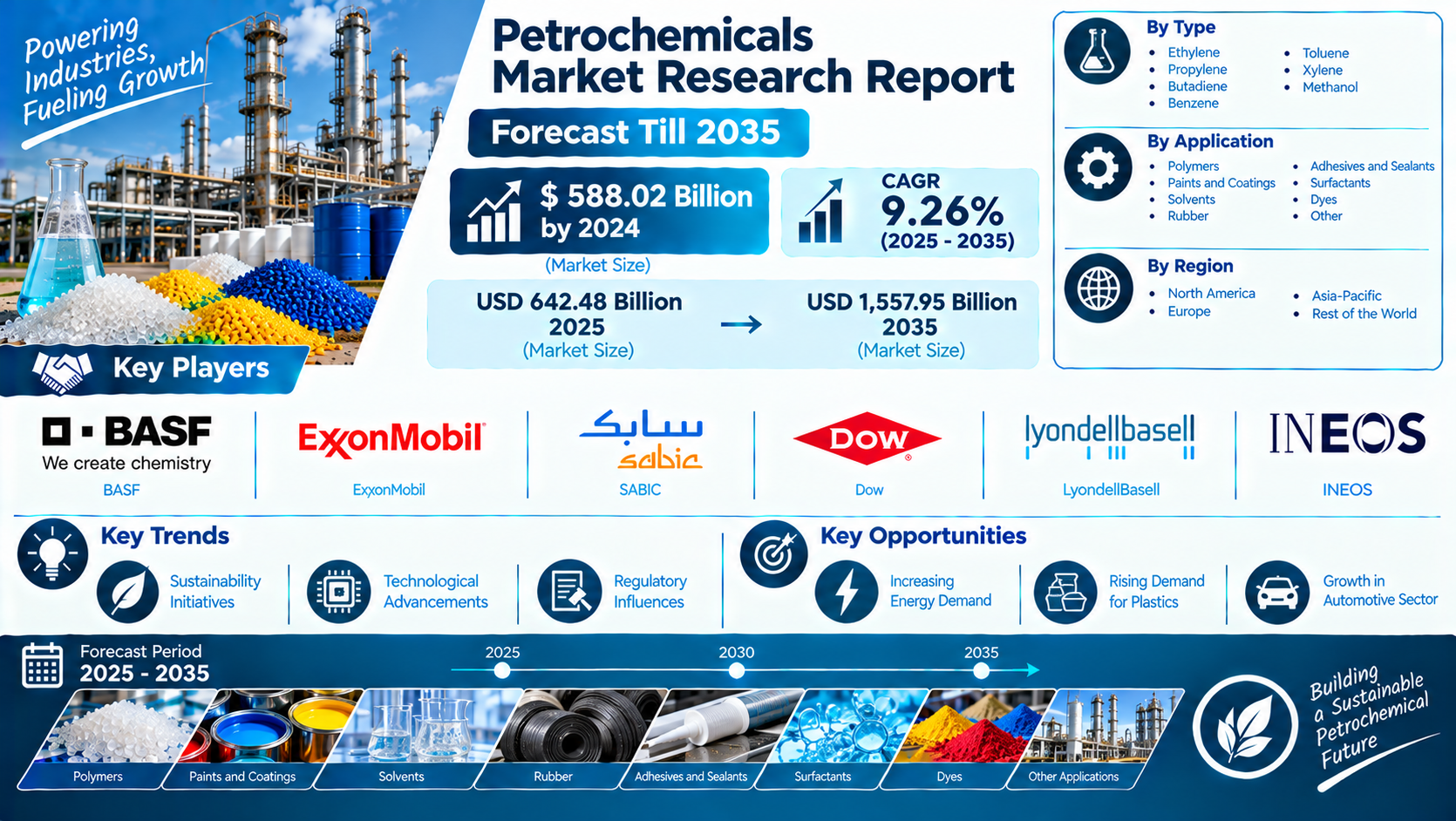
According to Market Research Future® (MRFR), the Petrochemical Market was valued at USD 588.02 billion in 2024 and is projected to grow from USD 642.48 billion in 2025 to USD 1,557.95 billion by 2035, registering a compound annual growth rate (CAGR) of 9.26% during the forecast period from 2025 to 2035. Petrochemicals are essential inputs for a broad range of industrial and consumer products, including polymers, paints and coatings, solvents, rubber, adhesives and sealants, surfactants, and dyes. Demand across manufacturing, packaging, construction, transportation, and other industries shapes the market’s long-term outlook.
Petrochemical Market Overview
The petrochemical industry converts hydrocarbon-based feedstocks into chemical building blocks used in downstream manufacturing. These materials are incorporated into products ranging from plastics and synthetic rubber to coatings, solvents, and industrial chemicals. Their wide application base makes the sector closely connected to economic activity, manufacturing output, consumer demand, and investment in industrial capacity.
Ethylene, propylene, butadiene, benzene, toluene, xylene, and methanol represent major product categories in the market. Each serves different chemical value chains and supports the production of multiple downstream materials. Ethylene and propylene are important inputs for polymer production, while other petrochemicals support synthetic rubber, solvents, resins, and related industrial applications.
The market’s growth outlook reflects continued demand for these materials across established and developing industries. However, petrochemical producers must also respond to changing feedstock costs, environmental expectations, production technology, and regulatory requirements. The ability to operate efficiently while adapting to customer and policy priorities will influence competitive positioning.
Market Size and Growth Forecast
The petrochemical market is projected to expand from USD 642.48 billion in 2025 to USD 1,557.95 billion by 2035, following a reported CAGR of 9.26% over 2025–2035. The 2024 market size was USD 588.02 billion. This forecast points to substantial expansion over the decade, supported by the continued use of petrochemical-derived materials in a wide range of products.
Growth will depend on downstream demand, industrial investment, capacity utilization, and the economics of feedstock processing. Producers must align output with demand across polymer, chemical, rubber, coating, and other value chains. Changes in consumer purchasing, infrastructure activity, and manufacturing requirements can influence the volumes and product grades that customers need.
The market’s scale also makes operating efficiency important. Energy consumption, plant performance, supply reliability, and technology investment can affect production costs and profitability. Companies must evaluate these factors alongside demand trends when making decisions about capacity and product portfolios.
Key Trends Shaping the Industry
Sustainability Initiatives
Sustainability is becoming an important consideration for petrochemical producers and downstream customers. The sector supplies materials used in packaging, automotive components, construction products, and numerous consumer goods, placing it within broader discussions about resource use, waste, and material recovery.
Companies may pursue improvements in production efficiency, waste management, and the use of recycled or alternative feedstocks where technically and commercially viable. Demand for recyclable products and more resource-efficient material systems can also influence downstream specifications. The effectiveness of these initiatives depends on available technologies, infrastructure, economics, and the requirements of individual applications.
Technological Advancements
Technology influences how petrochemical facilities process feedstocks, manage operations, and produce materials with specific characteristics. Improvements in process control, equipment performance, and production planning can support efficiency and consistency. Producers also need to respond to evolving requirements from customers who use petrochemicals in specialized formulations and manufactured products.
Innovation across downstream applications can create demand for different grades of polymers, solvents, coatings inputs, and other chemical building blocks. Companies that align product development with customer specifications may be better positioned to serve changing market requirements.
Regulatory Influences
Environmental and industrial regulations affect production practices, emissions management, product specifications, and waste handling. Requirements vary by jurisdiction and application, so companies operating across regions must understand the rules relevant to their facilities and customers.
Regulatory change can increase compliance costs and require operational adjustments, but it can also encourage investment in cleaner processes, improved material recovery, and alternative production approaches. Businesses that incorporate compliance considerations into investment planning may be better prepared for changing operating conditions.
Market Segmentation
By type, the market includes ethylene, propylene, butadiene, benzene, toluene, xylene, and methanol. These products support different downstream industries and chemical processes. Demand for each depends on its role in polymer production, synthetic rubber, solvents, coatings, and other industrial applications.
By application, the market covers polymers, paints and coatings, solvents, rubber, adhesives and sealants, surfactants, dyes, and other uses. Polymers form a significant downstream category because petrochemical building blocks are used in numerous plastic and synthetic material applications. Coatings, adhesives, solvents, and surfactants also support manufacturing and consumer product formulation across multiple sectors.
Regionally, the market includes North America, Europe, Asia-Pacific, and the Rest of the World. Regional demand reflects manufacturing capacity, industrial development, consumer markets, feedstock availability, and investment in petrochemical infrastructure. The relative importance of these factors varies among markets, influencing production decisions and trade flows.
Competitive Landscape and Opportunities
Key companies identified in the market include BASF, ExxonMobil, SABIC, Dow, LyondellBasell, and Ineos. Competition can involve production scale, feedstock access, operating efficiency, product quality, technology, and relationships with downstream customers. The ability to supply consistent materials across large industrial value chains is important to maintaining customer confidence.
Opportunities are associated with increasing energy demand, rising demand for plastics, and growth in the automotive sector. Petrochemicals supply materials used in vehicle components, coatings, rubber products, and other automotive applications. Changes in vehicle design and manufacturing requirements may influence demand for particular material categories, although outcomes depend on the technologies and products adopted by manufacturers.
Expanding polymer applications also create opportunities for producers serving packaging, construction, consumer goods, and industrial markets. Companies may strengthen their position by improving product performance, developing more resource-efficient processes, and responding to changing customer specifications.
Future Outlook
The petrochemical market is projected to expand through 2035, supported by its broad role in industrial production and consumer products. Polymers, coatings, solvents, rubber, and other chemical applications provide a diversified demand base. At the same time, sustainability expectations, technological change, feedstock economics, and regulatory requirements will influence how the industry develops. Producers that combine efficient operations with reliable supply and responsive product development may be better positioned to navigate the market’s changing conditions.
Categories
- Artificial Intelligence (AI)
- Technology
- Business
- Education
- Science
- Lifestyle
- Healthcare
- Entertainment
- Politics
- Environment
- Travel
- Finance
- Automobile
- News
- Art
- Causes
- Crafts
- career
- Dance
- Drinks
- Film
- Fitness
- Food
- Games
- Gardening
- Health
- Home
- Literature
- Music
- Networking
- Other
- Party
- Religion
- Shopping
- Sports
- Theater
- Wellness
Read More
As per Market Research Future, the Uninterruptible Power Supply Batteries market is expanding steadily as organizations increasingly prioritize business continuity and operational resilience. In a world where digital systems power nearly every aspect of commerce and communication, the importance of reliable backup energy solutions cannot be overstated. UPS batteries serve as the backbone of...

The Surgical Helmet Cover Market is expanding as hospitals place greater emphasis on infection prevention, operating-room safety, and protective equipment for surgical teams. The market was estimated at approximately USD 290 million in 2023 and is projected to grow from USD 320 million in 2024 to USD 573 million by 2032, representing a 7.72% CAGR from 2025 to 2032. The increasing number of...
The Medical Accompaniment Service Market research report has been crafted with the most advanced and best tools to collect, record, estimate, and analyze market data. The report also sheds light on the market overview in its entirety touching diverse aspects like product definition, prevailing vendor landscape, and market segmentation. Through the comprehensive and systematic market...

Ants may look harmless, but a small ant problem can quickly become a larger household pest issue. Choosing the right ant control products can help homeowners manage visible ants and reduce the chances of repeated infestations. For residents near 33 Uxbridge St, Staten Island, NY 10314, understanding how ant infestations develop and when professional Pest Control is needed can make pest...

The textile yarn market is expanding steadily as technological advancements improve yarn quality, production efficiency, and sustainability. Innovations in recycled fibers, high-performance synthetic yarns, smart textiles, and automated spinning technologies are enabling manufacturers to produce stronger, lighter, and more sustainable yarn products. According to Business Market Insights,...
