

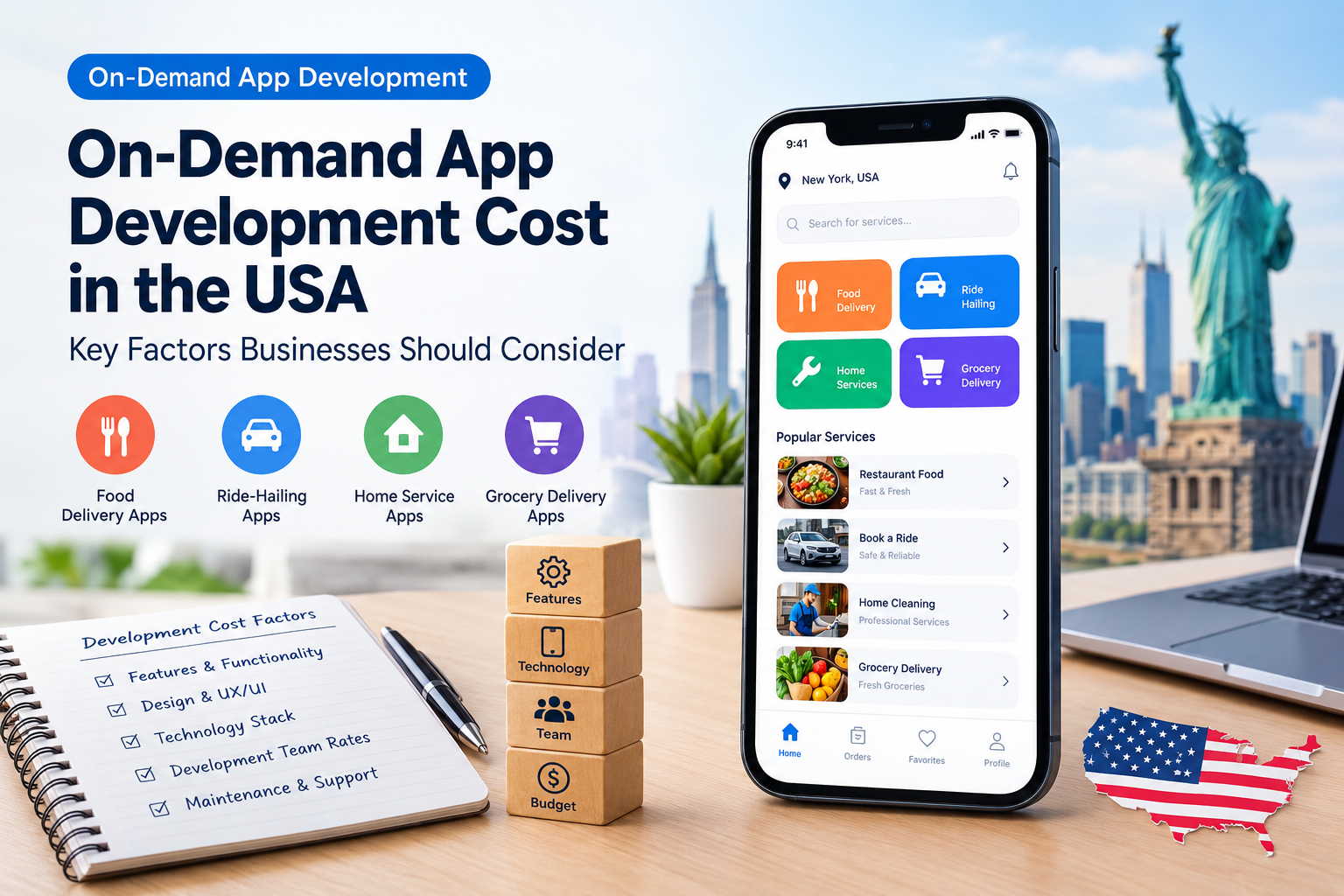
On-Demand App Development Cost in the USA: Key Factors Businesses Should Consider

Convenience has become an important part of how Americans purchase products and access services. From booking a cab and ordering restaurant meals to arranging household repairs, customers increasingly prefer mobile applications that connect them with the services they need. This shift has created opportunities for businesses to develop digital platforms that simplify everyday transactions and improve customer experiences.
However, launching an on-demand application requires more than an attractive interface. Businesses must consider development expenses, essential functionality, technology choices, payment systems, and future maintenance. Understanding these requirements before starting a project can help entrepreneurs establish a realistic budget and avoid unnecessary spending.
The on-demand app development cost in USA varies according to the type of application, its complexity, and the resources required to build and maintain it. Whether a company plans to introduce a grocery delivery platform, a ride-booking application, or a home service marketplace, understanding the factors behind the investment can support better planning and decision-making.
What Is the Estimated Cost of Developing an On-Demand App in the USA?
There is no universal price for developing an on-demand application because every business has different operational requirements. An application designed for a small local service provider may need only a few essential features, whereas a platform serving multiple cities could require advanced tracking, automated scheduling, and sophisticated backend infrastructure.
The following estimates can help businesses prepare an initial development budget.
| Application Type | Estimated Development Budget | Potential Development Duration |
|---|---|---|
| Basic application | $15,000–$35,000 | 2–3 months |
| Intermediate application | $35,000–$80,000 | 3–5 months |
| Feature-rich application | $80,000–$150,000+ | 5–9+ months |
| Enterprise application | $150,000–$300,000+ | 8–12+ months |
These figures are approximate planning estimates, not guaranteed prices or verified market averages. Actual quotations depend on the development team's location, project specifications, integrations, testing requirements, and delivery model.
For instance, a neighborhood service-booking app might require customer accounts, appointment scheduling, provider profiles, and payment processing. A nationwide delivery platform could involve several additional components, including driver management, live location updates, delivery allocation, and inventory integrations.
Businesses should define the minimum functionality needed for launch before requesting quotations. A clearly defined scope makes it easier to estimate expenses, compare providers, and determine which features can be introduced during later development phases.
Which On-Demand App Development Services Offer the Best Value for Businesses?
Choosing an appropriate development approach can influence both the initial investment and the application's long-term flexibility. Businesses should compare available options according to their objectives, technical requirements, and expected growth rather than selecting a solution based on price alone.
Custom on-demand app development allows businesses to create applications around their specific workflows, customer expectations, and operational processes. It can be particularly useful when an existing platform does not provide the required functionality.
For startups working with limited resources, MVP app development offers another practical approach. Instead of launching a fully featured product immediately, businesses can introduce a smaller version containing the essential functions needed to test their concept.
Other development approaches include:
-
Cross-platform mobile app development: A shared codebase can support both iOS and Android, potentially reducing duplicated development work.
-
Native app development: Separate applications built for individual operating systems can provide deeper platform integration when required.
-
White-label app development: Existing solutions can be adapted to a business's branding and operational needs, although customization may be limited.
-
Custom backend development: A tailored server-side system can support specialized workflows, integrations, and business rules.
Each option involves different trade-offs. A white-label solution may offer a faster starting point, while custom development can provide greater control over functionality and future enhancements.
Before making a decision, businesses should compare implementation expenses, recurring fees, customization limitations, ownership rights, and future maintenance requirements.
Which Features Should Businesses Budget for When Building an On-Demand Mobile App?
The functionality included in an application has a direct effect on development time and cost. Every feature requires planning, implementation, and testing, while complex integrations may introduce additional technical challenges.
Most on-demand platforms contain three major components: a customer-facing application, a service provider application, and an administrative system. The exact requirements depend on whether the platform handles deliveries, transportation, appointments, or other services.
Customer Application
The customer interface should make it straightforward to find services, submit requests, and complete transactions.
Common requirements include:
-
Account creation and secure authentication
-
Service discovery and search filters
-
Product or service information
-
Booking and order placement
-
Online payment processing
-
Booking confirmations and status notifications
-
Ratings, reviews, and support options
Service Provider Application
Service providers need tools to manage incoming requests and complete assigned work. Depending on the business model, the application may include availability settings, job acceptance, navigation, earnings information, and order history.
For delivery and transportation services, live location sharing and trip updates may also be necessary.
Administrative Dashboard
The administrative interface gives business owners control over daily operations. It may include customer management, service provider verification, transaction monitoring, commission settings, promotional tools, and performance reports.
Developing all three components with extensive functionality from the beginning can increase the initial budget. Businesses can manage costs by identifying essential workflows first and postponing lower-priority features until the application has established a user base.
How Much Should You Budget for an On-Demand App Development Company in the USA?
The price of hiring an on-demand app development company in the USA depends on the team's expertise, project complexity, engagement structure, and level of support. Businesses can work with established agencies, independent specialists, or dedicated development teams.
US-based agencies may provide product planning, interface design, mobile development, backend engineering, testing, and project coordination under one engagement. Independent developers can be suitable for smaller assignments, although businesses may need additional resources to coordinate different specialists.
The following hourly rates are illustrative budgeting ranges.
| Professional Role | Approximate Hourly Rate |
|---|---|
| UI/UX designer | $40–$100 |
| Mobile application developer | $50–$150 |
| Backend engineer | $50–$150 |
| Quality assurance engineer | $30–$90 |
| Project manager | $40–$120 |
These rates are not fixed industry averages. Actual prices depend on experience, location, specialization, project duration, and contractual arrangements.
Development providers may offer fixed-price projects, hourly billing, or dedicated teams. A fixed-price agreement can help control expenses when requirements are clearly documented. Hourly engagement may be more suitable for projects where functionality is expected to evolve throughout development.
Before signing a contract, businesses should request a breakdown of design, development, testing, deployment, and maintenance expenses. They should also clarify the process for approving additional features and handling changes to the original scope.
Comparing detailed proposals can help identify differences in service quality, deliverables, and long-term value.
What Does It Cost to Develop Food Delivery, Ride-Hailing, and Home Service Apps?
The industry a business operates in can substantially affect its application development budget. Different on-demand business models require different workflows, integrations, and management tools.
Food Delivery Applications
Food delivery platforms connect customers with restaurants and delivery partners. Typical functionality includes restaurant listings, digital menus, shopping carts, online payments, order status updates, and delivery coordination.
Businesses building multi-restaurant marketplaces may also need restaurant management dashboards, commission calculations, promotional campaigns, and reporting tools. Integrating restaurant inventory or point-of-sale systems can introduce additional development work.
Ride-Hailing Applications
Ride-hailing solutions generally require passenger and driver interfaces, GPS-based tracking, fare estimation, route calculations, and trip management.
Additional features may include scheduled rides, driver verification, automated dispatching, payment processing, and location-based pricing. These capabilities can increase the complexity of the backend system and the cost of ongoing infrastructure.
Home Service Applications
Home service platforms help customers book professionals for activities such as cleaning, plumbing, appliance repair, and household maintenance.
Common requirements include service listings, appointment scheduling, provider profiles, reviews, and payment management. More advanced platforms may support recurring appointments, quotations, staff allocation, and service-area restrictions.
Grocery Delivery Applications
Grocery applications often require product catalogs, inventory availability, shopping carts, delivery time slots, and order fulfillment management.
Supporting multiple retailers or synchronizing stock with existing store systems can make the project more complex. Businesses should account for these operational requirements when calculating the development budget.
Rather than applying the same budget to every business model, companies should identify their target audience, primary service, and essential operational workflows before estimating costs.
How Can Businesses Lower On-Demand App Development Costs While Maintaining Quality?
A limited budget does not necessarily prevent a business from launching a reliable application. Careful planning, appropriate technology choices, and disciplined feature prioritization can reduce unnecessary expenses without sacrificing essential functionality.
Launch with a focused MVP. Build the smallest useful version of the application that allows customers to complete its main task. Additional capabilities can be introduced after the business evaluates customer feedback and usage patterns.
Prioritize essential functionality. Identify the features that directly support the main customer journey. Optional personalization, advanced reporting, and complex automation can often be introduced later.
Select technology according to actual needs. Cross-platform development may be appropriate when the product needs to support iOS and Android without extensive platform-specific functionality. The final decision should also account for performance, maintainability, and developer expertise.
Document requirements before development. Unclear specifications and frequent scope changes can create delays and additional expenses. Written requirements, agreed milestones, and defined acceptance criteria help keep the project organized.
Integrate established third-party services. Existing payment gateways, mapping systems, authentication tools, and notification platforms can eliminate the need to build every component independently. Their licensing and usage fees should still be included in the budget.
Avoid unnecessary technical complexity. Infrastructure should match the application's expected workload. A new startup generally does not need the same architecture as a mature platform processing a large volume of transactions.
Make testing part of the development process. Identifying defects early can reduce rework and improve reliability. Security checks, usability testing, and device compatibility assessments should be included in project planning.
These measures allow businesses to focus their investment on features that provide meaningful value to customers and support the product's primary objectives.
What Are the Ongoing Maintenance Costs of an On-Demand App?
Publishing an application does not mark the end of its expenses. After launch, businesses must maintain the software, monitor performance, address technical issues, and keep integrations working correctly.
The total cost of ownership includes several recurring expenses.
-
Hosting and cloud infrastructure: Servers, databases, storage, and data processing contribute to operational costs.
-
Software maintenance: Bug fixes, operating system compatibility updates, and technical improvements require continued development work.
-
Third-party integrations: Mapping, messaging, identity verification, and analytics services may charge based on usage or subscription plans.
-
Payment processing: Payment providers typically apply transaction fees according to their pricing structures.
-
Security management: Businesses may need vulnerability assessments, access controls, security updates, and other protective measures.
-
Customer service: Support teams help resolve payment issues, cancellations, booking problems, and customer complaints.
-
Marketing and user acquisition: Advertising, introductory offers, and referral campaigns can contribute substantially to launch and growth expenses.
Maintenance requirements vary according to application complexity, usage levels, industry requirements, and service expectations. Businesses should prepare a recurring operating budget before launch instead of allocating all available funds to initial development.
A realistic financial plan should cover both technical maintenance and the operational resources required to deliver a consistent customer experience.
Which Technology Stack Is Worth Investing In for On-Demand App Development?
Technology selection influences how an application performs, how quickly it can be developed, and how easily it can be maintained. The appropriate technology stack depends on the product's functionality, expected workload, integration requirements, and available technical expertise.
For mobile development, businesses may consider Swift for iOS, Kotlin for Android, or cross-platform frameworks such as Flutter and React Native.
Backend systems can use technologies such as Node.js, Python, or Java, depending on the architecture and development team's capabilities. Database systems, cloud services, authentication tools, and monitoring solutions must also be selected according to project requirements.
For example, a basic appointment-booking application may operate effectively with a relatively straightforward backend. A large delivery platform with frequent location updates, automated dispatching, and substantial transaction volumes may require more advanced infrastructure.
When comparing technology options, businesses should evaluate:
-
Compatibility with the intended mobile platforms
-
Performance under anticipated user demand
-
Availability of experienced developers
-
Integration requirements for payments and location services
-
Data protection and security needs
-
Long-term maintenance and expansion costs
Choosing technology based solely on popularity can lead to unnecessary complexity. A better approach is to select tools that meet current requirements while leaving room for practical future growth.
How Can You Choose the Right Mobile App Development Company for Your Budget?
Selecting a development partner is an important financial decision because the quality of planning and implementation can influence the application's long-term costs.
Businesses should assess potential providers based on technical expertise, communication, project transparency, and relevant experience.
Review previous projects. Examine applications the provider has developed for comparable industries or business models. Relevant experience can help the team identify common challenges and practical solutions.
Evaluate technical capabilities. Confirm that the company can manage mobile interfaces, backend systems, API integrations, security, and testing.
Request an itemized quotation. A detailed proposal should explain what is included in the price and identify expenses that may be charged separately.
Check project management practices. Ask how milestones are tracked, progress is communicated, and changes are approved.
Clarify ownership rights. Contracts should explain access to source code, intellectual property ownership, technical documentation, and third-party licenses.
Understand post-launch support. Confirm whether maintenance, bug fixes, monitoring, and future enhancements are included in the agreement.
Businesses should also discuss delivery timelines, quality assurance procedures, and potential project risks before making a commitment.
The lowest quotation may not offer the best overall value if important deliverables, testing activities, or support services are excluded. Comparing the complete scope of work provides a more reliable basis for selecting a development partner.
Final Thoughts on On-Demand App Development Costs in the USA
Building an on-demand application requires businesses to balance their available budget with functionality, performance, security, and future expansion plans. The total investment depends on the business model, development approach, technology stack, team rates, and resources required to operate the platform after launch.
Startups can reduce initial expenses by validating their ideas through an MVP, while established businesses may need more extensive integrations and operational controls from the beginning. Regardless of the project size, clear requirements and a realistic financial plan help prevent unnecessary spending.
Businesses should evaluate development proposals carefully, account for ongoing maintenance, and prioritize features that directly support customer needs. With an appropriate development strategy, an on-demand mobile application can provide a practical foundation for delivering services, improving customer convenience, and supporting long-term business growth.

