

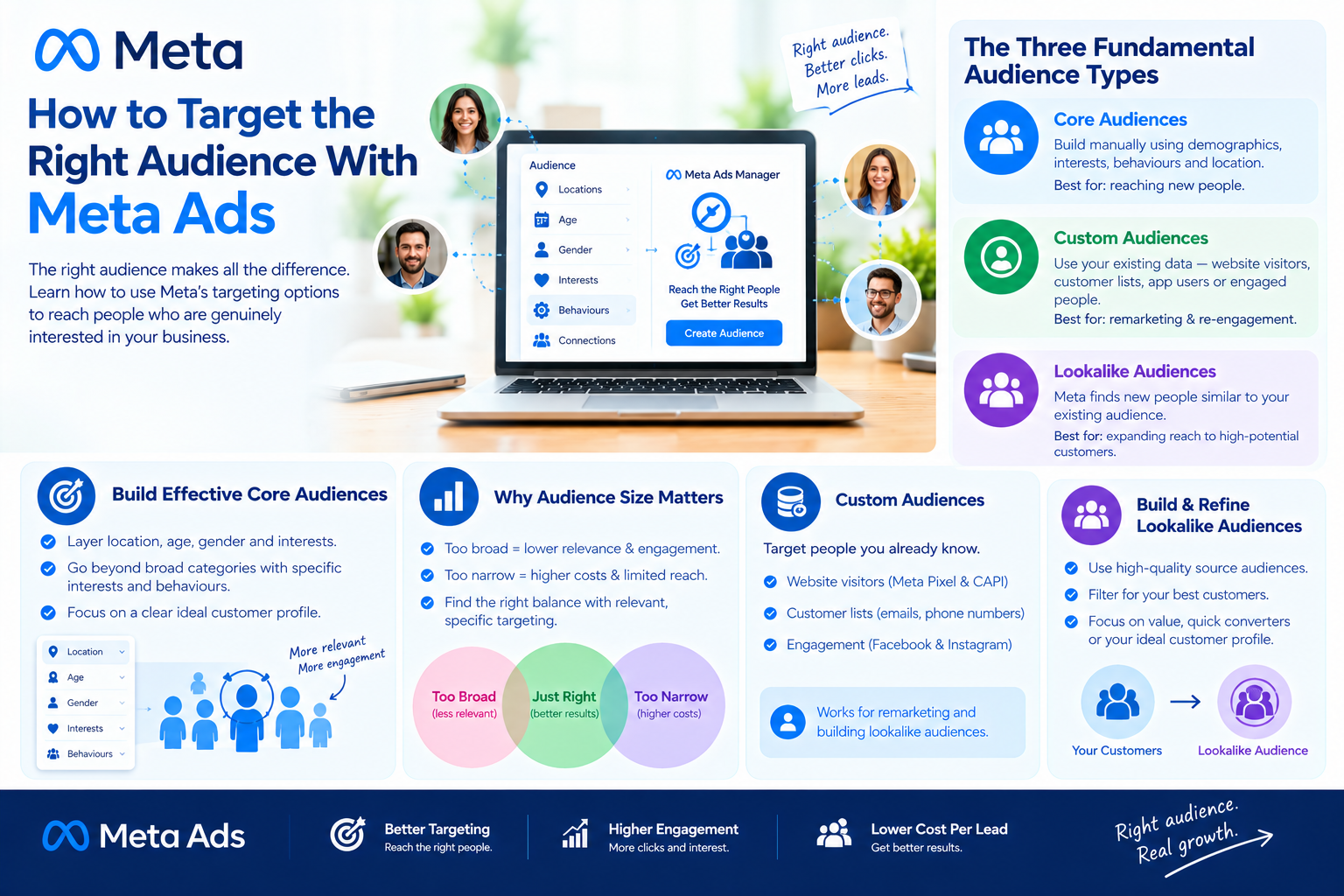

Audience targeting is the single decision in Meta Ads that most directly shapes everything else about a campaign's performance. The same ad, the same budget, and the same offer can produce completely different results depending purely on who's actually seeing it — and unlike Google Ads, where targeting is largely driven by what people search for, Meta's targeting system works by defining who people are, based on demographics, interests, behaviours, and relationships to a business's existing audience.
Getting this right requires understanding the different audience types Meta offers, how they genuinely differ from one another, and how to combine them strategically rather than defaulting to whichever option feels most familiar or easiest to set up. This guide works through Meta's audience targeting system in full, with a focus on building audiences that are genuinely well-matched rather than simply broad.
The Three Fundamental Audience Types
Meta's targeting system is built around three distinct audience categories, each serving a different purpose within a broader strategy. Core audiences are built manually by selecting specific demographics, interests, behaviours, and locations — the traditional, most hands-on approach to defining who should see an ad. Custom audiences are built from existing data a business already has — website visitors, customer lists, app users, or people who've engaged with previous content — allowing a business to specifically target or exclude people based on a genuine prior relationship with the business. Lookalike audiences are built by Meta's algorithm analysing a source custom audience (such as past customers) and finding new people who share similar characteristics and behaviours, extending reach to people statistically likely to be a good fit without needing to manually define that likeness.
Each of these serves a different stage of a typical customer journey, and the strongest Meta Ads strategies generally use some combination of all three, rather than relying exclusively on just one approach.
Building Effective Core Audiences
Core audience targeting works by layering different criteria — location, age, gender, detailed targeting based on interests and behaviours — to define a specific group of people. The temptation with core audiences is often to cast a wide net, assuming more reach means more opportunity, but a loosely defined, overly broad core audience typically produces weaker relevance and engagement than one built around a genuinely specific understanding of the ideal customer.
Effective interest and behaviour targeting usually goes beyond the most obvious, broad categories. Rather than targeting simply "home improvement" as an interest, layering in more specific signals — particular related brands, more niche sub-interests, specific behaviours like recent movers or homeowners — tends to produce a more precisely defined, genuinely relevant audience than relying on a single broad category alone.
Why Audience Size Matters More Than It Might Seem
An audience that's too broad dilutes relevance, since the algorithm has less specific signal to work with when deciding who within that large pool is actually worth showing the ad to. An audience that's too narrow can struggle with efficient delivery, since there simply aren't enough people within that small pool to support stable, cost-effective reach, particularly as a campaign scales budget upward.
There's no single universally correct audience size, since the right range depends heavily on budget, campaign objective, and how niche the actual target market genuinely is. As a general principle, an audience broad enough to give Meta's algorithm meaningful room to identify the best-performing segments within it, but still built around genuinely relevant, specific targeting criteria rather than arbitrary broadness, tends to strike the most effective balance.
Custom Audiences: Targeting People You Already Know
Custom audiences represent one of Meta's most valuable targeting capabilities, since they allow a business to reach people based on an actual, demonstrated relationship rather than inferred interest alone. Website custom audiences, built using the Meta Pixel and Conversions API, allow targeting (or excluding) people who've visited specific pages or taken specific actions on a business's website. Customer list custom audiences allow uploading existing contact data — email addresses, phone numbers — to specifically reach (or exclude) people already known to the business. Engagement custom audiences allow targeting people who've interacted with a business's Facebook or Instagram content, even without ever visiting the website directly.
These custom audiences serve two critical, complementary purposes: remarketing to warm, previously engaged people who haven't yet converted, and providing the source data needed to build effective lookalike audiences for reaching entirely new people who share similar characteristics.
Building and Refining Lookalike Audiences
Lookalike audience quality depends heavily on the quality of the source audience used to build it. A lookalike built from a broad, unfiltered list of every past customer — including both genuinely great-fit customers and poor-fit, low-value ones — will produce a less precisely targeted lookalike than one built from a carefully filtered source audience representing only the most genuinely ideal customers.
Where possible, building lookalikes from a specifically curated source — top-tier customers by value, customers who converted quickly and easily, or a list specifically representing the business's clearest ideal customer profile — tends to produce a more precisely matched, higher-performing lookalike audience than defaulting to the broadest, least filtered customer list available.
Meta also allows adjusting lookalike audience size, from a smaller percentage closely matching the source audience's characteristics to a larger percentage offering broader reach with somewhat less precise matching. Starting with a smaller, more tightly matched percentage, then testing larger variations once initial performance data is available, allows a more evidence-based approach to finding the right balance between precision and reach for a specific business.
Understanding Advantage+ Audience and Algorithmic Expansion
Meta has increasingly shifted toward Advantage+ audience features, which allow the algorithm more flexibility to find relevant people beyond strictly defined manual targeting, informed by the campaign's accumulated conversion data. For campaigns with strong, well-established conversion tracking and meaningful historical performance data, this expanded flexibility can sometimes uncover efficient opportunities that manual targeting alone might miss, since the algorithm can identify patterns in who actually converts that aren't obvious from manually selected interest categories.
For newer campaigns without much historical data, or businesses with a very specific, well-understood niche audience, more manual control often provides clearer, more predictable initial results. Testing algorithmic expansion once a campaign has accumulated reasonable performance history — rather than defaulting immediately to maximum automation — allows for a more considered, evidence-based approach to how much targeting control to hand over to the algorithm.
The Impact of Privacy Changes on Audience Targeting
Changes to mobile privacy frameworks in recent years, particularly Apple's App Tracking Transparency framework, have meaningfully reduced the volume and precision of behavioural data available to Meta's advertising system compared to several years ago, since a significant share of iOS users now opt out of the cross-app tracking that previously fed detailed behavioural targeting data into the platform.
This shift has pushed Meta's own systems, and effective advertiser strategy, increasingly toward first-party data — a business's own website conversion data, customer lists, and the Conversions API (which transmits conversion data server-side, somewhat more resilient to these privacy changes than browser-based pixel tracking alone) — as the foundation for both custom audiences and the algorithm's broader optimisation. Businesses relying heavily on precise, narrow interest-based targeting without strong first-party data foundations have generally seen declining targeting precision over this period, reinforcing the growing importance of building genuine first-party data assets — website conversion tracking, customer lists, engagement data — as a core part of sustainable Meta Ads strategy going forward.
Excluding the Wrong People Is Part of Good Targeting
Effective audience targeting isn't only about who to include — deliberate exclusions meaningfully improve targeting precision too. Excluding existing customers or recent converters from cold acquisition campaigns prevents wasted spend on an audience that's already converted and doesn't need to see the same acquisition-focused messaging again. Excluding geographic areas genuinely outside a business's realistic service area, even within an otherwise well-targeted interest-based audience, prevents spend on leads that could never realistically be served regardless of genuine interest.
For businesses running multiple simultaneous campaigns targeting different audience segments or funnel stages, excluding each other's audiences — ensuring cold acquisition campaigns don't overlap with warm remarketing campaigns, for example — prevents internal competition between a business's own campaigns for the same limited audience pool, which can otherwise inflate costs without any genuine benefit.
Layering Targeting for Different Funnel Stages
Rather than using a single, identical audience approach across an entire campaign structure, effective Meta Ads strategies often layer different audience types toward different stages of a prospective customer's journey. Broader core or lookalike audiences work well for top-of-funnel awareness and initial interest generation, reaching people with no prior relationship to the business. Narrower custom audiences — website visitors, engaged users, partial form completions — serve the middle and lower funnel, re-engaging people who've already shown some genuine interest with more specific, often higher-converting messaging suited to their greater existing familiarity with the business.
This layered structure generally outperforms a single, undifferentiated audience approach applied uniformly across an entire campaign, since it matches targeting precision and messaging to each audience segment's actual relationship with the business.
Testing and Refining Audience Strategy Over Time
Audience performance should be reviewed regularly, not set once during initial campaign setup and left unchanged indefinitely. Comparing performance across different audience segments — which specific interests, lookalike percentages, or custom audience sources are producing the strongest cost per lead and downstream conversion rate — reveals which targeting approaches are genuinely working for a specific business, allowing budget to be reallocated toward the strongest-performing segments over time.
This ongoing refinement matters particularly given how audience behaviour and platform dynamics continue to shift — an audience strategy that performed well a year ago may need genuine reassessment as privacy changes, platform algorithm updates, and shifting user behaviour continue to reshape what works best.
Final Thoughts
Targeting the right audience with Meta Ads requires understanding and deliberately combining the platform's distinct audience types — core, custom, and lookalike — rather than relying on a single approach throughout an entire campaign structure. Building genuine first-party data assets, curating lookalike source audiences carefully, layering targeting toward different funnel stages, and reviewing performance regularly all contribute to audiences that are genuinely well-matched, rather than simply broad or convenient to set up.
In an advertising environment where privacy changes have made precise, automatic behavioural targeting less reliable than it once was, businesses that invest deliberately in their own first-party data and thoughtful, evidence-based audience strategy tend to maintain considerably stronger targeting precision — and ultimately stronger campaign performance — than those relying purely on Meta's broadest, most automated targeting options alone.

