

Italy Contract Logistics Market Demand: E-commerce Expansion and Global Trade Dynamics

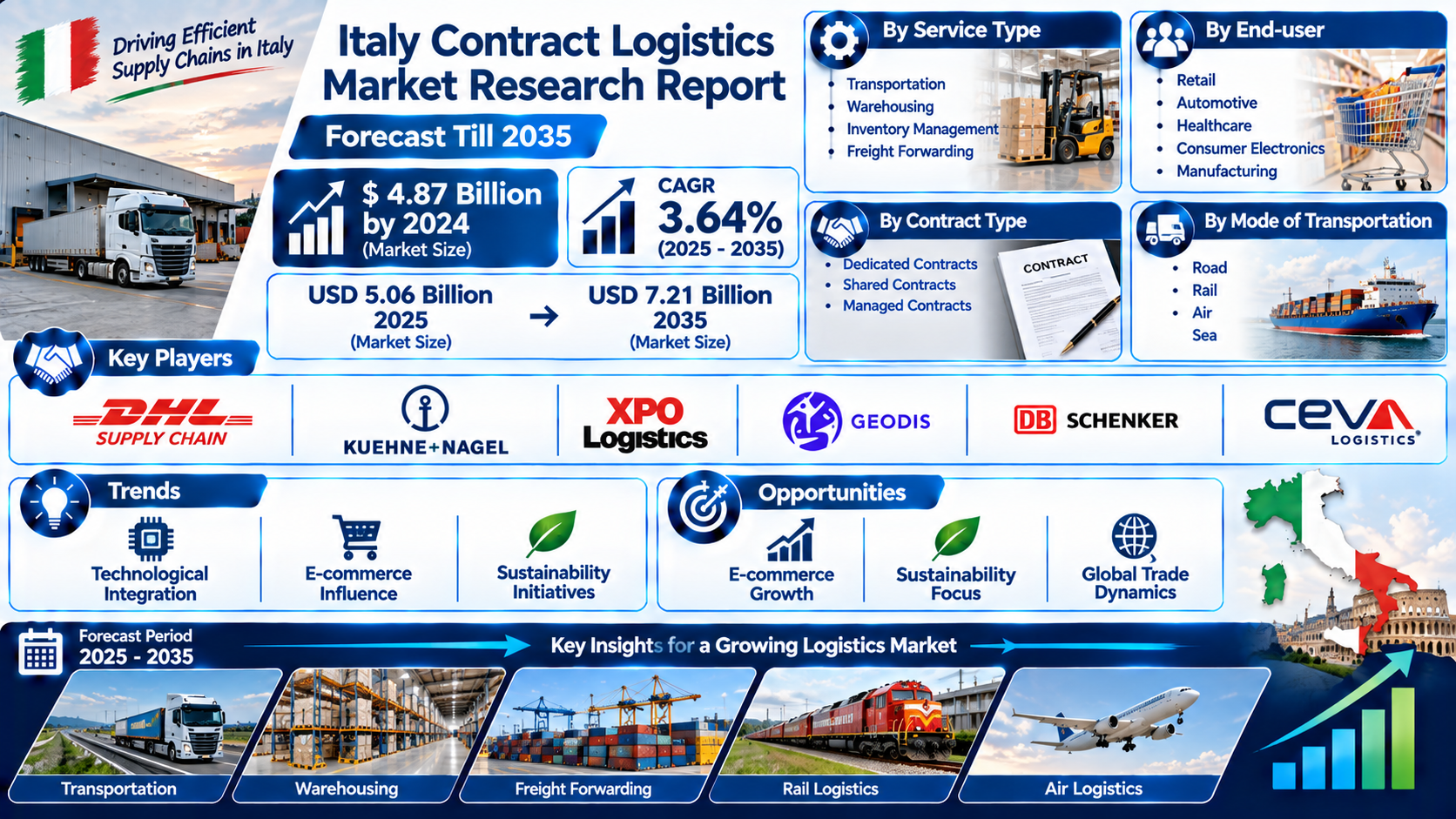
According to Market Research Future® (MRFR), the Italy Contract Logistics Market is expected to expand from USD 5.06 billion in 2025 to USD 7.21 billion by 2035, following a CAGR of 3.64% over the forecast period. The market's 2024 valuation was USD 4.87 billion. Growth is connected to the increasing use of outsourced logistics services by businesses seeking coordinated transportation, warehousing, inventory management and freight forwarding. E-commerce activity, digital transformation and sustainability priorities are also influencing service models and investment decisions across Italy's logistics sector.
The Role of Contract Logistics in Italy
Contract logistics gives businesses access to specialized supply chain services through agreements with external providers. Rather than managing every logistics activity independently, companies can outsource selected functions or broader operational responsibilities. Depending on the contract, these services may include storage, inventory control, shipment coordination, transportation and freight forwarding.
For Italian businesses, these arrangements can support supply chains serving domestic customers as well as international markets. Retailers need distribution systems that can handle changing order volumes, while manufacturers require dependable movement of materials and finished products. Automotive, healthcare and consumer electronics companies also have specific logistics requirements that can influence the design of outsourced services.
The market's structure reflects this diversity. MRFR identifies service type, end-user industry, contract type and transportation mode as the principal segmentation categories.
E-commerce and Changing Distribution Requirements
E-commerce growth is a major opportunity for the Italy contract logistics market. Online retail requires businesses to coordinate inventory availability, warehouse operations, order preparation and delivery. These activities must work together to meet customer expectations while controlling fulfillment costs.
Contract logistics providers can support online retailers through warehousing, inventory management and transportation services. Integrated arrangements may help businesses coordinate stock across distribution locations and organize product movement more efficiently. As e-commerce operations develop, demand may increase for providers that can adapt logistics capacity and service processes to changing business requirements.
The influence of e-commerce extends beyond retail. Manufacturers and consumer electronics businesses may also use digital sales channels and more varied distribution models. This can increase the need for logistics partners capable of managing inventory and shipments across multiple routes to market.
Technology as a Source of Operational Improvement
Technological integration is reshaping logistics management. Digital systems can help providers monitor inventory, coordinate warehouse activities, plan transportation and track shipments. Access to timely operational information can support decision-making and improve visibility across supply chain processes.
Warehouse and transport management platforms are relevant to the market because they connect activities that may otherwise be handled through separate systems. Better coordination can help providers identify delays, monitor stock movements and organize resources. Technology adoption can also support customer reporting and communication.
Nevertheless, digital transformation requires investment, employee training and integration with customer systems. Logistics providers must evaluate technology according to operational needs and ensure that digital tools support reliable service delivery. The ability to combine technology with practical logistics expertise can be an important competitive factor.
Sustainability and Supply Chain Efficiency
Sustainability initiatives are becoming increasingly relevant to logistics strategies. Transportation networks, warehouse operations and distribution planning all influence the resources required to move and store goods. Providers can explore route optimization, better vehicle utilization, efficient facility management and improved coordination to support operational and environmental objectives.
The sustainability focus also creates opportunities for logistics providers to work with customers seeking more efficient supply chain arrangements. Transport mode selection is one consideration. Road, rail, air and sea each have different cost, timing and operational characteristics. Choosing an appropriate combination can help businesses balance delivery requirements with efficiency objectives.
Sustainability measures must also remain commercially practical. Providers need to consider infrastructure, shipment volumes, customer expectations and the operating characteristics of different goods when developing solutions.
Services and Contract Models
The service-type segment includes transportation, warehousing, inventory management and freight forwarding. Transportation covers the movement of goods through domestic and international networks. Warehousing provides storage and handling capacity, while inventory management supports stock monitoring and replenishment planning. Freight forwarding coordinates shipment arrangements and related logistics activities.
Contract type is another defining feature of the market. Dedicated contracts are structured around the requirements of a particular customer. Shared contracts allow logistics resources to serve multiple customers, while managed contracts can involve broader responsibility for coordinating logistics operations. The appropriate arrangement depends on a company's shipment profile, service expectations, operational complexity and desired level of control.
End-User Industries
Retail is an important customer group because of its distribution and fulfillment requirements. Automotive businesses need logistics support for components, materials and finished vehicles, while manufacturing companies depend on reliable supply chain coordination to support production and distribution.
Healthcare customers may require logistics arrangements that address product handling and delivery specifications. Consumer electronics companies can have complex inventory and distribution needs due to product variety and changing demand. These differing requirements create opportunities for providers to develop specialized services rather than relying on a single standardized operating model.
Transportation Modes
The market includes road, rail, air and sea transportation. Road transport supports flexible movement across domestic distribution networks. Rail can serve suitable freight routes and shipment profiles, while air transport is relevant where delivery speed is a priority. Sea transport supports international freight movements and larger shipments.
The selection of transport mode depends on shipment characteristics, destination, timing, cost and customer requirements. Contract logistics providers may coordinate multiple modes as part of an integrated service arrangement, helping businesses manage movement across different stages of the supply chain.
Competitive Landscape
Key companies identified in the report include DHL Supply Chain, Kuehne + Nagel, XPO Logistics, Geodis, DB Schenker and CEVA Logistics. Competition is influenced by logistics infrastructure, service reliability, technology integration, customer relationships and the ability to provide tailored contracts.
Providers must demonstrate that they can manage customer requirements across transportation, storage and inventory-related activities. Their ability to coordinate multiple services and maintain consistent operational performance can influence their position in the market.
Opportunities and Market Outlook
The report highlights e-commerce growth, sustainability focus and global trade dynamics as major opportunities. Online retail can increase demand for coordinated fulfillment and distribution, while sustainability initiatives encourage providers to review transport networks and facility operations. Global trade activity creates requirements for freight forwarding and connections between domestic and international supply chains.
The market is forecast to increase from USD 4.87 billion in 2024 to USD 7.21 billion in 2035, with the 2025 valuation estimated at USD 5.06 billion and a projected CAGR of 3.64% for 2025–2035. These figures indicate steady expansion in demand for outsourced logistics services.
Italy's contract logistics sector will continue to be shaped by how providers respond to digital adoption, e-commerce requirements and sustainability priorities. Companies that combine flexible contract structures with reliable transportation, warehousing and inventory services may be well placed to address the changing needs of Italian businesses.

