

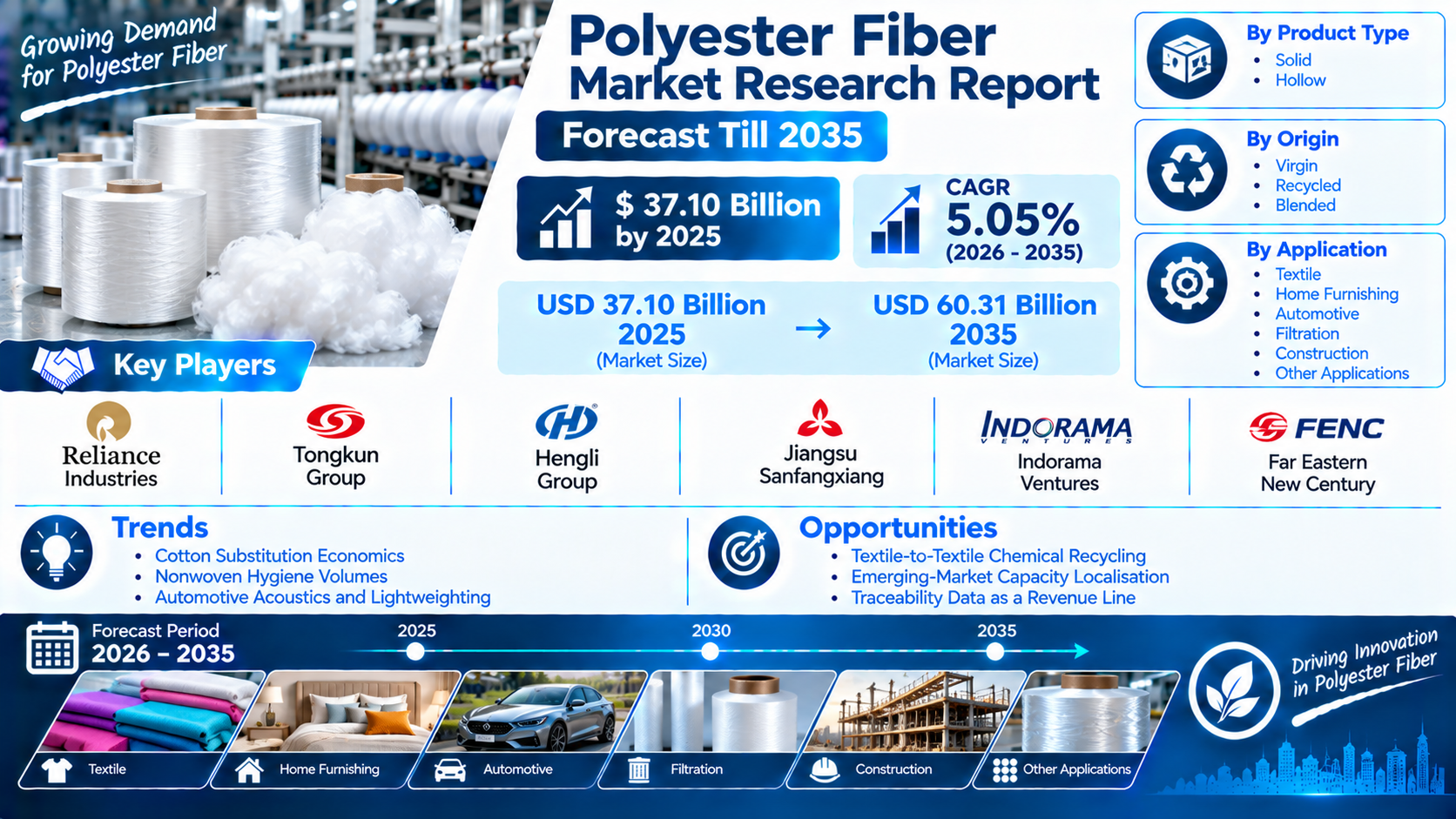

According to Market Research Future® (MRFR), the Polyester Fiber Market is projected to grow from USD 37.10 billion in 2025 to USD 60.31 billion by 2035, registering a compound annual growth rate (CAGR) of 5.05% during the forecast period from 2026 to 2035. Polyester fiber holds an important position in the global materials industry because of its broad use in textiles, home furnishings, automotive components, filtration, construction and other applications. Its market outlook is influenced by demand for versatile synthetic fibers, production economics, changing consumer preferences and the growing importance of recycled material inputs.
Textile Demand and Cotton Substitution Economics
Textiles remain a significant application area for polyester fiber. Apparel, fabrics and other textile products rely on fibers that can meet requirements for durability, processing efficiency, appearance and cost. Polyester's established role in textile manufacturing supports its continued use across a wide range of products. Its commercial appeal is also connected to cotton substitution economics, as manufacturers assess the relative costs, availability and performance characteristics of natural and synthetic fibers when selecting raw materials.
Changes in cotton prices and supply conditions can influence purchasing decisions, although substitution depends on the intended product and its specifications. Blended fabrics provide manufacturers with another option, combining polyester with other fibers to achieve desired characteristics. Demand is therefore shaped not only by overall textile production but also by the balance between virgin polyester, recycled inputs and blended materials. Producers must respond to customer requirements while managing raw-material costs and manufacturing efficiency.
Product Types and Fiber Origins
The market is segmented by product type into solid and hollow polyester fibers. Solid fibers serve a range of applications where consistent structure and material characteristics are required. Hollow fibers have a different internal structure that can make them suitable for selected applications in which properties such as bulk, insulation or weight are relevant. Product selection depends on end-use specifications, manufacturing processes and the performance expected from the finished material.
Origin is another important market dimension, comprising virgin, recycled and blended polyester fibers. Virgin polyester is produced from primary raw materials and remains part of the industry's established supply base. Recycled polyester provides an alternative input route by using recovered materials, including suitable post-consumer or post-industrial polyester waste. Blended fibers combine different material inputs to meet particular production and product requirements.
The growing focus on circular material use is encouraging attention toward recycling technologies and feedstock quality. However, recycled fiber production requires effective collection, sorting, processing and quality-control systems. Textile-to-textile recycling is a notable opportunity because it aims to return used textile materials to fiber production rather than relying only on other waste streams. Scaling this approach requires technological development and coordination across textile manufacturers, recyclers and collection networks.
Nonwoven Hygiene and Industrial Applications
Beyond conventional textiles, polyester fiber serves several industrial and consumer applications. Nonwoven hygiene volumes provide a demand area in which fiber selection is influenced by product design, consistency and processing requirements. Filtration applications also require materials suited to particular filtration conditions and operating environments. Construction uses can include selected fiber-based materials, while home furnishing applications encompass products such as filling materials and fabrics.
Automotive applications offer another source of demand. Polyester fibers can be incorporated into interior materials and components where manufacturers consider acoustic performance, weight and durability. Automotive acoustics and lightweighting are relevant industry trends as vehicle producers evaluate materials that support their design and manufacturing objectives. The suitability of a fiber depends on the specific component, technical requirements and applicable standards.
Recycling and Manufacturing Innovation
Sustainability is becoming a more prominent consideration in polyester fiber production. Textile-to-textile chemical recycling offers an opportunity to recover polyester from used textiles and process it into material that can re-enter manufacturing. Compared with recycling pathways that rely on other feedstocks, this approach is intended to strengthen circularity within the textile value chain. Its commercial development depends on process economics, collection infrastructure, sorting accuracy and the ability to produce fiber that meets required specifications.
Manufacturers are also examining ways to improve production efficiency and resource utilization. Advances in processing, quality monitoring and material handling can support consistent output and help manage operational costs. Traceability data is emerging as a potential revenue line, as customers seek greater visibility into material origin, recycled content and supply-chain practices. Reliable documentation can help suppliers respond to procurement requirements and demonstrate product attributes, provided that the information is accurate and verifiable.
Regional Capacity and Competitive Landscape
Emerging-market capacity localisation represents another opportunity for the industry. Establishing or expanding production closer to major customer markets can help manufacturers respond to local demand, manage logistics and improve supply-chain resilience. Investment decisions nevertheless depend on infrastructure, energy and feedstock availability, workforce capabilities, trade conditions and the economics of operating production facilities.
Key companies identified in the market include Reliance Industries, Tongkun Group, Hengli Group, Jiangsu Sanfangxiang, Indorama Ventures and Far Eastern New Century. Competition involves production scale, cost management, product quality, technological capabilities and access to customers across textile and industrial applications. Companies are also responding to the changing balance between virgin and recycled materials, as buyers evaluate sourcing practices alongside price and performance.
Market Outlook Through 2035
The Polyester Fiber Market is forecast to reach USD 60.31 billion by 2035, rising from USD 37.10 billion in 2025 at a CAGR of 5.05% over 2026–2035. Textile manufacturing, nonwoven hygiene demand, automotive applications and industrial uses are expected to remain important areas of market activity. At the same time, chemical recycling, localized capacity and supply-chain traceability offer opportunities for industry participants. Companies that combine efficient manufacturing with consistent product quality and credible material sourcing practices will be better positioned to address evolving customer requirements.

