

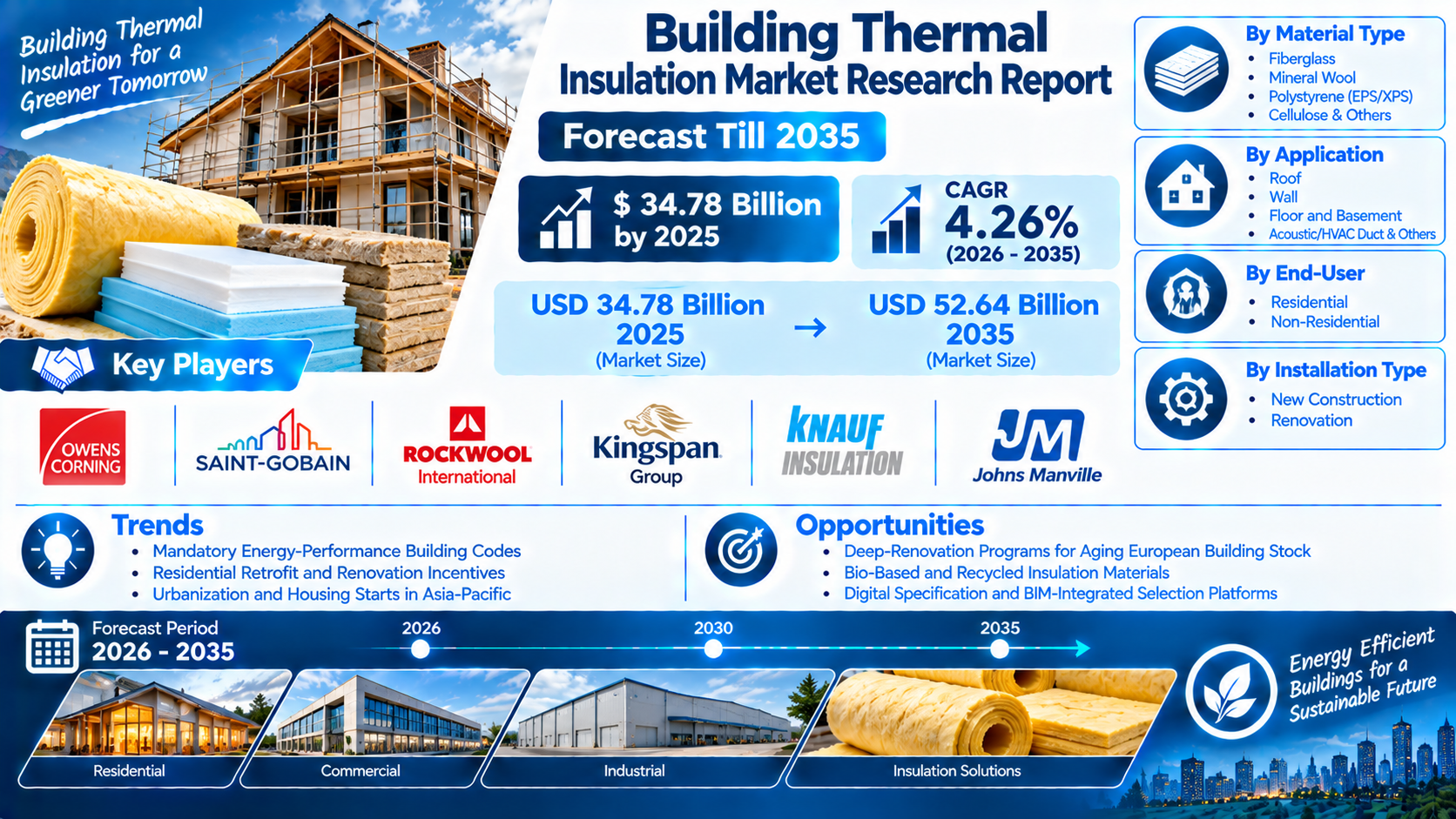

According to Market Research Future® (MRFR), the Building Thermal Insulation Market is projected to increase from USD 34.78 billion in 2025 to USD 52.64 billion by 2035, registering a compound annual growth rate (CAGR) of 4.26% during the forecast period from 2026 to 2035. Thermal insulation is an important component of building design because it helps limit unwanted heat transfer through roofs, walls, floors and other building elements. Demand is influenced by energy-performance requirements, construction activity, renovation programs and growing attention to building efficiency. Material innovation and digital tools for product specification are also creating opportunities across the industry.
Energy Performance Standards Shape Market Demand
Building energy performance has become a significant consideration for property developers, owners and construction professionals. Thermal insulation can reduce heat transfer between indoor and outdoor environments, helping buildings maintain more stable internal temperatures. Depending on climate, building design and system efficiency, suitable insulation can also reduce the heating and cooling loads placed on HVAC equipment. These benefits make insulation relevant to both new construction and the improvement of existing buildings.
Mandatory energy-performance building codes are an important market trend. Governments and regulatory authorities increasingly establish requirements related to building energy use, thermal performance and construction quality. The specific rules differ by country and region, but compliance can influence material selection, insulation thickness, installation methods and building-envelope design. Manufacturers must therefore understand the standards applicable to their target markets and provide products that meet the required technical specifications.
Energy-performance requirements also affect the decisions of architects, engineers, contractors and building owners. Insulation is not selected on thermal performance alone. Fire behavior, moisture resistance, acoustic properties, durability, installation complexity and cost can all influence the choice of material. Suppliers that provide reliable technical information and application guidance can support specification decisions across different project types.
Material Choices Address Different Building Requirements
The market includes fiberglass, mineral wool, polystyrene in expanded and extruded forms (EPS/XPS), cellulose and other materials. Each category has distinct characteristics and application considerations. Fiberglass is widely used in building insulation and is available in forms suited to different parts of the building envelope. Mineral wool is selected for applications where thermal performance and other properties, including fire and acoustic characteristics, are relevant. Product performance depends on the specific formulation, density and installation quality.
Polystyrene insulation includes EPS and XPS products, which are used in selected roof, wall, floor and below-grade applications. Their suitability depends on factors such as moisture exposure, compressive strength and building design. Cellulose and other insulation materials provide additional options, including products made from recycled or alternative feedstocks. Material selection requires consideration of the building's climate conditions, intended use, applicable codes and overall project requirements.
Manufacturers are also responding to interest in bio-based and recycled insulation materials. These products can support efforts to diversify raw-material sources and improve resource utilization. However, their adoption depends on consistent quality, verified performance, fire and moisture characteristics, durability, availability and cost. Product claims must be supported by appropriate testing and certification.
Roof, Wall and Floor Applications
Thermal insulation is used across several building areas, including roofs, walls, floors and basements. Roof insulation is important because roofs can be exposed to substantial temperature variation and solar heat gain. Wall insulation helps limit heat transfer through the building envelope, while floor and basement insulation addresses thermal movement through lower building elements and spaces in contact with the ground.
Acoustic and HVAC duct applications extend the market beyond conventional envelope insulation. Certain insulation products can help manage sound transmission, while duct insulation can limit unwanted heat gain or loss as conditioned air moves through a building. The required product depends on system design, operating temperatures, acoustic objectives and relevant building standards.
Installation quality is essential to achieving the intended performance. Gaps, compression, moisture exposure and poorly managed junctions can reduce the effectiveness of insulation systems. Appropriate detailing around windows, doors, service penetrations and structural connections is therefore important. Contractors and specifiers must consider the complete building assembly rather than evaluating insulation materials in isolation.
Residential and Non-Residential Construction
Residential buildings are a major end-user category. Housing construction, energy-efficiency improvements and homeowner interest in indoor comfort can support demand for insulation products. Residential retrofit and renovation incentives are another important trend, as financial support or regulatory programs can encourage property owners to improve the energy performance of existing homes. The scale of activity depends on program design, eligibility, funding and the condition of the housing stock.
Non-residential buildings, including offices, commercial facilities, industrial properties and public buildings, also require insulation solutions. These projects can involve more complex technical specifications, larger building areas and different operational requirements. Energy consumption targets, occupant comfort and building-management considerations can influence product selection. Renovation activity in this segment can create demand where older buildings require upgrades to meet current performance expectations.
Urbanization and housing starts in Asia-Pacific provide another source of market opportunity. Expanding urban populations and housing development can increase the need for building materials, including thermal insulation. Demand will vary across countries according to construction investment, climate, building regulations, household purchasing power and the availability of qualified installation services.
New Construction and Renovation Opportunities
The market serves both new construction and renovation projects. New buildings allow insulation to be incorporated during the design and construction process, enabling coordinated decisions about the building envelope and HVAC requirements. Renovation projects can be more complex because insulation must be integrated with existing structures, moisture conditions and architectural constraints. The suitability of an upgrade depends on the building's condition and the performance improvements that can be achieved.
Deep-renovation programs for aging European building stock represent a significant opportunity. Older buildings may require extensive improvements to roofs, walls, floors and other components to improve energy performance. Such projects can support demand for insulation materials, installation services and technical assessment. Program effectiveness depends on financing, regulation, contractor capacity and the ability to manage disruption during construction.
Digital specification and Building Information Modeling (BIM)-integrated selection platforms are also emerging as opportunities. Digital tools can help architects and engineers compare product characteristics, coordinate building components and document material specifications. Accurate product data can improve decision-making and support collaboration among project participants. Manufacturers that provide reliable digital information may strengthen their position in specification-led projects.
Competitive Landscape and Outlook
Key companies identified in the market include Owens Corning, Saint-Gobain, ROCKWOOL International, Kingspan Group, Knauf Insulation and Johns Manville. Competition is shaped by product performance, manufacturing capacity, distribution networks, technical support and the ability to meet regional building requirements. Investment in sustainable materials and digital specification resources may also influence competitive positioning.
The Building Thermal Insulation Market is forecast to reach USD 52.64 billion by 2035, growing at a CAGR of 4.26% over 2026–2035. Energy-performance codes, residential retrofits, Asia-Pacific housing development and deep-renovation programs are expected to support demand. Bio-based materials, recycled insulation and BIM-integrated specification tools provide additional opportunities. Manufacturers that combine verified product performance, reliable technical guidance and adaptable material portfolios will be better positioned to serve changing building requirements.

