

Waterproofing Membrane Market Analysis: Liquid-Applied and Sheet-Based Solutions

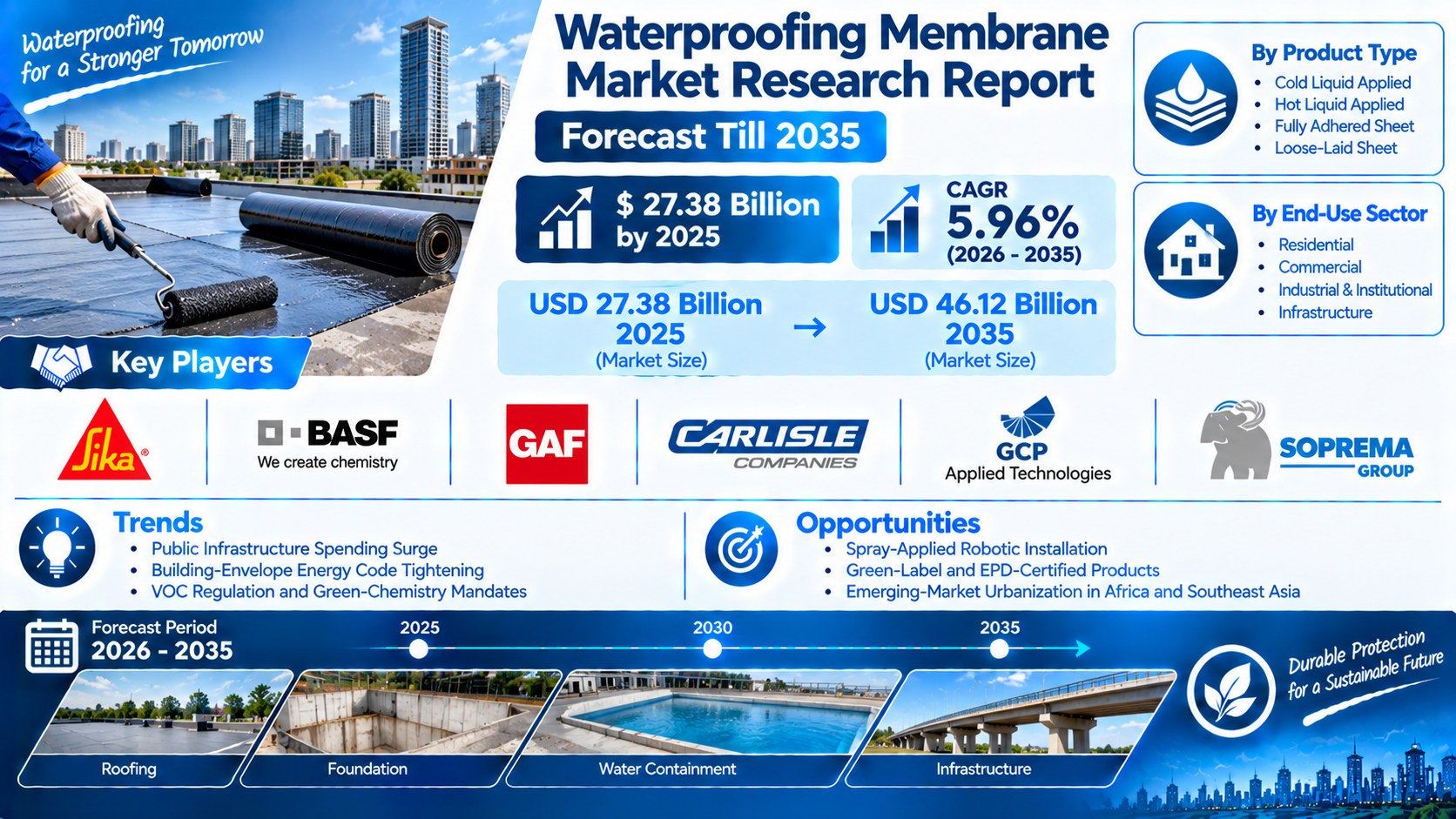
According to Market Research Future® (MRFR), the Waterproofing Membrane Market is expected to reach USD 46.12 Billion by 2035, increasing from USD 27.38 Billion in 2025. The market is forecast to record a CAGR of 5.96% between 2026 and 2035. Its development reflects the construction industry's continuing need to protect buildings and infrastructure from water penetration. Waterproofing membranes are used in different parts of the built environment, including foundations, roofs, basements and other exposed structures. Demand is supported by residential and commercial development, industrial construction, public infrastructure projects and growing attention to the durability of building materials.
A Market Supported by Long-Term Asset Protection
Waterproofing is an important consideration throughout the lifecycle of a building or infrastructure asset. Moisture entering through roofs, foundations or structural joints can lead to deterioration, dampness and recurring maintenance requirements. Membranes provide a protective layer that helps limit water ingress when correctly specified and installed. As a result, they are relevant not only to new construction but also to renovation, refurbishment and repair work.
The market's growth is closely connected to public infrastructure spending. Government and infrastructure development projects require materials capable of protecting structures exposed to weather and ground moisture. Bridges, tunnels, transport facilities and other public assets can involve extensive waterproofing requirements. These projects create opportunities for manufacturers offering products suited to different substrates, installation methods and construction conditions.
Building-envelope energy code tightening is also influencing the construction environment. Developers and project teams are paying greater attention to how building components work together to meet evolving performance requirements. Waterproofing membranes form part of this wider building-envelope system, where coordination with roofing, insulation and other materials is important. Product selection increasingly involves evaluating compatibility, application conditions and long-term maintenance considerations rather than considering the membrane as an isolated material.
Product Categories and Their Applications
Cold liquid applied membranes are one of the major product categories. These materials are applied in liquid form and create a continuous layer after curing. Their ability to cover irregular surfaces and detailed areas makes them useful where conventional sheet installation may require additional cutting or joint treatment. Surface preparation, application thickness and curing conditions are important to achieving the intended waterproofing performance.
Hot liquid applied membranes serve projects that specify heated liquid systems. Their installation involves controlled heating and application procedures, requiring appropriate equipment and trained workers. Project teams must consider the substrate, site conditions and product requirements when determining whether this category is suitable.
Sheet-based products are represented by fully adhered sheet and loose-laid sheet membranes. Fully adhered systems are bonded to the substrate, helping maintain contact between the membrane and the underlying surface. This approach may be preferred where the project design calls for an adhered waterproofing layer. Loose-laid sheet membranes are installed without full-surface bonding and rely on the specified system design and securing details. Both categories require careful treatment of seams, penetrations, edges and transitions to maintain continuity across the protected area.
The availability of multiple product types allows contractors and specifiers to select systems according to construction design, substrate conditions, installation access and project specifications. This diversity also encourages manufacturers to serve a wide range of applications rather than relying on a single membrane format.
End-Use Sectors Shape Market Demand
Residential construction contributes to demand through housing development and the maintenance of existing properties. Waterproofing is relevant to roofs, terraces, balconies, foundations and other areas exposed to water. In residential projects, effective installation can help reduce moisture-related problems and support the durability of the building envelope. Renovation activity creates an additional source of demand when older waterproofing layers need replacement or repair.
Commercial buildings require protection across roofs, podiums, basements and service areas. Offices, retail properties and other commercial facilities may have extensive roof areas and complex building layouts, making membrane selection and installation planning important. Industrial and institutional projects also require waterproofing solutions that align with their specific building functions, operating conditions and maintenance needs.
Infrastructure represents a further end-use sector with requirements that can differ from conventional building projects. Transport and public works may involve large surfaces, below-ground structures and areas exposed to changing environmental conditions. The scale and technical requirements of these projects create opportunities for suppliers with products that meet project-specific design and installation criteria.
Sustainability, Regulation and Technology
VOC regulation and green-chemistry mandates are encouraging manufacturers to consider the environmental characteristics of waterproofing formulations. Product development is increasingly influenced by regulatory requirements and procurement expectations related to material composition. Green-label and EPD-certified products offer an opportunity to provide more transparent environmental information. Such documentation can help project teams compare materials and assess whether products meet sustainability-related specifications.
The shift toward documented product characteristics may also influence competition. Manufacturers that can provide relevant technical information, environmental declarations and application guidance may be better positioned in projects where sustainability criteria form part of procurement. However, product selection still needs to account for performance requirements, substrate compatibility and installation conditions.
Spray-applied robotic installation is another opportunity with potential to change selected application processes. Robotics may support more consistent coverage and help manage repetitive work, particularly across larger project areas. The practical value of automation will depend on the nature of the surface, site accessibility, equipment capabilities and the availability of trained operators. It is therefore likely to complement rather than automatically replace established installation methods across all project types.
Regional Development and Competitive Positioning
Emerging-market urbanization in Africa and Southeast Asia offers opportunities as expanding cities require housing, commercial properties and infrastructure. New development increases the need for construction materials that can protect assets from water exposure. At the same time, existing buildings in established markets create demand through maintenance and renovation.
The market includes Sika AG, BASF SE, GAF, Carlisle Companies, GCP Applied Technologies and Soprema Group. Competition involves the ability to serve different product categories and end-use requirements while responding to changing environmental expectations and construction specifications. Technical support, product suitability and installation guidance are relevant considerations for contractors and project owners evaluating membrane systems.
Outlook Through 2035
The waterproofing membrane market is projected to grow at a CAGR of 5.96% from 2026 to 2035, with its value increasing from USD 27.38 Billion in 2025 to USD 46.12 Billion by 2035. Infrastructure spending, building-envelope requirements and urban construction are expected to remain important demand influences. Opportunities in robotic spray application and environmentally documented products may further shape product development and market positioning. As construction stakeholders place greater emphasis on asset protection and material selection, waterproofing membranes are expected to remain an important part of building and infrastructure projects.

