

India Biomass Pellets Market Growth Driven by Agricultural Residue Utilization and Renewable Energy Initiatives

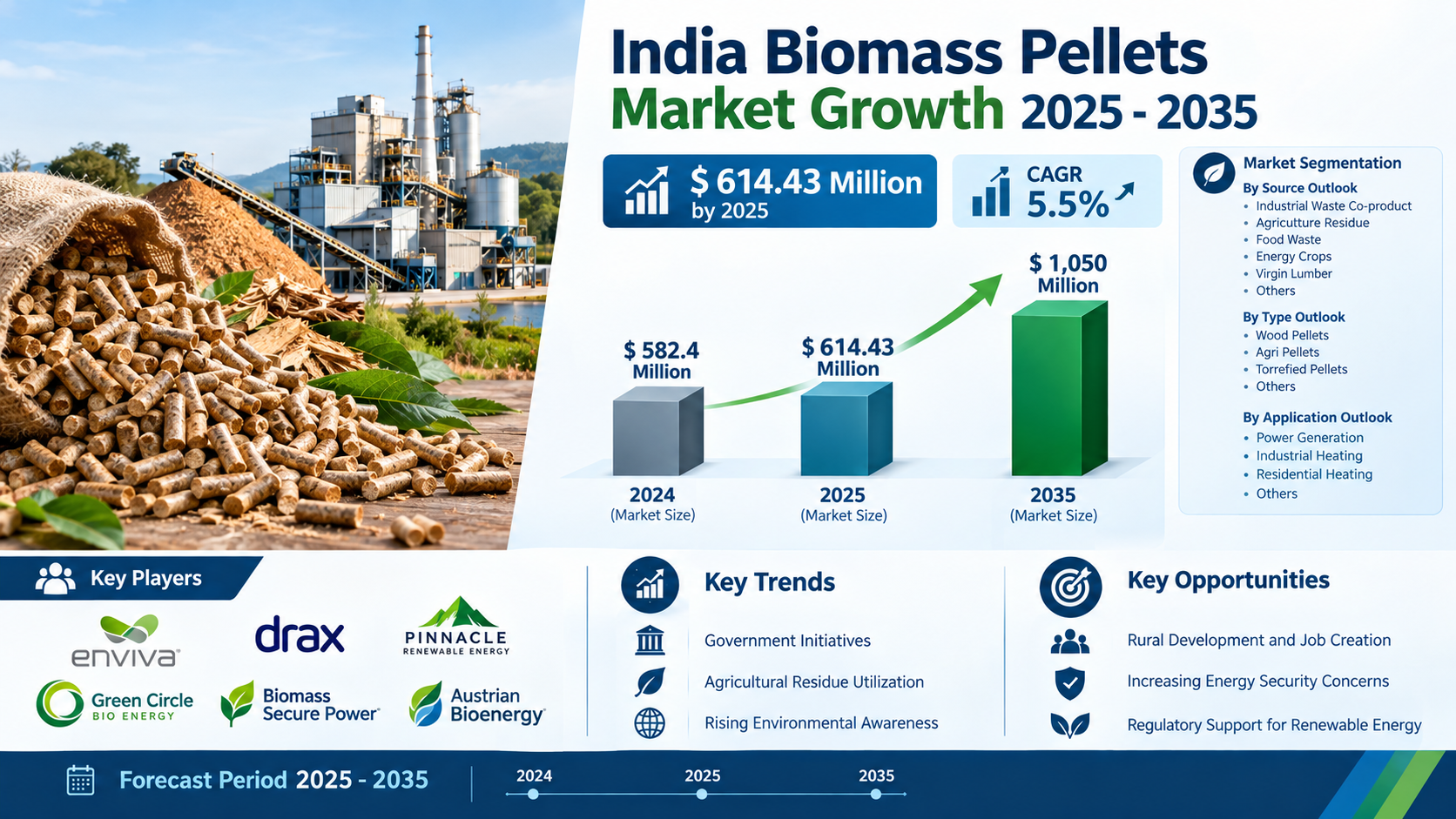
According to Market Research Future® (MRFR), the India Biomass Pellets Market was valued at USD 582.4 million in 2024 and is estimated to reach USD 614.43 million in 2025. The market is projected to grow to USD 1,050 million by 2035, registering a compound annual growth rate (CAGR) of 5.5% during the 2025–2035 forecast period. Increasing attention to renewable energy, government initiatives, and the utilization of agricultural residues are supporting the development of biomass pellets as an alternative fuel. Growing energy security concerns and the potential for rural employment are also creating opportunities across India's biomass supply chain.
Market Overview
Biomass pellets are compacted solid fuels produced from organic materials, including agricultural residues, industrial waste co-products, food waste, and wood-based resources. Their standardized form makes them suitable for handling, storage, transportation, and use in compatible heating and power generation systems. In India, the availability of agricultural residues and other biomass resources provides a foundation for developing a domestic pellet industry.
The market's development is connected to efforts to diversify energy sources and improve the productive use of organic materials. Agricultural residues can have value beyond their conventional uses when collected and processed into fuel. Converting suitable biomass into pellets can support more organized resource utilization while creating commercial activity around collection, processing, and distribution. However, the availability of feedstock, seasonal variations, transportation costs, and processing requirements remain important considerations for producers.
Key Drivers Supporting Market Growth
Government initiatives are an important factor influencing the market. Policy attention toward renewable energy and alternative fuels can encourage investment in biomass processing and the adoption of pellet-based energy solutions. Supportive regulatory measures can also improve awareness among industrial and power-sector users. The effectiveness of these initiatives depends on implementation, infrastructure availability, and the ability of producers to supply pellets that meet user specifications.
Agricultural residue utilization is another central growth driver. India's agricultural activity generates different types of crop residues that may be suitable for biomass applications, depending on their composition, moisture content, availability, and competing uses. Processing appropriate residues into pellets can create an additional value chain for agricultural by-products. It can also help connect farmers, aggregators, pellet manufacturers, transport providers, and energy consumers.
Rising environmental awareness is encouraging businesses and institutions to assess alternatives to conventional fossil fuels. Biomass pellets can provide a renewable fuel option when sourced and produced responsibly. Their environmental performance, however, depends on the feedstock's origin, processing energy, transport distances, combustion technology, and emissions controls. Reliable sourcing and efficient end-use systems are therefore important to achieving the intended environmental benefits.
Market Segmentation
The India Biomass Pellets Market is segmented by source, type, and application. These categories reflect differences in raw material availability, pellet characteristics, and end-user requirements.
By source, the market includes industrial waste co-product, agriculture residue, food waste, energy crops, virgin lumber, and others. Agricultural residue is particularly relevant to India's resource base, while industrial waste co-products and food waste offer additional feedstock possibilities where collection and processing systems are commercially viable. Energy crops and virgin lumber represent other potential sources, although their use depends on land availability, sustainability considerations, and competition with alternative applications.
By type, the market covers wood pellets, agri pellets, torrefied pellets, and others. Wood pellets are manufactured from wood-based materials, whereas agri pellets use agricultural residues. Torrefied pellets undergo a thermal treatment process that changes certain fuel properties and can influence storage, handling, and combustion characteristics. The suitability of each type depends on equipment compatibility, fuel specifications, and customer requirements.
By application, the market is divided into power generation, industrial heating, residential heating, and others. Power generation represents an important potential outlet for biomass pellets, particularly where facilities are equipped or adapted to use solid biomass fuels. Industrial heating offers another opportunity, as manufacturers assess fuel alternatives for suitable thermal processes. Residential heating provides a separate application category, with adoption influenced by affordability, availability, equipment compatibility, and local heating needs.
Industrial Heating and Power Generation Opportunities
Power generation and industrial heating can support demand as energy users explore ways to diversify fuel inputs. Biomass pellets offer a relatively standardized form of solid fuel, which can simplify some aspects of storage and handling compared with loose biomass. Their use nevertheless requires appropriate combustion systems, fuel-quality controls, and operational planning.
Industrial facilities may consider biomass pellets where process temperatures, equipment design, and fuel characteristics are compatible. The economics of adoption depend on pellet prices, transport distances, conversion requirements, and the cost of competing fuels. Power producers must similarly evaluate fuel consistency, supply security, combustion performance, and emissions management before increasing biomass use.
Rural Development and Energy Security
Rural development and job creation represent significant market opportunities. A functioning biomass pellet supply chain can generate activities in residue collection, aggregation, drying, processing, packaging, transportation, and equipment maintenance. These activities may create income opportunities in agricultural regions, particularly when local producers and suppliers participate in the value chain.
Energy security concerns provide another reason to develop domestic biomass resources. A diversified energy mix can reduce dependence on a narrow range of fuel sources, although biomass pellets are not a universal substitute for conventional energy. Their contribution depends on reliable feedstock supply, competitive production costs, suitable infrastructure, and consistent demand from end users. Regulatory support for renewable energy can help strengthen the commercial environment for these investments.
Competitive Landscape
The market's key players include Enviva, Drax Group, Pinnacle Renewable Energy, Green Circle Bio Energy, Biomass Secure Power, and Austrian Bioenergy. These companies are identified in the report's competitive landscape. Competition in the Indian market can involve feedstock sourcing, production efficiency, pellet quality, distribution capabilities, and relationships with power producers and industrial customers.
Manufacturers must manage raw material procurement and processing costs while maintaining consistent product specifications. Supply reliability is especially important for large energy users that require regular fuel deliveries. Partnerships across the agricultural, logistics, and energy sectors can support more dependable sourcing and distribution arrangements.
Market Outlook Through 2035
The India Biomass Pellets Market is forecast to increase from USD 614.43 million in 2025 to USD 1,050 million by 2035, at a CAGR of 5.5%. Government initiatives, agricultural residue utilization, and rising environmental awareness are expected to remain important influences on market development. Opportunities associated with rural employment, energy security, and regulatory support further strengthen the industry's potential.
Long-term progress will depend on converting feedstock availability into a dependable commercial supply chain. Investments in collection networks, processing facilities, storage, transport, and compatible end-use equipment will be important to expanding adoption. As producers and energy consumers address these practical requirements, biomass pellets could play a more established role in India's renewable energy landscape.

