

Global Fuel Additive Market Growth Driven by Fuel Efficiency and Emission Standards

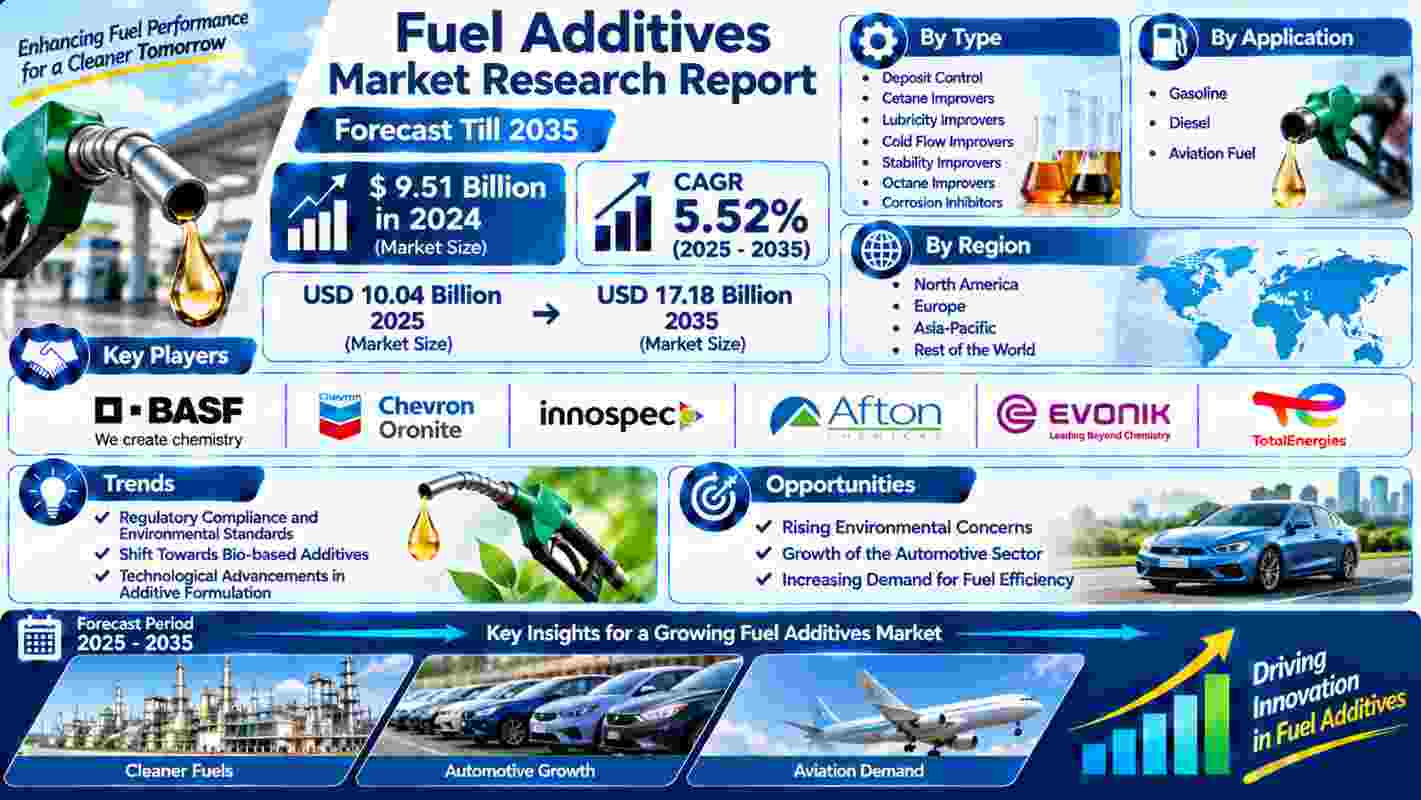
According to Market Research Future® (MRFR), the Fuel Additive Market is projected to expand as fuel producers, vehicle manufacturers, and transportation operators place greater emphasis on fuel efficiency, engine performance, and compliance with environmental standards. The market was valued at USD 9.51 billion in 2024 and is estimated to reach USD 10.04 billion in 2025. By 2035, its value is expected to rise to USD 17.18 billion, registering a compound annual growth rate (CAGR) of 5.52% during the forecast period from 2025 to 2035. Demand across gasoline, diesel, and aviation fuel applications, alongside advances in additive formulation, is expected to support this growth.
Market Drivers and Industry Developments
Fuel additives are chemical compounds blended with fuels to improve selected performance characteristics, protect fuel systems, or address operating challenges. Their functions vary according to formulation and fuel type. Additives can help control deposits, improve ignition characteristics, enhance lubricity, support low-temperature performance, maintain fuel stability, increase octane ratings, and inhibit corrosion. These functions make additives relevant to fuel suppliers and users seeking consistent performance under different operating conditions.
Environmental standards and regulatory compliance are important influences on market development. Fuel quality requirements and emissions-related regulations encourage refiners and fuel distributors to evaluate formulations that support cleaner and more efficient combustion. Additives can contribute to specific fuel-performance objectives, although their effectiveness depends on the fuel composition, engine technology, dosage, and operating environment. Regulatory requirements also vary by market, creating demand for products that meet applicable fuel specifications.
The automotive sector provides a significant opportunity for additive suppliers. Vehicle use and fuel consumption create ongoing requirements for gasoline and diesel products that meet performance and quality expectations. As manufacturers and operators seek to improve engine efficiency and maintain fuel-system performance, deposit control, lubricity, and ignition-related additives remain important product categories. The transition toward alternative powertrains may influence long-term fuel demand, but conventional fuels continue to serve a broad range of vehicles and commercial transportation activities.
Product Types and Their Functions
The market is segmented by type into Deposit Control, Cetane Improvers, Lubricity Improvers, Cold Flow Improvers, Stability Improvers, Octane Improvers, and Corrosion Inhibitors. Each category addresses a different aspect of fuel quality or system performance.
Deposit control additives help manage the accumulation of deposits in fuel injectors and other engine components. Maintaining cleaner fuel delivery systems can support consistent engine operation. Cetane improvers are used in diesel fuel to enhance ignition quality, while lubricity improvers help compensate for reduced lubricating properties in certain fuel formulations. These additives are relevant to diesel engines, where fuel also plays a role in lubricating components of the injection system.
Cold flow improvers address the behavior of fuels at low temperatures. They can help manage issues associated with wax crystal formation in diesel fuel, supporting flow under colder operating conditions. Stability improvers help maintain fuel quality during storage and handling by limiting deterioration associated with oxidation and other processes. Octane improvers are used in gasoline to increase resistance to engine knocking, while corrosion inhibitors help protect fuel-system components from corrosive effects.
The selection of an additive depends on fuel specifications, operating conditions, storage requirements, and the performance objective. Fuel producers and distributors must ensure that formulations are compatible with the base fuel and comply with relevant quality standards.
Applications Across Gasoline, Diesel and Aviation Fuel
Gasoline represents an important application area, particularly for additives designed to control deposits, improve octane quality, support stability, and protect fuel-system components. The performance requirements of gasoline vary with engine design, fuel specifications, and regional standards. Additive formulations are therefore developed to address the needs of different vehicle categories and distribution systems.
Diesel applications include cetane improvers, lubricity improvers, cold flow improvers, stability improvers, and corrosion inhibitors. Commercial vehicles, industrial equipment, and other diesel-powered systems operate under varied load and temperature conditions. Fuel additives can help address specific challenges related to ignition, lubrication, storage, and low-temperature flow. Their use is especially relevant where fuel quality and equipment reliability are important operational considerations.
Aviation fuel represents another application segment with demanding quality and performance requirements. Aviation fuel must meet stringent specifications to support safe and reliable aircraft operation. Additives may be used for particular purposes, subject to applicable aviation fuel standards and approvals. The specialized nature of this application makes product consistency, testing, and regulatory compliance essential.
Sustainability and Formulation Innovation
The shift toward bio-based additives is an emerging market trend. Growing attention to environmental performance is encouraging manufacturers to explore renewable feedstocks and formulations that may reduce dependence on conventional petrochemical inputs. The commercial potential of bio-based products depends on their technical performance, production economics, availability of raw materials, and compatibility with existing fuel systems. Environmental benefits also need to be evaluated across the complete product lifecycle rather than assumed from feedstock origin alone.
Technological advancements in additive formulation are supporting the development of products designed for specific fuel compositions and operating requirements. Research focuses on improving additive effectiveness, compatibility, stability, and performance at appropriate treatment levels. Formulators must balance performance with cost, regulatory requirements, and the need to avoid adverse interactions with other fuel components.
Regional Market Outlook and Competitive Landscape
The market is analyzed across North America, Europe, Asia-Pacific, and the Rest of the World. Regional demand is shaped by vehicle fleets, fuel consumption, refining activity, transportation infrastructure, fuel-quality regulations, and environmental policies. Differences in climate also influence the need for particular formulations, especially cold flow improvers. Asia-Pacific offers opportunities linked to automotive and transportation activity, while established fuel markets in North America and Europe continue to emphasize fuel specifications and regulatory compliance.
Key participants include BASF SE, Chevron Oronite Company LLC, Innospec Inc., Afton Chemical Corporation, Evonik Industries AG, and TotalEnergies SE. Competition is influenced by formulation expertise, product performance, technical support, research investment, supply reliability, and relationships with refiners and fuel distributors.
Market Outlook Through 2035
The Fuel Additive Market is expected to benefit from continuing requirements for fuel quality, engine protection, and efficiency across gasoline, diesel, and aviation applications. Regulatory compliance, environmental concerns, bio-based additive development, and advances in formulation technology are likely to shape the industry's direction. With market value projected to increase from USD 10.04 billion in 2025 to USD 17.18 billion by 2035, the sector is forecast to register a CAGR of 5.52% during 2025–2035.

