

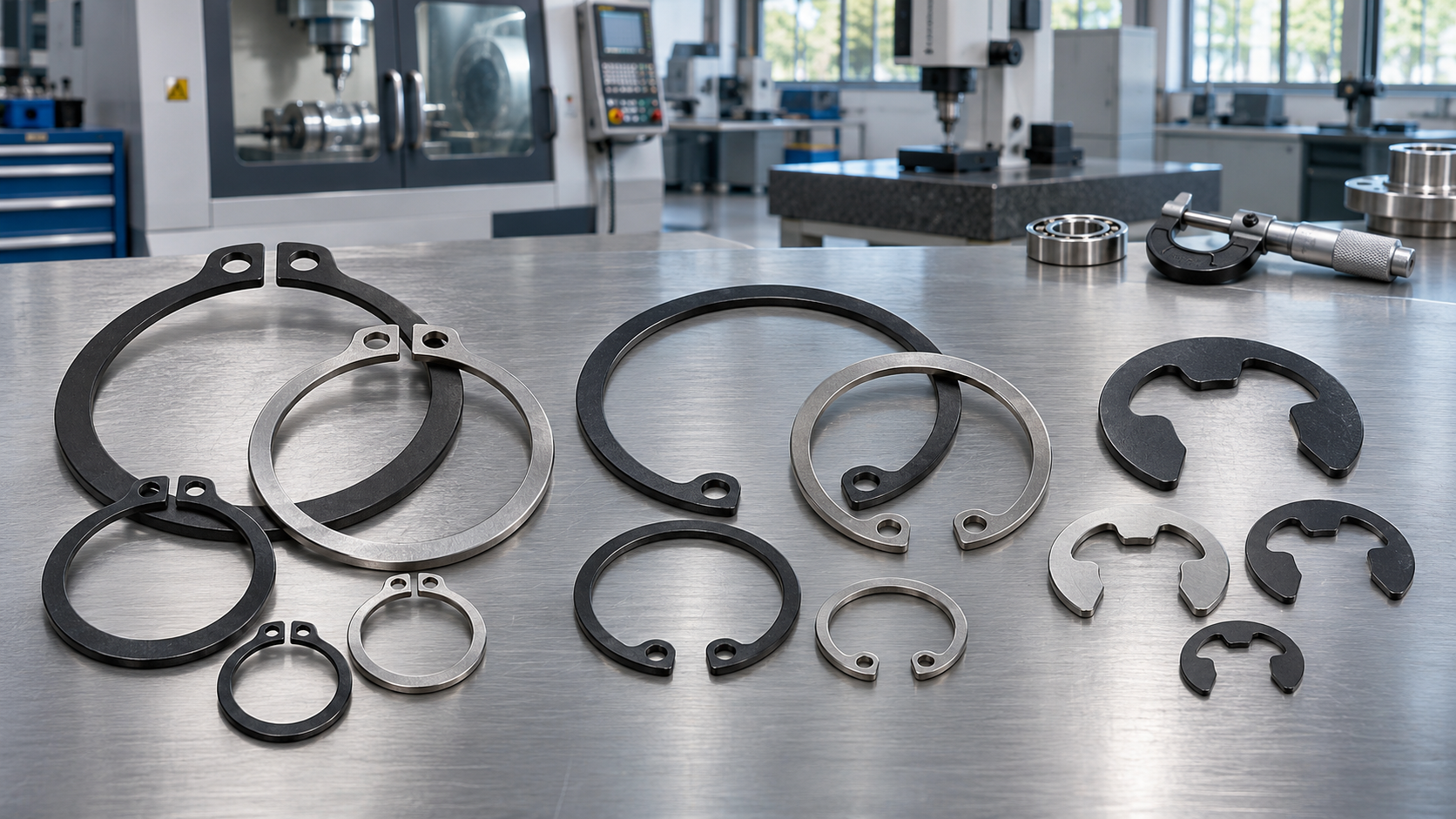

Modern industrial machinery depends on numerous components working together with precision. While large mechanical parts often receive the most attention, smaller components also play an important role in equipment performance. A Circlip is one such component that helps maintain the correct positioning of machine parts and prevents unwanted axial movement.
Used in automotive systems, industrial equipment, pumps, gearboxes, and mechanical assemblies, circlips provide a simple yet effective retaining solution. Their compact design, easy installation, and practical functionality make them an essential part of many engineering applications. However, selecting the right circlip requires attention to dimensions, material properties, operating conditions, and manufacturing quality.
Understanding the Role of Circlips in Mechanical Assemblies
A circlip is a semi-flexible retaining ring that fits into a specially designed groove on a shaft or inside a housing. Once installed, it creates a physical stop that keeps components in their intended positions.
Unlike conventional threaded fasteners, circlips do not require additional nuts or bolts for retention. This makes them particularly useful in compact mechanical assemblies where installation space and component weight are important considerations.
Their applications include retaining bearings, securing gears, positioning bushes, and supporting rotating mechanical components. A properly selected circlip helps maintain assembly stability and reduces the possibility of unwanted component displacement.
Common Types of Circlips and Their Applications
Different mechanical arrangements require different circlip designs. Understanding these variations helps engineers and purchasing professionals identify suitable products.
Internal Circlips
Internal circlips are designed to fit inside a cylindrical bore or housing. They are compressed during installation and expand into an internal groove. These rings are commonly used to retain bearings and other components within housings.
External Circlips
External circlips are fitted around shafts and installed by expanding the ring over the shaft. Once positioned inside the external groove, they help prevent components from moving axially.
They are frequently used in gear assemblies, automotive mechanisms, pumps, and industrial machinery.
E-Type Circlips
E-type circlips have a distinctive E-shaped design and are fitted radially into a shaft groove. Their compact construction makes them suitable for smaller mechanical assemblies where conventional retaining rings may not be practical.
Each type serves a specific purpose, making correct product selection essential for dependable assembly performance.
Factors That Influence Circlip Performance
The performance of a retaining ring depends on several engineering considerations. Choosing a product based only on its nominal diameter may lead to fitting difficulties or inadequate retention.
1. Dimensional accuracy
Shaft diameter, bore diameter, groove width, and groove depth must be considered. Correct dimensional compatibility helps ensure proper seating and retention.
2. Material properties
Spring steel is commonly selected for its strength and elastic properties. Stainless steel may be suitable for applications requiring improved corrosion resistance. Material selection should reflect the actual operating environment.
3. Mechanical loading
The circlip must be suitable for the forces experienced during equipment operation. Engineers should evaluate axial loads, vibration, rotational conditions, and other relevant application requirements.
4. Surface protection
Depending on environmental exposure, appropriate surface treatments may help protect against corrosion and improve service life.
5. Engineering standards
Standards such as DIN 471, DIN 472, and DIN 6799 cover different retaining-ring categories. Buyers should verify the applicable standard and product dimensions before ordering.
Industries That Depend on Circlips
Circlips are used across a wide range of industrial sectors because they provide compact and effective component-retention solutions.
-
Automotive manufacturing: Used in transmissions, gear systems, wheel assemblies, and other mechanical mechanisms.
-
Industrial machinery: Help secure shafts, bearings, and rotating components.
-
Agriculture: Used in tractors, agricultural machinery, pumps, and equipment assemblies.
-
Electrical equipment: Support the positioning of suitable motor and mechanical components.
-
Heavy engineering: Provide retaining solutions in industrial machines and mechanical systems.
Their versatility makes them valuable wherever controlled component positioning is necessary.
How to Choose Reliable Circlip Manufacturers and Suppliers
For industrial buyers, sourcing decisions directly influence product consistency, assembly efficiency, and maintenance requirements. Experienced Circlip Manufacturers should understand material selection, dimensional tolerances, manufacturing processes, and inspection requirements.
When evaluating potential Circlip Suppliers, procurement teams should consider more than product pricing.
Important factors include:
-
Availability of internal, external, and E-type circlips.
-
Consistent dimensional accuracy.
-
Clearly documented material specifications.
-
Quality inspection and testing procedures.
-
Availability of technical drawings and product information.
-
Ability to fulfil bulk and specific industrial requirements.
EASCO provides circlip solutions for industrial applications, offering product information to help buyers explore different retaining-ring options. Its circlip range can be considered by businesses looking for suitable components for mechanical and manufacturing requirements.
Why Quality Matters When Selecting Retaining Rings
Using an unsuitable retaining ring can create assembly problems, component displacement, and additional maintenance requirements. In applications involving rotating equipment or continuous operation, correct installation and product compatibility become particularly important.
Quality evaluation should include dimensional inspection, material verification, and checking whether the product meets the intended engineering specifications. Buyers should also ensure that the shaft or housing groove is designed according to the relevant retaining-ring requirements.
Selecting suitable products from dependable manufacturers supports consistent assembly quality and helps reduce avoidable production issues.
Conclusion
Circlips are small but essential components in modern mechanical engineering. Their ability to secure bearings, gears, shafts, and other machine parts makes them useful across automotive, manufacturing, agricultural, and heavy engineering industries.
Understanding the differences between internal, external, and E-type circlips helps buyers make better purchasing decisions. By considering material properties, dimensions, engineering standards, and quality-control practices, businesses can identify retaining rings suited to their applications.
Working with experienced manufacturers and reliable suppliers further supports consistent product quality and dependable industrial operations.
Frequently Asked Questions (FAQs)
1. What is a circlip used for in machinery?
A circlip prevents unwanted axial movement by securing components on shafts or inside housing bores.
2. Are circlips and retaining rings the same?
Yes. Circlip is another commonly used name for a retaining ring or snap ring. These components perform similar mechanical-retention functions.
3. Which circlip is used for shafts?
External circlips are generally used on shafts because they fit into external grooves and prevent components from sliding along the shaft.
4. What are the common materials used for circlips?
Spring steel and stainless steel are commonly used. The appropriate material depends on strength, corrosion resistance, and operating conditions.
5. What should buyers check before purchasing circlips?
Buyers should verify dimensions, material specifications, applicable standards, load requirements, surface finish, and manufacturing quality.
6. How can I find dependable circlip suppliers?
Evaluate suppliers based on their product range, technical knowledge, dimensional consistency, quality-control practices, and ability to meet industrial requirements.

