

US Interior Doors Industry Forecast 2035: Residential and Commercial Demand Outlook

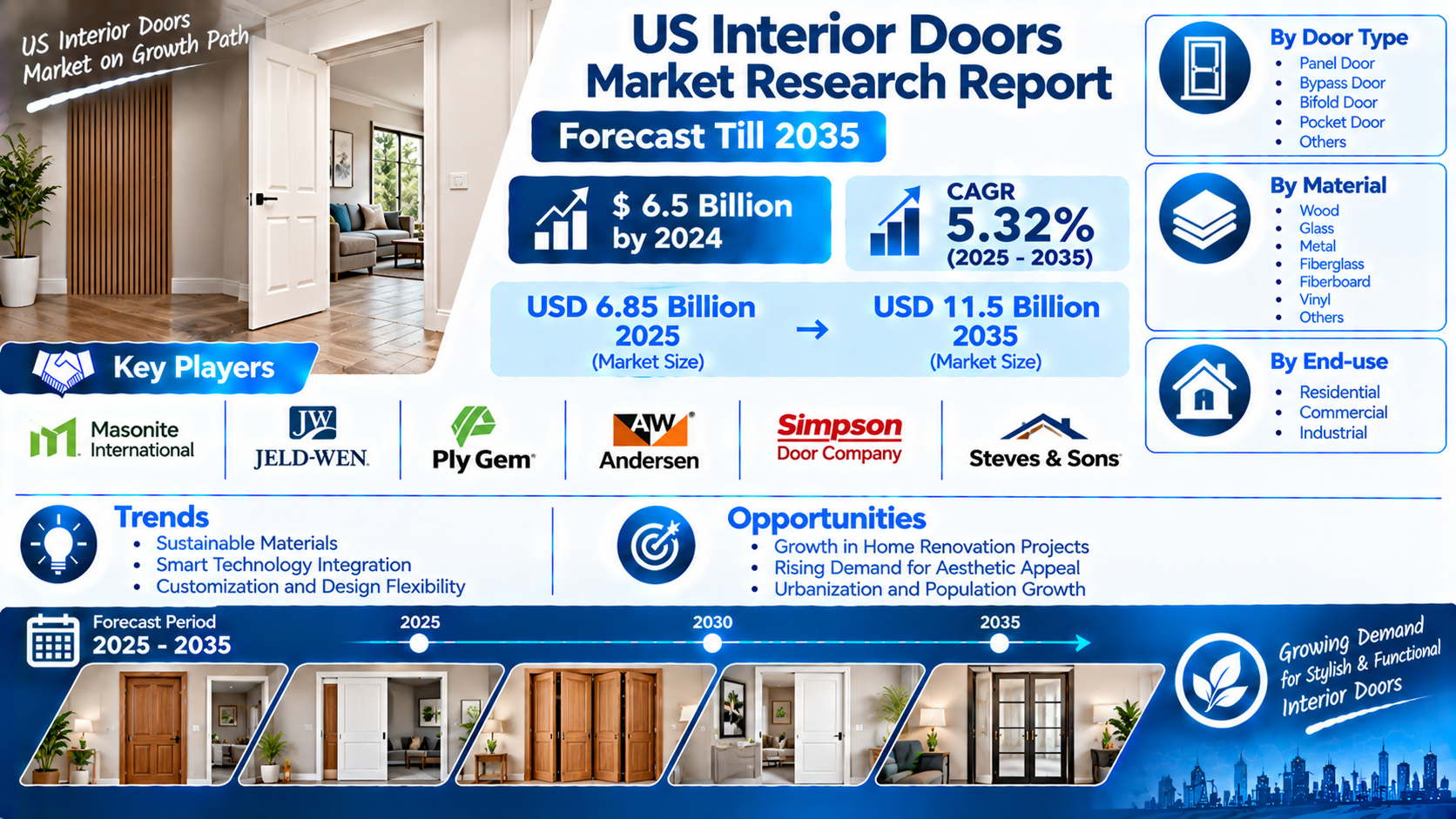
According to Market Research Future® (MRFR), the US Interior Doors Market is forecast to register steady growth through 2035, supported by housing activity, remodeling projects, and evolving expectations for interior design. Its value is projected to rise from USD 6.5 billion in 2024 to USD 6.85 billion in 2025, reaching USD 11.5 billion by 2035. This outlook represents a CAGR of 5.32% over the 2025–2035 forecast period. Demand is being shaped by the need for practical room separation, flexible layouts, sustainable materials, and designs that complement modern residential and commercial spaces.
Renovation and Design Trends Influence Demand
Interior doors are functional building elements that also contribute to the character of a property. They define room boundaries, provide privacy, influence circulation between spaces, and form part of the overall interior finish. As homeowners and property developers place greater emphasis on coordinated interiors, door selection increasingly involves decisions about style, material, color, panel design, glazing, and hardware.
Home renovation is a key opportunity for the industry. Remodeling projects often include replacing outdated doors to refresh a property's appearance or adapt rooms to changing needs. A door replacement may be part of a broader renovation involving flooring, wall finishes, storage, and interior layout improvements. Demand can extend to products designed for compact spaces, where sliding or folding mechanisms can provide an alternative to conventional swinging doors.
The preference for aesthetic appeal is encouraging manufacturers to offer greater customization and design flexibility. Buyers can choose from traditional panel profiles, contemporary finishes, glass inserts, and different material combinations. These options help address a wide range of residential preferences and commercial design requirements. At the same time, purchasers must balance appearance with durability, maintenance, acoustic performance, installation complexity, and price.
Urbanization and population growth also support the market's long-term prospects. New housing and changes in the use of existing properties generate requirements for interior building components. Commercial and industrial construction adds demand from projects that need doors suited to their operating environments and building specifications.
Door Configurations for Different Spaces
Panel Door, Bypass Door, Bifold Door, Pocket Door, and Others form the door-type categories in the market. Panel doors are used across a broad range of interior settings, with variations in panel arrangement and finish allowing them to suit different architectural styles. Their widespread design flexibility makes them relevant to both new construction and replacement projects.
Bypass doors use sliding panels that move past one another. They are frequently selected for closet openings and other locations where a swinging door would restrict movement or use of nearby space. Bifold doors fold along hinged sections, allowing access to wider openings without requiring the full clearance of a conventional hinged door. These configurations are useful in selected storage and room-divider applications.
Pocket doors move into a recess within the wall, leaving the opening unobstructed when fully open. Their space-saving operation can be valuable in smaller rooms and compact floor plans. However, the wall must be suitable for the pocket mechanism, and installation may require additional planning. Other door configurations address requirements that differ according to opening size, building design, accessibility, and intended use.
The choice of door type is therefore a practical decision as well as a design choice. Property owners and contractors evaluate how the door will operate, the available clearance, the expected frequency of use, privacy requirements, and compatibility with the surrounding structure.
Materials Shape Performance and Appearance
Material selection is another major part of purchasing decisions. The market includes Wood, Glass, Metal, Fiberglass, Fiberboard, Vinyl, and Others. Wood doors remain relevant because of their appearance and adaptability to different finishes. They can be specified in styles ranging from traditional raised panels to simpler contemporary designs. Product performance varies according to the wood species, construction method, finish, and exposure conditions.
Glass doors can introduce natural light into interior areas and create visual connections between rooms. Their suitability depends on the required level of privacy, the type of glazing, and applicable safety requirements. Metal doors offer a different combination of durability and design characteristics, while fiberglass provides an alternative for applications where its material properties and maintenance profile are appropriate.
Fiberboard products allow manufacturers to create different profiles and surface finishes, supporting a range of design and price requirements. Vinyl doors provide another material option for selected interior applications. Across these categories, buyers consider resistance to wear, moisture exposure, weight, acoustic needs, finish quality, maintenance, and total installed cost.
Sustainability and Technology Create New Product Directions
Sustainable materials are becoming more important as manufacturers and customers assess the environmental impact of building products. Interest in responsibly sourced wood, recycled inputs, efficient manufacturing, and longer product lifespans is encouraging suppliers to review their material and production choices. Sustainability claims need to reflect sourcing, processing, transportation, durability, and end-of-life considerations rather than relying on a single material attribute.
Smart technology integration is also influencing product development. Electronic locks, access-control hardware, and connected building systems can add convenience or improve access management in selected applications. These features are relevant to some residential and commercial projects, although their adoption depends on cost, compatibility, installation requirements, and the level of technology integration desired by the building owner.
Manufacturers must ensure that technology-enabled components work reliably with the door's construction and intended use. Product development therefore involves coordination between door design, hardware, installation methods, and building systems.
End-Use Segments and Competitive Environment
Residential, Commercial, and Industrial are the market's end-use categories. Residential demand is influenced by housing construction, remodeling, replacement cycles, and consumer preferences. Commercial properties require products that can accommodate regular use while meeting design, privacy, accessibility, and building requirements. Industrial applications may call for specialized configurations or materials according to the facility's operating conditions.
The competitive landscape includes Masonite International, Jeld-Wen, Ply Gem, Andersen Corporation, Simpson Door Company, and Steves & Sons. These companies compete through product range, design options, manufacturing capacity, distribution, pricing, and customer relationships. The ability to offer different door types and materials is important in a market serving varied building formats and project budgets.
US Interior Doors Market Forecast to 2035
The US Interior Doors Market is expected to benefit from renovation activity, demand for visually appealing interiors, and continued development across residential and non-residential properties. Customization, sustainable material choices, and smart technology integration are creating additional product opportunities. With market value forecast to reach USD 11.5 billion by 2035 from USD 6.85 billion in 2025, the industry is projected to grow at a CAGR of 5.32% during 2025–2035.

