

How can IVF Lab Design In India support uninterrupted laboratory operations during power failures?

INTRODUCTION
A reliable power supply is essential for maintaining the safety, accuracy, and continuity of fertility laboratory operations. Even a short power interruption can affect incubators, embryo culture conditions, cryogenic storage monitoring, air handling systems, and other critical equipment. Therefore, IVF Lab Design In India must incorporate a carefully planned electrical infrastructure that supports uninterrupted operations during power failures. From backup generators and uninterruptible power supply (UPS) systems to emergency circuits and intelligent monitoring, every component should be designed to protect sensitive laboratory processes. A well-planned power resilience strategy helps fertility centres maintain environmental stability, safeguard valuable biological materials, and reduce operational disruptions.
1. Why Is Continuous Power Supply Important in an IVF Laboratory?
An IVF laboratory depends on several electrically powered systems that operate continuously or according to carefully controlled schedules. These systems support embryo culture, gamete handling, environmental regulation, and sample preservation.
Important equipment includes:
- Embryo incubators: Maintain controlled temperature and gas conditions required for embryo culture.
- Cryogenic storage monitoring: Supports monitoring of liquid nitrogen storage conditions and associated safety systems.
- Air handling units: Maintain required temperature, humidity, filtration, and airflow conditions.
- Microscopes and workstations: Support laboratory procedures and documentation.
- Laboratory refrigerators and freezers: Maintain specified storage temperatures for approved materials.
- Monitoring and alarm systems: Alert staff when environmental or equipment parameters move outside defined limits.
A power failure can interrupt these systems and create risks that require immediate attention. Electrical continuity planning should therefore be treated as a fundamental part of laboratory infrastructure rather than an optional facility upgrade.
2. Integrating Uninterruptible Power Supply Systems
An uninterruptible power supply is one of the most important components of an IVF laboratory's emergency electrical infrastructure. A UPS provides temporary battery-backed power when the main electricity supply fails.
Its primary purpose is to bridge the gap between a power interruption and the activation of a generator or another backup source.
Critical Equipment Connected to UPS
Depending on the laboratory's risk assessment and electrical design, UPS-backed circuits may support:
- Embryo incubator control systems.
- Environmental monitoring devices.
- Laboratory information and data management systems.
- Essential communication and alarm equipment.
- Selected refrigeration and storage monitoring systems.
- Critical control panels and automation systems.
Not every appliance necessarily requires UPS power. The design team should identify essential loads and distinguish between equipment that needs uninterrupted power and equipment that can safely restart after generator supply becomes available.
Selecting the Right UPS Capacity
UPS capacity should be determined by calculating the connected load, starting current, expected runtime, battery characteristics, and future expansion requirements.
A properly selected system should provide enough backup duration for the generator to start and stabilize or for staff to implement an approved emergency procedure. Battery health, replacement schedules, bypass arrangements, and periodic load testing should also be included in the maintenance plan.
3. Installing Backup Diesel Generators
A generator provides longer-duration backup power when a mains supply interruption continues beyond the UPS operating period. It is particularly important for laboratories that depend on continuous HVAC operation, refrigeration, and multiple critical electrical systems.
Key Generator Design Considerations
A suitable generator should be selected after evaluating:
- Total essential electrical load.
- Equipment starting and surge requirements.
- HVAC and air handling power demand.
- Critical laboratory equipment.
- Expected backup duration and fuel availability.
- Site conditions, ventilation, and exhaust arrangements.
- Maintenance access and noise management.
The generator should be sized with adequate operating capacity and appropriate allowance for future requirements. Oversizing or undersizing without proper engineering calculations can increase costs and affect performance.
Automatic Transfer Switches
An automatic transfer switch (ATS) detects the loss of the normal power supply and transfers designated electrical loads to the generator once it is ready.
When utility power returns and stabilizes, the system can transfer the loads back according to its configured sequence.
The ATS should be integrated with the electrical distribution system and tested under simulated power-failure conditions. Critical laboratory equipment should not be assumed to receive uninterrupted power from a generator alone because generator startup and transfer involve a brief interruption. This is why UPS integration is important.
4. Designing Dedicated Emergency Electrical Circuits
A well-organized electrical distribution system makes it easier to prioritize essential laboratory equipment during emergencies.
Dedicated emergency circuits separate critical loads from non-essential equipment. This prevents unnecessary appliances from consuming available backup capacity.
Recommended Electrical Zoning
An IVF laboratory may classify electrical loads into different priority groups:
Priority 1 – Immediate UPS Support
- Critical incubator controls.
- Environmental monitoring and alarm systems.
- Essential data systems.
- Selected safety and communication equipment.
Priority 2 – Generator-Backed Loads
- Air handling and HVAC systems.
- Laboratory refrigerators and freezers.
- Selected laboratory equipment.
- Essential lighting and utility systems.
Priority 3 – Non-Essential Loads
- Administrative equipment.
- General office appliances.
- Non-critical convenience outlets.
- Equipment that can remain switched off during an emergency.
The final classification must be based on equipment specifications, process requirements, and the laboratory's documented risk assessment.
5. Protecting Incubators and Embryo Culture Conditions
Embryo incubators are among the most sensitive pieces of equipment in an IVF laboratory. They maintain controlled temperature and gas conditions, which must remain within equipment-specific operating ranges.
Power interruptions may affect heating, gas regulation, display systems, and internal alarms. Even when an incubator retains some thermal stability, staff should not assume that all operating parameters remain acceptable.
Recommended Protection Measures
- Connect designated critical incubator circuits to an appropriately sized UPS.
- Provide generator backup for longer interruptions.
- Monitor temperature and gas parameters independently where appropriate.
- Configure alarms for deviations and power loss.
- Maintain documented emergency procedures for incubator failures.
- Keep suitable backup equipment and essential consumables available.
- Follow manufacturer instructions for restart and recovery procedures.
Laboratory staff should be trained to respond without unnecessary opening of incubator doors, because frequent access may disturb internal conditions.
6. Maintaining HVAC and Air Quality During Power Failures
HVAC systems play an important role in maintaining environmental conditions within an IVF laboratory. They help regulate temperature, humidity, filtration, ventilation, and pressure relationships between designated areas.
A prolonged power interruption may affect air handling units, exhaust systems, fans, and control equipment. The consequences depend on the duration of the interruption, room characteristics, and the laboratory's environmental requirements.
HVAC Backup Planning
A power-resilient laboratory design should evaluate:
- Backup power requirements for air handling units.
- Essential fan and control panel circuits.
- Temperature and humidity monitoring.
- Differential pressure monitoring where applicable.
- HEPA filtration system requirements.
- Restart sequences after power restoration.
The design should identify which HVAC components need continuous operation and which can restart in a controlled sequence.
HEPA filters remove airborne particles; they do not independently control every chemical contaminant or volatile organic compound. Material selection, source control, ventilation, and suitable gas-phase filtration may also be necessary depending on the laboratory's risk assessment.
7. Monitoring Cryogenic Storage and Nitrogen Safety
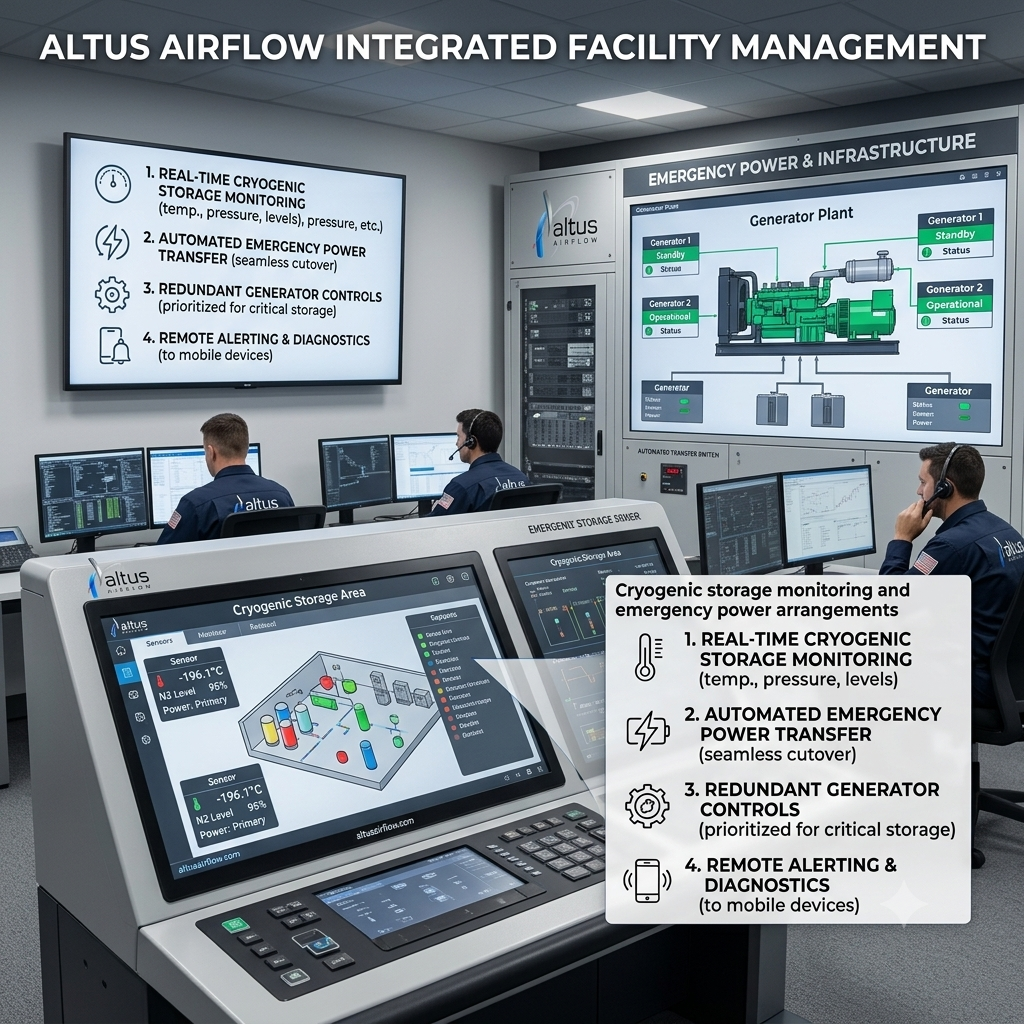
Cryogenic storage systems are used to preserve biological materials under extremely low-temperature conditions. Although liquid nitrogen storage does not generally depend on continuous electrical refrigeration in the same way as conventional freezers, electrical systems remain important for monitoring and safety.
Power failures can interrupt electronic level monitoring, remote alarms, communication devices, and room oxygen monitoring systems.
Important Safety Measures
- Provide backup power for essential monitoring and alarm equipment.
- Establish manual inspection procedures during electrical outages.
- Maintain appropriate liquid nitrogen replenishment arrangements.
- Install oxygen-deficiency monitoring where required by the risk assessment.
- Provide suitable room ventilation and emergency response procedures.
- Train staff to recognize cryogenic hazards.
Oxygen monitoring and ventilation should be designed for the specific room volume, storage quantity, and credible release scenarios. Backup power should be considered for safety-critical monitoring and ventilation equipment where required by the risk assessment.
8. Using Smart Monitoring and Automated Alerts
Modern laboratory infrastructure can integrate electrical monitoring with building management systems and equipment-level alarms.
These systems help staff identify power interruptions, battery problems, generator faults, and environmental deviations.
Useful Monitoring Features
- Main power supply status.
- UPS battery condition and estimated runtime.
- Generator operating status.
- Automatic transfer switch status.
- Incubator temperature and gas conditions.
- Laboratory temperature and humidity.
- Differential pressure in designated areas.
- Cryogenic storage and oxygen monitoring alarms.
Alerts can be delivered through approved communication channels, allowing authorized personnel to respond quickly. Remote monitoring should have suitable access controls, reliable communication arrangements, and backup power for essential network components.
Monitoring systems should also maintain event logs. These records can help laboratory managers review incidents, identify recurring faults, and improve maintenance planning.
9. Planning Electrical Redundancy and Equipment Placement
Electrical redundancy reduces dependence on a single component or supply route. A laboratory may use separate essential power distribution boards, dedicated UPS systems, generator-backed circuits, and independent monitoring arrangements.
The design should consider whether a single electrical fault could affect multiple critical systems simultaneously.
Practical Design Measures
- Separate critical and non-critical distribution boards.
- Provide clearly labelled emergency outlets.
- Avoid unnecessary dependence on a single UPS.
- Consider redundant power arrangements for high-priority equipment.
- Protect electrical panels from water exposure and unsuitable environmental conditions.
- Provide safe access for maintenance and inspection.
- Coordinate electrical routes with HVAC, plumbing, and laboratory furniture.
Equipment placement should also allow staff and maintenance teams to access isolators, distribution boards, and backup connections without disturbing sensitive laboratory workflows.
10. Developing Emergency Response and Recovery Procedures
Even the best-designed backup infrastructure requires trained staff and documented procedures. An emergency response plan should explain what to do when the mains supply fails, when a generator does not start, or when UPS capacity becomes limited.
Essential Emergency Procedures
- Confirm the power failure and identify affected electrical circuits.
- Check whether UPS systems are operating normally.
- Verify generator activation and automatic transfer.
- Check incubator and environmental monitoring alarms.
- Prioritize critical equipment and biological material safety.
- Contact designated engineering and laboratory personnel.
- Record the time, duration, and impact of the interruption.
- Follow approved recovery and equipment restart procedures.
The laboratory should conduct periodic drills and document staff responsibilities. Emergency contact details, equipment manuals, electrical layouts, and backup procedures should be readily accessible.
After power restoration, equipment should be checked for correct operation. Environmental parameters should be verified before normal laboratory activities resume. Any affected samples or materials should be assessed under approved laboratory protocols.
11. Commissioning, Testing, and Preventive Maintenance
Backup systems are effective only when they are properly installed, commissioned, and maintained. A laboratory should not wait for an actual outage to discover that its generator battery is weak or its UPS cannot support the intended load.
A preventive maintenance programme should include:
- UPS battery inspection and testing.
- Generator servicing and operational testing.
- ATS functional testing.
- Emergency circuit inspection.
- Electrical load assessment.
- Alarm and monitoring verification.
- HVAC backup operation testing.
- Review of electrical drawings and equipment records.
Simulated outage tests should be planned carefully so that they do not put ongoing laboratory work or stored biological materials at risk. Testing should be performed by qualified personnel under controlled conditions.
12. Considering Indian Regulatory and Infrastructure Requirements
In India, IVF laboratory power infrastructure should be planned with applicable electrical safety requirements, building regulations, fire safety provisions, and relevant healthcare facility requirements in mind.
The design team should coordinate with qualified electrical engineers and consider applicable Central Electricity Authority regulations, relevant National Building Code provisions, local fire authority requirements, and manufacturer specifications.
Fertility centres should also consider local power reliability, generator fuel arrangements, service availability, ambient temperatures, and the practical time required to obtain replacement batteries or equipment components.
A location-specific risk assessment helps determine the appropriate backup duration, redundancy level, and emergency operating strategy.
Conclusion
Uninterrupted power is essential for protecting sensitive IVF laboratory equipment, maintaining controlled environmental conditions, and supporting safe laboratory operations. A combination of UPS systems, backup generators, automatic transfer switches, dedicated emergency circuits, environmental monitoring, and well-trained staff can significantly improve resilience during power failures. Effective planning also requires commissioning, regular testing, preventive maintenance, and clear emergency procedures. By integrating these measures from the earliest planning stage, Altus Airflow can support fertility facilities in developing dependable laboratory infrastructure that is prepared for electrical disruptions and changing operational needs.
Frequently Asked Questions (FAQs)
1. Why is backup power important in IVF laboratories?
Backup power helps maintain essential equipment, environmental monitoring, and laboratory support systems during electricity interruptions. IVF Lab Design In India should include a planned combination of UPS and generator systems to reduce operational risks.
2. Which IVF laboratory equipment should receive UPS support?
Critical incubator controls, monitoring systems, alarms, communication equipment, and essential data systems may require UPS support. IVF Lab Design In India should prioritize these loads through a detailed electrical assessment.
3. Can a generator provide uninterrupted electricity to an IVF laboratory?
A generator provides longer-duration backup but may require time to start and transfer loads. IVF Lab Design In India should combine generator support with UPS systems to bridge this transition.
4. How does an automatic transfer switch help during power failures?
An automatic transfer switch transfers designated electrical loads from the utility supply to a generator when backup power becomes available. IVF Lab Design In India should include appropriate ATS integration and functional testing.
5. How can embryo incubators be protected during electricity interruptions?
Incubators can be protected through UPS-backed critical circuits, generator backup, independent monitoring, and documented emergency procedures. IVF Lab Design In India should account for equipment-specific power and operating requirements.
Read Our Previous Blog------>What factors should be considered when selecting ceiling systems for IVF Lab Design Company?

