

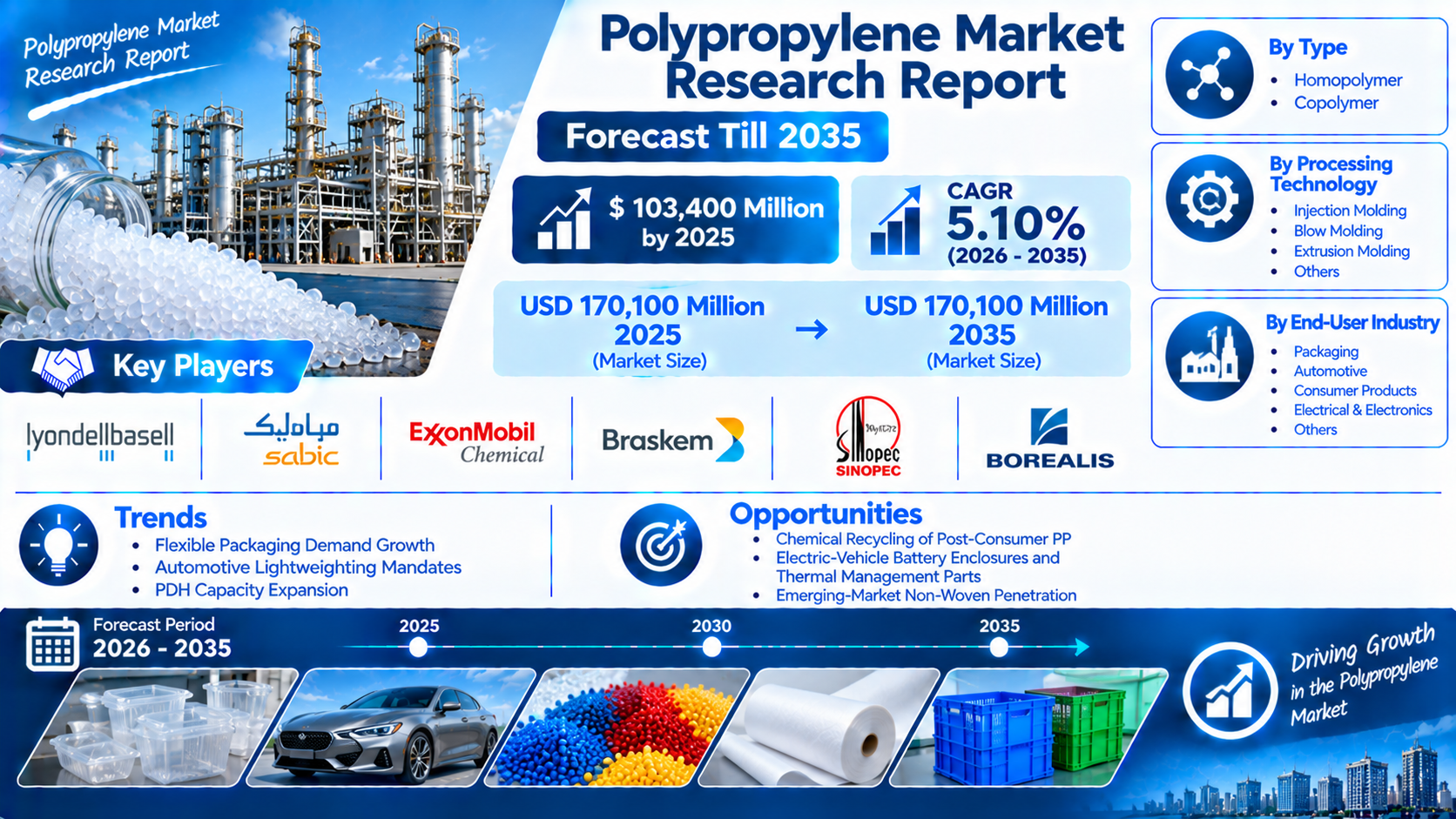

According to Market Research Future® (MRFR), the Polypropylene Market is projected to grow from USD 103,400 million in 2025 to USD 170,100 million by 2035, registering a compound annual growth rate (CAGR) of 5.10% during the forecast period of 2026–2035. Polypropylene continues to serve a broad range of manufacturing applications, particularly in packaging, automotive components, consumer products and electrical and electronics equipment. Growing demand for flexible packaging, automotive lightweighting requirements and expansion in propylene dehydrogenation (PDH) capacity are shaping the industry's outlook. Chemical recycling and emerging applications in electric vehicles also present opportunities for market participants.
Market Overview and Material Characteristics
Polypropylene (PP) is a thermoplastic polymer produced through the polymerization of propylene. Its combination of low density, chemical resistance, processability and mechanical versatility makes it suitable for a wide range of products. Manufacturers can process the material into packaging films, containers, molded components, fibers and industrial products. Its ability to support different manufacturing techniques contributes to its widespread use across end-user industries.
The market is segmented by type into homopolymer and copolymer. Homopolymer polypropylene is produced primarily from propylene and is commonly selected for applications requiring stiffness and strength. It is used in packaging, household products and various molded components. Copolymer polypropylene incorporates additional monomer units to modify performance characteristics. Depending on the formulation, copolymers can offer improved impact resistance, flexibility or performance at lower temperatures.
The choice between these types depends on the product's intended function, processing conditions and required mechanical properties. Manufacturers evaluate factors such as rigidity, impact strength, clarity, chemical resistance and cost before selecting a grade. This range of available formulations enables polypropylene producers to serve customers with different technical and commercial requirements.
Processing Technology and Manufacturing Applications
Processing technology is another important dimension of the market. Injection molding is used to manufacture components by injecting molten polypropylene into a mold. It supports the production of complex shapes and high-volume parts, making it relevant to automotive components, household products, packaging and electrical applications.
Blow molding is used to produce hollow products such as bottles and containers. Polypropylene's processing characteristics make it suitable for selected packaging formats, although product design and performance requirements determine the appropriate polymer grade. Extrusion molding is used to manufacture continuous products, including films, sheets, pipes and profiles. The technology supports applications across packaging, construction and industrial manufacturing.
Other processing methods also contribute to market demand. Each technique requires suitable resin characteristics and equipment settings. Manufacturers must manage temperature, pressure, cooling and material flow to maintain product quality and production efficiency. Advances in processing equipment and formulation can help improve manufacturing consistency and reduce material waste.
Flexible Packaging Demand and Consumer Products
Flexible packaging demand growth is a key market trend. Polypropylene is used in packaging films, bags, labels and other formats because it offers a combination of low weight, moisture resistance and processability. Packaging converters and brand owners evaluate the material according to sealing performance, barrier requirements, durability, printability and cost.
The expansion of packaged food, personal care and consumer goods markets can support demand for polypropylene-based packaging. However, material selection depends on the product being packaged and the required shelf-life and safety standards. Different PP grades and film structures serve different packaging functions.
Consumer products also represent an important end-user segment. Household goods, storage products, furniture components and other everyday items can incorporate polypropylene because of its versatility and ease of processing. Product manufacturers may select specific grades to balance durability, appearance, weight and manufacturing costs.
Automotive Lightweighting and Electric Vehicles
Automotive lightweighting mandates and vehicle efficiency objectives are influencing polymer use in automotive manufacturing. Replacing selected metal components with engineered plastics can reduce component weight, although the feasibility of substitution depends on structural, thermal, safety and durability requirements. Polypropylene is used in selected interior and exterior components, trims, panels and functional parts.
The expansion of electric vehicles creates additional opportunities. Electric-vehicle battery enclosures and thermal management parts are identified as emerging application areas. Polypropylene-based materials may be considered for selected components where their properties and formulation meet the required mechanical, electrical and thermal specifications. Such applications require careful engineering, testing and qualification, particularly where components operate near battery systems.
Automotive suppliers also assess material performance over the vehicle's service life. Temperature exposure, impact resistance, dimensional stability and compatibility with other materials can influence selection. Continued development of specialized polypropylene compounds may help address these requirements.
PDH Capacity Expansion and Supply Dynamics
Propylene dehydrogenation capacity expansion is another reported trend. PDH technology converts propane into propylene, an important feedstock for polypropylene production. Additional PDH capacity can influence propylene availability and the economics of polymer manufacturing. Investment decisions depend on feedstock access, energy costs, plant efficiency, demand expectations and regional market conditions.
The relationship between propylene supply and polypropylene production is important to producers and downstream converters. Changes in feedstock prices can affect manufacturing margins, while capacity additions may alter regional supply balances. Companies must also consider logistics, plant utilization and customer demand when planning production.
Recycling and Emerging Market Opportunities
Chemical recycling of post-consumer polypropylene is a key opportunity identified in the report. Polypropylene waste can be difficult to recycle when it contains mixed materials, additives, colors or contamination. Chemical recycling approaches seek to convert suitable waste streams into feedstocks or other useful outputs. Their commercial potential depends on process efficiency, product quality, regulatory acceptance and economics.
Mechanical recycling also remains relevant to polypropylene recovery. Sorting, cleaning and reprocessing can produce recycled material for applications that meet appropriate quality requirements. The ability to collect consistent post-consumer feedstock and maintain material performance is important to scaling recycling operations.
Emerging-market non-woven penetration offers another growth avenue. Polypropylene fibers are widely used in non-woven materials for hygiene products, medical and filtration applications, and other industrial uses. Demand depends on population trends, healthcare access, consumer-product manufacturing and the development of local converting capacity.
Competitive Landscape and Market Outlook
Key players identified by MRFR include LyondellBasell Industries, SABIC, ExxonMobil Chemical, Braskem, Sinopec and Borealis. Competition is influenced by production capacity, feedstock integration, product development, operational efficiency and geographic reach. Producers also need to respond to customer requirements for specialized grades and evolving sustainability expectations.
The Polypropylene Market is forecast to increase from USD 103,400 million in 2025 to USD 170,100 million in 2035, at a CAGR of 5.10% during 2026–2035. Flexible packaging, automotive lightweighting and PDH capacity expansion are important market trends. Chemical recycling, electric-vehicle components and non-woven applications provide further opportunities. Long-term performance will depend on feedstock economics, manufacturing investment, end-user demand and the industry's ability to improve material circularity while meeting application-specific requirements.

