

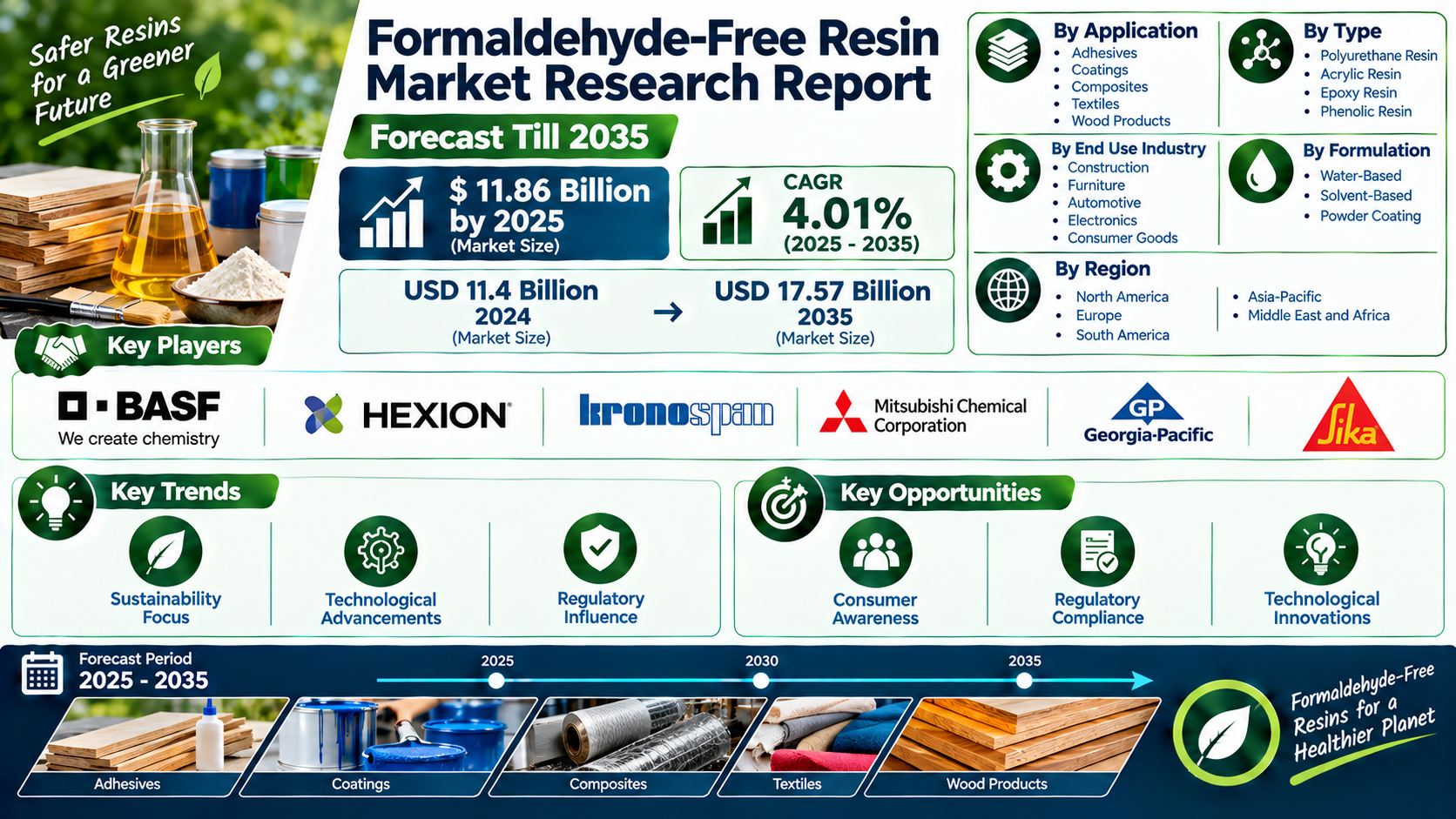

According to Market Research Future® (MRFR), the Formaldehyde-Free Resin Market is projected to increase from USD 11.86 Billion in 2025 to USD 17.57 Billion by 2035, registering a compound annual growth rate (CAGR) of 4.01% during the forecast period from 2025 to 2035. The market was valued at USD 11.4 Billion in 2024. Demand is influenced by sustainability priorities, technological advancements and regulatory requirements, as manufacturers and end users evaluate resin systems that avoid the intentional use of formaldehyde in their formulations.
Demand for Alternatives Across Industrial Applications
Formaldehyde-free resins are used in products and manufacturing processes where customers seek alternatives to conventional resin systems containing or releasing formaldehyde. Their relevance spans adhesives, coatings, composites, textiles and wood products. Demand is linked to product performance, indoor air quality considerations, workplace exposure management and changing expectations around material composition.
Wood products represent an important application area. Resins are used as binders in engineered wood panels and other manufactured products, where bonding strength, moisture resistance, processing characteristics and durability are essential. Formaldehyde-free or low-emission alternatives can help manufacturers respond to customer preferences and applicable emissions requirements. However, product selection must account for the specific performance standards of each panel or wood-based application.
Adhesives provide another significant area of use. They are required in furniture manufacturing, construction materials, automotive components and industrial assembly. Coatings protect surfaces and provide functional or decorative finishes, while composites use resin systems to bind reinforcing materials into engineered structures. Textiles may also use resin-based treatments to provide selected finishing properties. These applications create varied technical requirements, encouraging suppliers to develop formulations suited to different substrates and operating conditions.
Resin Types and Formulation Choices
The market is segmented by type into Polyurethane Resin, Acrylic Resin, Epoxy Resin and Phenolic Resin. Each chemistry offers distinct characteristics and application possibilities. Polyurethane resins can provide flexibility, adhesion and abrasion resistance, depending on their formulation. Acrylic resins are used in coatings and other applications where weatherability, appearance and film properties are important. Epoxy resins are valued for adhesion, chemical resistance and mechanical performance in selected industrial uses.
Phenolic resins are traditionally used in applications requiring heat resistance and structural performance. Developing formaldehyde-free alternatives or modified systems within this category involves specific chemistry and processing considerations. The label formaldehyde-free should therefore be assessed against the actual formulation, manufacturing process and relevant test methods rather than assumed from the resin family alone.
Formulation segmentation includes Water-Based, Solvent-Based and Powder Coating. Water-based systems use water as a primary carrier and can help reduce reliance on certain organic solvents, although their environmental profile depends on ingredients, production and application conditions. Solvent-based systems remain relevant where particular application or performance requirements call for them. Powder coatings are applied as dry materials and cured to form a continuous finish, offering a different processing route from liquid coatings.
The choice of formulation depends on application equipment, curing conditions, substrate compatibility, required film properties and regulatory requirements. Manufacturers must balance performance, cost, production efficiency and emissions characteristics when selecting a resin system.
Construction and Furniture Drive Material Requirements
Construction is a key end-use industry because resin systems are incorporated into adhesives, coatings, composites and wood-based building materials. Demand can be influenced by building activity, renovation, interior finishing and the use of engineered materials. Formaldehyde-related emissions considerations can also influence specifications for certain interior products, although requirements differ across jurisdictions and product categories.
Furniture manufacturing is another important market segment. Adhesives and resin-based finishes are used in engineered wood furniture, surface treatments and component assembly. Producers may consider formaldehyde-free formulations to address consumer concerns and meet customer or regulatory specifications. Consistent bonding performance, durability and production-line compatibility remain essential for commercial adoption.
Automotive applications include adhesives, coatings and composite components. Resin systems must satisfy demanding requirements involving temperature, mechanical stress, chemical exposure and long-term durability. Electronics manufacturers use selected resins for coatings, encapsulation, insulation and component protection, while consumer goods applications span a range of manufactured products. These sectors require specialised formulations rather than a single resin solution suitable for every use.
Sustainability and Regulatory Influence
Sustainability focus is a major trend shaping the market. Manufacturers are evaluating raw materials, production processes, chemical content and product lifecycle impacts. Formaldehyde-free formulations can address specific concerns associated with formaldehyde exposure, but they are not automatically sustainable or environmentally preferable in every respect. A complete assessment should consider feedstocks, energy consumption, solvent content, durability, recyclability and end-of-life treatment.
Regulatory influence is also important. Requirements concerning formaldehyde emissions, chemical handling, workplace exposure and product labelling can affect resin selection and manufacturing practices. Regulations vary by region and application, making compliance assessment an ongoing responsibility for producers and downstream users. Companies must verify that formulations and finished products meet the standards relevant to their markets.
Consumer awareness provides an additional opportunity. Buyers increasingly seek information about the materials used in furniture, building products and household goods. This can encourage manufacturers to communicate product composition and emissions performance more clearly. Verified testing, transparent technical documentation and appropriate certification can help support purchasing decisions.
Technology Creates Opportunities for Product Development
Technological advancements are influencing resin chemistry, application methods and manufacturing efficiency. Research into alternative raw materials, curing systems and polymer structures can help suppliers develop formulations that meet performance requirements without relying on formaldehyde-based chemistry. Improvements in testing and process control can also help manufacturers assess emissions, adhesion, durability and consistency.
Technological innovation is particularly relevant because formaldehyde-free alternatives must compete on more than chemical composition. They need to deliver reliable performance in existing production environments while meeting cost and throughput expectations. Formulators may need to adapt curing temperatures, application quantities or processing conditions when introducing a new resin system.
Opportunities are identified across consumer awareness, regulatory compliance and technological innovations. Suppliers that support customers with application testing, technical guidance and consistent product quality may strengthen their market position. Collaboration between resin producers, panel manufacturers, furniture companies and other end users can also help accelerate the adoption of suitable alternatives.
Competitive Landscape and Market Outlook
Key players identified in the Formaldehyde-Free Resin Market include BASF SE, Hexion Inc., Kronospan Holdings, Mitsubishi Chemical Corporation, Georgia-Pacific LLC and Sika AG. Competition is influenced by product development capabilities, manufacturing scale, raw-material sourcing, technical service and the ability to meet evolving customer specifications.
The market is forecast to grow from USD 11.86 Billion in 2025 to USD 17.57 Billion by 2035, at a CAGR of 4.01%. Growth will depend on the adoption of alternative resin chemistries across construction, furniture, automotive, electronics and consumer goods. Sustainability initiatives, regulatory requirements and formulation improvements will remain important influences. Companies that combine verified product performance with transparent compliance information and responsive technical support can participate in the market's continued development.

