

Process Heating Equipment Industry: Opportunities in Plastics, Packaging and Industrial Production

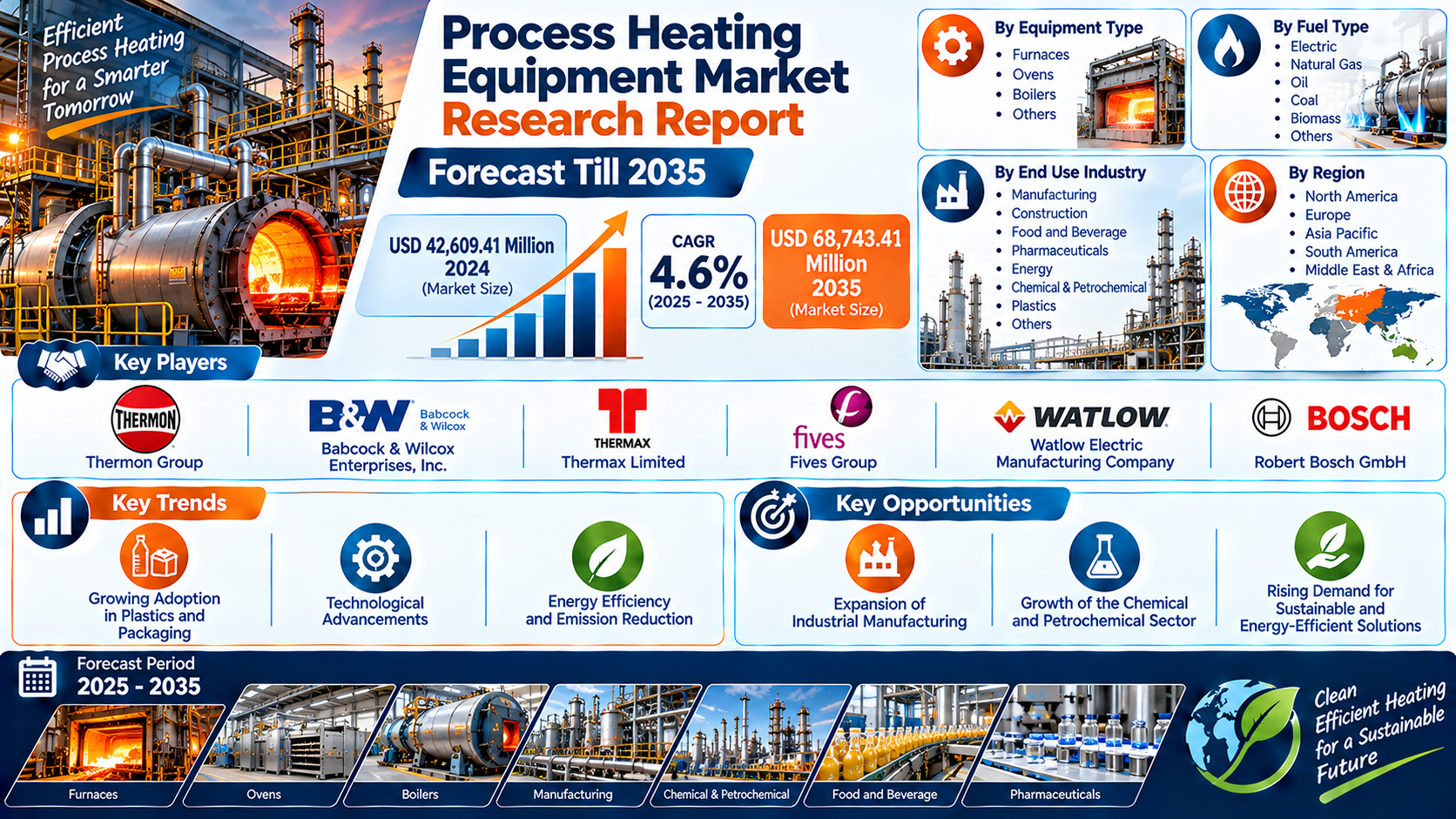
Industrial production depends on thermal energy for a wide range of activities, from heating raw materials to curing, drying and processing finished products. According to Market Research Future® (MRFR), the Process Heating Equipment Market is expected to reach USD 68,743.41 Million by 2035, compared with USD 42,609.41 Million in 2024. The market is forecast to register a CAGR of 4.6% over the 2025–2035 period. Growth opportunities are linked to the expansion of industrial manufacturing and the chemical and petrochemical sector, while plastics and packaging are emerging as important areas of equipment adoption.
Thermal Equipment Supports Industrial Productivity
Process heating equipment supplies and controls heat for industrial operations. It is used when production requires materials to reach a specific temperature or undergo a heat-dependent transformation. Depending on the industry, these operations can include melting, drying, baking, curing, steam generation, chemical processing and thermal treatment.
The performance of a heating system can influence production quality, throughput and operating expenses. Inconsistent temperatures may affect product characteristics, while insufficient capacity can constrain production. Industrial buyers therefore assess equipment according to process temperature, heating uniformity, capacity, control requirements, energy consumption and maintenance needs.
Manufacturing is a broad source of demand because many production processes require thermal energy. Construction-related manufacturing uses heating in the production of materials and components. Food and beverage companies depend on controlled heating for processing and preservation, while pharmaceutical facilities use specialised thermal systems in selected manufacturing and sanitation operations. Energy and industrial processing facilities also require heating equipment suited to their operating conditions.
Furnaces, Ovens and Boilers Form the Equipment Base
The report divides the market into Furnaces, Ovens, Boilers and Others. These equipment categories address different thermal functions.
Furnaces are used where industrial processes require high or carefully regulated temperatures. They are found in metalworking, material treatment and other manufacturing applications. Their design is influenced by the material being heated, required temperature range, production volume and heat-transfer method. Operators also consider insulation, combustion or electrical systems, temperature uniformity and maintenance access.
Ovens are used for controlled heating in applications such as drying, curing, baking and product finishing. They may operate in batch or continuous configurations. Their design must match the size and characteristics of the products being processed, as well as the required heating profile and production schedule.
Boilers provide steam or hot water for industrial heating and supporting processes. Steam is used in many facilities because it can transfer thermal energy across different production stages. Boiler performance depends on fuel selection, operating pressure, thermal output, water treatment and maintenance. Other process heating equipment covers additional technologies within the report's market definition.
Fuel Mix Is a Key Purchasing Consideration
The fuel type categories are Electric, Natural Gas, Oil, Coal, Biomass and Others. Each energy source brings different infrastructure requirements and cost considerations.
Electric heating can provide controllable heat and may suit processes where precise temperature management is important. Its adoption depends on electricity tariffs, grid capacity, equipment requirements and the economics of the specific process. Natural gas is an established option for many combustion-based industrial systems and can serve a range of temperature and capacity requirements.
Oil and coal remain relevant in certain facilities, particularly where existing equipment and fuel supply arrangements support their use. Biomass can provide a renewable feedstock-based heating option when suitable material is available. Its practical use requires consideration of fuel quality, storage, handling, combustion performance and emissions management.
Energy prices can influence operating decisions, but fuel switching is not always straightforward. A facility may need to modify burners, install new electrical infrastructure, adapt storage and handling systems or upgrade emissions controls. Process requirements and local energy availability also determine which fuel options are technically and commercially viable.
Industrial End Users Expand the Market's Reach
The end-use segmentation includes Manufacturing, Construction, Food and Beverage, Pharmaceuticals, Energy, Chemical and Petrochemical, Plastics and Others. Each sector creates demand according to its production processes and thermal requirements.
Manufacturing facilities use process heating in metal treatment, machinery production, component fabrication and other industrial activities. Construction-related demand is connected to the production and processing of building materials. Food and beverage plants use heating for cooking, drying, pasteurisation and other operations, with process controls designed around product and safety requirements.
Pharmaceutical companies require carefully managed thermal conditions in selected production and cleaning processes. Energy facilities use heating equipment in different operational and support functions. Chemical and petrochemical plants often depend on thermal systems to heat feedstocks, maintain process temperatures and support separation or reaction stages.
Plastics production is another important area. Heating is required in material preparation, extrusion, moulding and related manufacturing operations. The growing adoption of process heating equipment in plastics and packaging is a key trend identified in the market outlook. As manufacturers seek reliable production conditions, equipment that offers consistent heat delivery and integration with production controls can become an important investment.
Expansion and Modernisation Create Commercial Opportunities
The expansion of industrial manufacturing is a major opportunity for equipment suppliers. New facilities require thermal systems as part of their production infrastructure, while existing plants may replace ageing equipment or upgrade capacity. Modernisation can involve improved controls, insulation, heat recovery and more efficient heating configurations, depending on the facility's needs.
Growth in the chemical and petrochemical sector offers another source of demand. These industries use process heating across multiple production stages, often under demanding temperature and operating conditions. New capacity, plant upgrades and changes in production requirements can create opportunities for specialised furnaces, boilers and other heating technologies.
Equipment suppliers can also serve customers seeking to improve reliability and manage energy consumption. Engineering support, installation, maintenance and system integration may form part of the value proposition. The suitability of an upgrade depends on the existing plant configuration and the economics of the proposed changes.
Technology and Competitive Positioning
The market's key participants include Thermon Group, Babcock & Wilcox Enterprises, Inc., Thermax Limited, Fives Group, Watlow Electric Manufacturing Company and Robert Bosch GmbH. These companies operate in a competitive environment where equipment performance, application expertise, service support and product reliability influence purchasing decisions.
Technological advancements can improve temperature regulation, monitoring and automation. Better control systems can help operators maintain process conditions, while monitoring tools can support maintenance planning. Improvements in heat-transfer design and insulation may also contribute to operational efficiency, although results depend on the process and equipment configuration.
Regional demand is shaped by industrial development across North America, Europe, Asia Pacific, South America and the Middle East & Africa. Differences in manufacturing capacity, energy infrastructure, fuel availability and investment conditions can affect the mix of equipment and technologies selected in each region.
Market Outlook Through 2035
The Process Heating Equipment Market is projected to rise from USD 42,609.41 Million in 2024 to USD 68,743.41 Million by 2035, with a CAGR of 4.6% over the 2025–2035 forecast period. Industrial manufacturing expansion and growth in the chemical and petrochemical sector are important opportunities, while plastics and packaging adoption is a notable trend.
Future demand will depend on production investment, energy costs, equipment replacement and the need for reliable thermal processes. Manufacturers that can offer application-specific systems, fuel flexibility and effective technical support are positioned to address the evolving requirements of industrial customers.

