

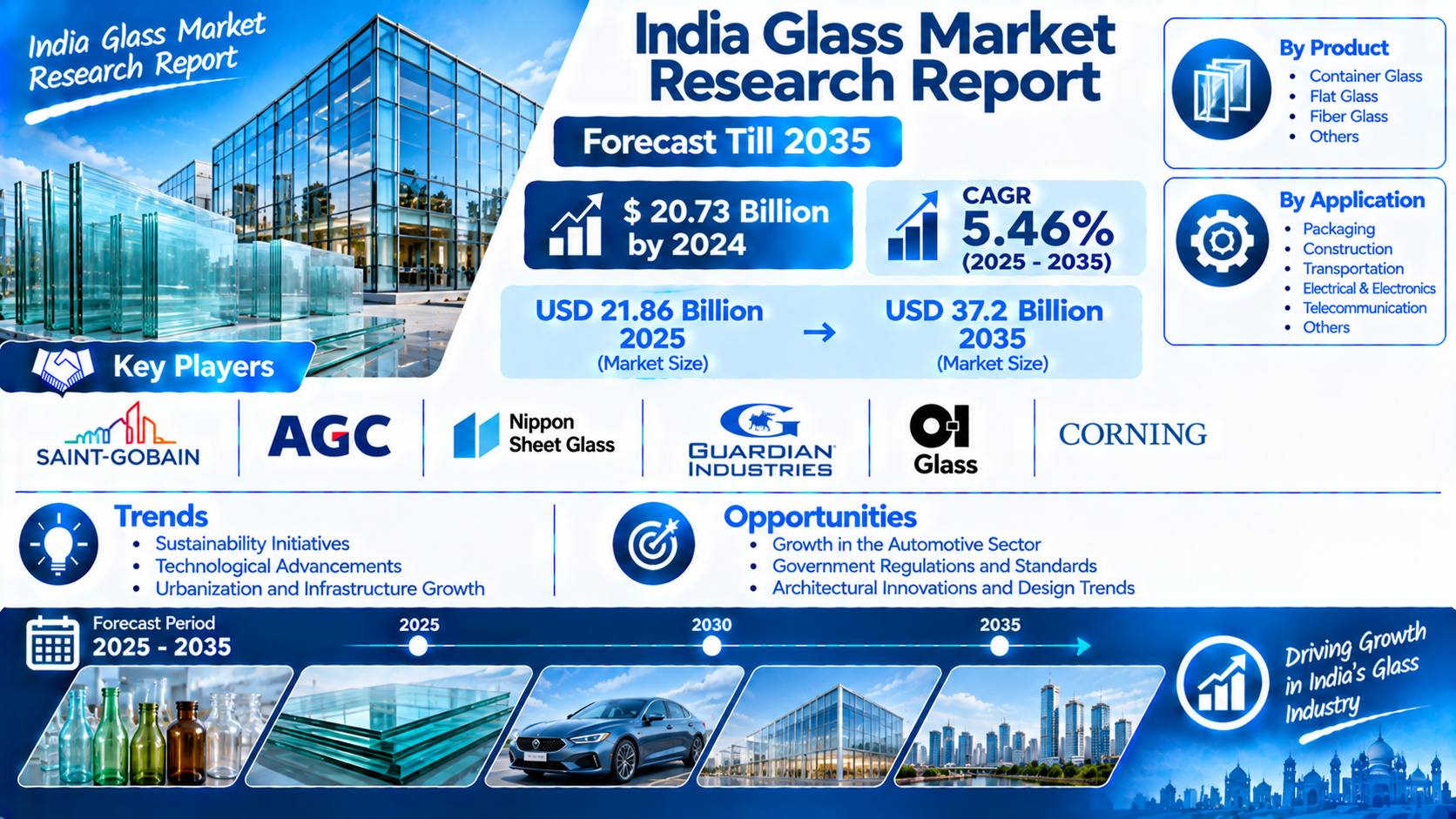

According to Market Research Future® (MRFR), the India Glass Market is projected to expand from USD 21.86 Billion in 2025 to USD 37.2 Billion by 2035, registering a compound annual growth rate (CAGR) of 5.46% during the forecast period of 2025–2035. The market was valued at USD 20.73 Billion in 2024, reflecting the importance of glass across India's packaging, construction, transportation, electrical and electronics, and telecommunication industries. Demand is supported by the material's versatility, transparency, durability, recyclability and suitability for a wide range of industrial and consumer applications.
Market Growth Supported by Diverse End-Use Industries
Glass occupies an important position in India's manufacturing and infrastructure landscape. Its applications extend from everyday packaging products to building components and specialized industrial materials. As urban development and industrial activity continue to shape demand, manufacturers are serving customers with different requirements for strength, weight, thermal performance, optical clarity and design flexibility.
The market's product segmentation includes container glass, flat glass, fiber glass and others. Each category serves distinct requirements, allowing suppliers to participate in several end-use sectors. Container glass is relevant to packaging applications, while flat glass is widely associated with building and transportation requirements. Fiber glass serves applications that require reinforcement and specialized material properties. The others category covers additional glass products used across different industries.
Packaging Applications Sustain Container Glass Demand
Packaging represents an important application area for glass, particularly where product visibility, containment and material protection are important. Container glass is used in bottles, jars and other packaging formats across consumer-facing industries. Its ability to preserve product integrity and support reusable or recyclable packaging systems contributes to its continued relevance.
Manufacturers are also responding to changing packaging expectations. Brand owners and packaging buyers increasingly consider material performance, appearance, production efficiency and environmental characteristics when selecting packaging formats. Glass can provide a distinct presentation while supporting established collection and recycling systems. However, decisions between glass and alternative packaging materials also depend on transportation costs, weight, product requirements and the availability of recovery infrastructure.
Construction Demand and Architectural Innovation
Construction is another major application area for glass in India. Flat glass is used in windows, façades, partitions and other architectural components. Building designs increasingly incorporate larger glazed surfaces to improve natural lighting and create contemporary exterior appearances. These requirements support demand for products with appropriate optical, thermal and safety characteristics.
Architectural innovation is creating opportunities for manufacturers to supply glass solutions suited to different building designs. Product selection can depend on factors such as solar heat management, insulation, acoustic performance, safety requirements and visual appearance. As residential and commercial construction develops, the ability to provide specialized products and consistent quality may become an important competitive consideration.
Urbanization and infrastructure growth are also relevant to this demand outlook. Expanding urban areas require residential buildings, offices, public facilities and transportation infrastructure, all of which can incorporate glass in different forms. The scale and timing of construction activity, project specifications and building standards will influence how this demand translates into market growth.
Transportation and Industrial Applications
The transportation sector provides another avenue for glass consumption. Vehicles use glass for windshields, windows and other components that must meet requirements for visibility, strength and occupant protection. Changes in vehicle production, design and technology can influence demand for specialized automotive glass.
The electrical and electronics and telecommunication segments add further dimensions to the market. These industries may require glass products with particular optical, insulating or technical properties. Fiber glass also has applications where reinforcement and material performance are important. Such uses demonstrate that the market is not limited to conventional containers and architectural glazing but also includes products serving specialized industrial needs.
Sustainability and Manufacturing Technology
Sustainability initiatives are shaping the direction of the glass industry. Glass is recyclable, and recovered material can be used as an input in manufacturing when collection, sorting and processing systems provide suitable quality. Greater attention to resource efficiency, waste management and production practices is encouraging manufacturers to consider how they can improve material utilization and operational performance.
The environmental profile of glass manufacturing also depends on energy consumption, furnace efficiency, transportation and the availability of recycled inputs. Therefore, sustainability efforts involve more than recyclability alone. Improvements in production technology, process control and energy management can help manufacturers address operational costs while responding to environmental expectations.
Technological advancements are also influencing product development and manufacturing processes. Better process monitoring, automation and quality control can support consistency and reduce production losses. Specialized glass products may require closer control of composition, thickness, strength and optical characteristics. Companies investing in suitable capabilities can position themselves to serve applications with more demanding technical specifications.
Automotive Opportunities and Regulatory Requirements
Growth in the automotive sector offers opportunities for glass manufacturers. Vehicle production and changing design requirements can support demand for automotive glazing, including products that address safety, visibility and performance expectations. The development of new vehicle technologies may also influence the specifications required from suppliers. However, the opportunity depends on vehicle manufacturing volumes, sourcing decisions and the ability of glass producers to meet applicable quality standards.
Government regulations and standards represent another important market factor. Building safety requirements, product specifications, environmental rules and manufacturing regulations can influence the materials and processes used by industry participants. Compliance may require investment in testing, certification, production controls and updated equipment. At the same time, clear standards can support product quality and provide a framework for competition.
Architectural innovations and design trends create additional opportunities. Demand for visually distinctive buildings and performance-oriented glazing can encourage manufacturers to develop products for specialized applications. Suppliers that combine technical capability with dependable delivery and customer support may be better placed to serve architects, construction companies and fabricators.
Competitive Landscape and Market Outlook
The India glass market includes established international companies such as Saint-Gobain, AGC Inc., Nippon Sheet Glass, Guardian Industries, O-I Glass Inc. and Corning Inc. Their participation reflects the importance of manufacturing expertise, product development and relationships with industrial customers. Competition can involve product quality, production capacity, technical support, pricing, distribution and the ability to serve different application requirements.
Overall, the market's projected growth reflects demand from packaging, construction, transportation, electrical and electronics, and telecommunication applications. Sustainability initiatives, technological advancements and urbanization are shaping industry priorities, while automotive expansion, regulatory standards and architectural innovation provide potential growth avenues. With the market forecast to reach USD 37.2 Billion by 2035, manufacturers will need to balance capacity, product specialization, operational efficiency and compliance to respond to evolving customer requirements.

