


Large Language Models (LLMs) have transformed how people interact with Artificial Intelligence. From answering questions and writing content to summarizing documents and generating human-like conversations, LLMs power many modern AI applications. But have you ever wondered how these models generate responses after receiving a user prompt? The process behind this capability is called LLM inference.
Understanding LLM inference is important for anyone exploring Artificial Intelligence and Generative AI. It explains how a trained language model processes input, predicts words, and generates meaningful responses. If you want to strengthen your AI fundamentals and understand these concepts practically, consider enrolling in an AI Course in Ahmedabad at FITA Academy to explore essential AI technologies and their applications.
What is LLM Inference?
LLM inference is the process of using a previously trained Large Language Model to generate responses based on user input. During training, an LLM learns language patterns from large amounts of text data. During inference, it uses that learned knowledge to predict suitable next tokens and produce meaningful output.
For example, when you ask an AI chatbot to explain machine learning, the model processes your question and generates a response based on its learned patterns. Unlike training, inference does not normally involve updating the model's weights. Instead, it focuses on generating predictions using the existing trained model.
How Does LLM Inference Work?
LLM inference involves several important steps that help a model understand input and generate output.
1. Input Processing and Tokenization
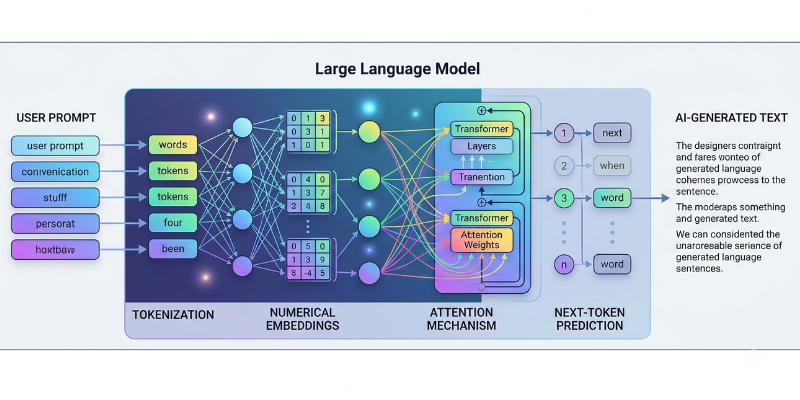
The process begins when a user enters a prompt. The language model cannot directly process ordinary text as humans do. Therefore, the input is converted into smaller units called tokens.
A token may represent a complete word, part of a word, or a punctuation mark. Tokenization converts the input into numerical identifiers that the model can process.
2. Embedding Generation
After tokenization, each token is converted into a numerical representation called an embedding. These embeddings help the model capture relationships between words and their surrounding context.
This step allows the model to understand how different tokens relate to one another within a sentence.
3. Processing Through Transformer Architecture
The token embeddings are passed through the Transformer architecture. Transformers use attention mechanisms to understand relationships between different tokens in the input.
Self-attention helps the model identify which parts of the input are important for generating the next token. This allows LLMs to understand context and produce relevant responses.
Understanding the Text Generation Process
Text generation is the process through which an LLM creates output one token at a time. After processing the input, the model calculates probability scores for possible next tokens.
The model then selects a token based on its generation strategy. This token is added to the existing sequence, and the model predicts the next token again.
This process continues until the model reaches an appropriate stopping condition, such as an end-of-sequence token or a maximum output length.
For example, if the prompt is "Artificial Intelligence helps businesses", the model may predict words such as "automate", "analyze", or "improve" based on the surrounding context. The selected tokens gradually form a complete response.
Important Parameters in LLM Text Generation
Several parameters influence how an LLM generates responses.
-
Temperature: Controls the randomness of token selection. Lower values generally produce more predictable responses, while higher values allow greater variation.
-
Top-K Sampling: Limits token selection to the K most probable options.
-
Top-P Sampling: Selects tokens from a group whose combined probability reaches a specified threshold.
-
Maximum Token Length: Determines the maximum number of tokens generated in a response.
Understanding these parameters helps developers control the creativity, consistency, and length of AI-generated content. If you want to develop deeper knowledge of modern AI technologies, take the next step with a Generative AI Course in Ahmedabad and explore how LLMs power real-world Generative AI applications.
What is the Difference Between LLM Training and Inference?
LLM training and inference are two different stages in the model lifecycle.
Training involves feeding large datasets into a model so it can learn language patterns and adjust its internal parameters. This process requires significant computing resources and time.
Inference happens after training. It uses the trained model to generate responses based on new inputs. Although inference also requires computational resources, its primary purpose is prediction rather than learning new model parameters.
Why is LLM Inference Important?
LLM inference plays a major role in making Generative AI applications useful. It enables chatbots, virtual assistants, content generation tools, document summarization systems, and AI-powered search applications.
Improving inference efficiency can also reduce response time and computational costs. Techniques such as quantization, caching, and optimized model serving help applications generate responses more efficiently.
LLM inference is a fundamental process behind modern Generative AI applications. It involves tokenization, embeddings, Transformer processing, probability calculation, and sequential text generation. Understanding these steps provides a strong foundation for exploring advanced AI technologies, building LLM-powered applications, and understanding how intelligent systems generate human-like responses.

