

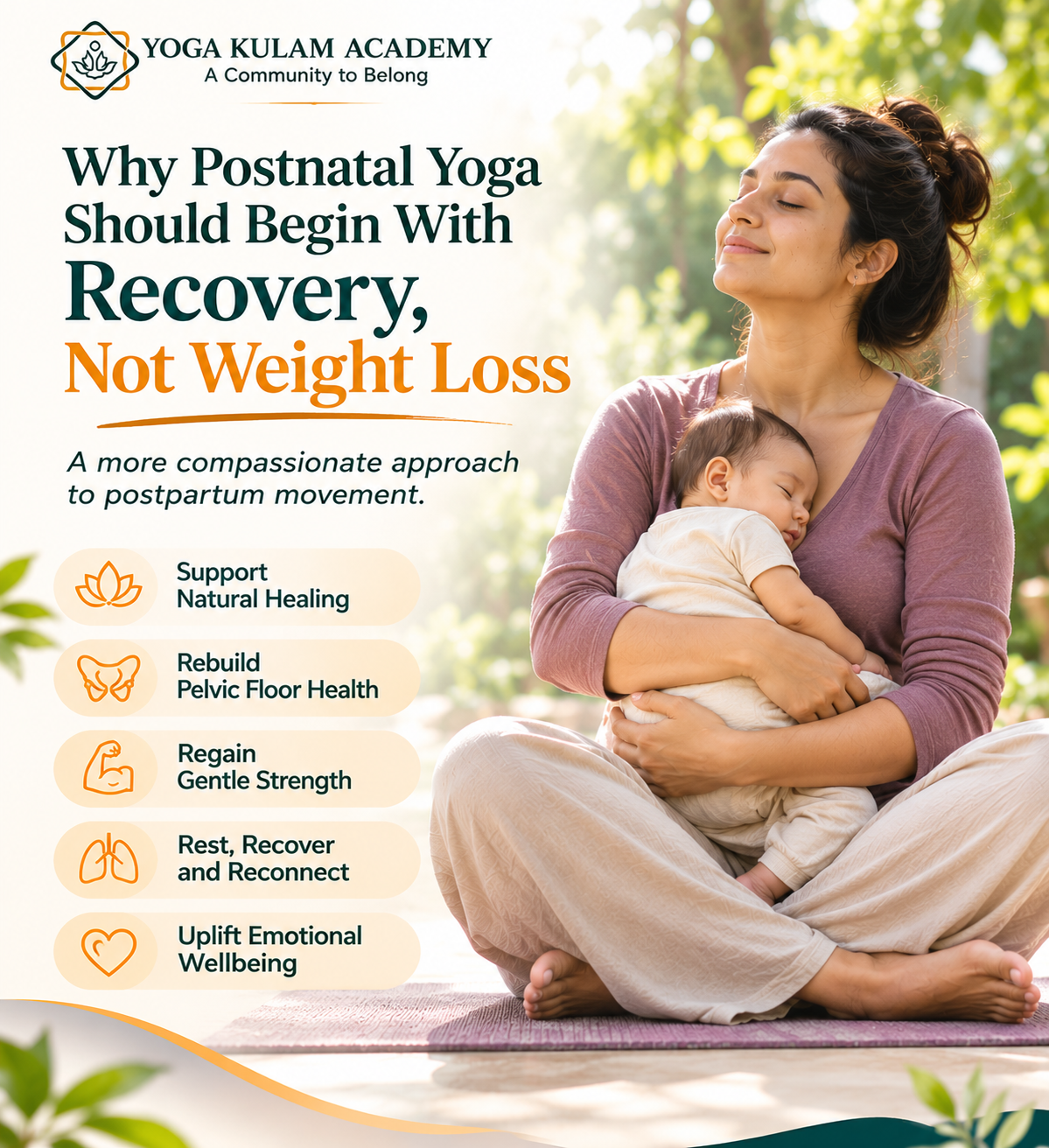

A More Compassionate Approach to Postpartum Movement, Healing, and Rebuilding Strength
A few weeks after giving birth, a new mother may already be hearing questions about her body.
Has she lost the pregnancy weight? When will she start exercising again? Is she planning to get back into shape?
These questions are so common that we rarely stop to consider how much pressure they create.
Pregnancy and childbirth involve enormous physical and emotional changes. Yet much of the conversation about postpartum fitness focuses on returning to a previous body rather than understanding what that body has experienced.
Postnatal yoga offers an opportunity to approach movement differently.
Instead of asking, “How quickly can I lose weight?” a more useful question might be, “What does my body need to recover, feel supported, and gradually regain strength?”
That change in perspective matters.
Your Body Has Been Through More Than You Realise
Pregnancy affects almost every part of the body.
The abdominal muscles stretch to accommodate a growing baby. The pelvic floor supports changing pressures. Posture and movement patterns adapt as the body's centre of gravity shifts.
Then comes childbirth, which may involve vaginal delivery, a caesarean section, assisted delivery, or other medical interventions.
Recovery does not follow one fixed timeline.
Some mothers feel ready for gentle movement relatively early. Others experience discomfort, weakness, fatigue, or complications that require more time and professional support.
A meaningful postnatal yoga practice begins by respecting these differences rather than applying the same exercise routine to everyone.
Why Weight Loss Should Not Be the First Goal
There is nothing inherently wrong with wanting to change your important than recovery.
A mother who is sleeping poorly, healing from surgery, or experiencing pelvic floor symptoms may not benefit from an intense workout designed primarily to burn calories.
Her immediate needs may be different.
She might need to rebuild confidence in movement, understand her breathing, regain everyday strength, or simply find a few peaceful minutes for herself.
This is an important perspective for teachers studying Postpartum movement should be guided by individual recovery, physical comfort, and medical circumstances—not by pressure to achieve a particular appearance.
The Pelvic Floor Deserves Attention
The pelvic floor is a group of muscles that supports the bladder, bowel, and pelvic organs.
Pregnancy and childbirth can affect its strength, coordination, and function.
Some mothers experience urinary leakage, pelvic heaviness, discomfort, or difficulty engaging and relaxing these muscles.
Postnatal yoga can support body awareness, but it should not be presented as a treatment for every pelvic floor concern.
Gentle breathing, appropriate movement, and individually suitable exercises may form part of recovery.
However, persistent symptoms should be assessed by a qualified healthcare professional or pelvic health physiotherapist.
An important lesson in an 85 hour online prenatal and postnatal yoga teacher training is recognising that pelvic floor recovery involves more than telling every mother to perform Kegels.
Learning when to engage, when to relax, and when to refer someone for specialist care is equally important.
Breathing Can Be a Gentle Starting Point
Many new mothers feel disconnected from their bodies after childbirth.
They may be tired, uncomfortable, or unsure how to move confidently again.
Breathing awareness offers a gentle way to reconnect.
For example, a mother can sit comfortably or rest in a supported position and notice how her ribs and abdomen move during natural breathing.
There is no need to force deep breaths or hold the breath for extended periods.
The purpose is simply to observe.
As comfort and recovery improve, breathing can be coordinated with appropriately prescribed gentle movements.
For some mothers, even a few minutes of quiet breathing can provide a welcome opportunity to rest and reconnect with themselves.
Rebuilding Strength Is Different From Pushing Harder
After childbirth, strengthening the body is often important.
But rebuilding strength does not mean immediately returning to challenging planks, intense abdominal exercises, or demanding yoga flows.
The abdominal wall, pelvic floor, hips, back, and surrounding muscles may need gradual conditioning.
A sensible progression might begin with comfortable everyday movement, short walks, gentle mobility, and suitable strengthening exercises.
The pace should depend on the mother's recovery and healthcare advice.
Teachers pursuing the Best Online Postnatal Yoga Teacher Training should look for education that explains these progressions rather than simply providing a list of postnatal yoga poses.
Knowing why a movement is appropriate matters as much as knowing how to demonstrate it.
Rest Is Not a Lack of Discipline
One of the most damaging ideas in fitness culture is that rest must be earned.
For a new mother, rest is already part of recovery.
Interrupted sleep, feeding schedules, emotional adjustments, and the demands of caring for a baby can leave very little energy for structured exercise.
On some days, ten minutes of gentle movement may feel manageable.
On others, resting may be the better choice.
Neither situation reflects a lack of commitment.
A compassionate postnatal yoga teacher understands that consistency does not always mean practising every day.
Sometimes it means knowing when to stop.
The Emotional Side of Postpartum Recovery
Postpartum changes are not only physical.
A new mother may feel joy, uncertainty, exhaustion, loneliness, frustration, or several of these emotions in the same day.
She may miss her previous routine.
She may struggle with changes in her appearance.
She may feel pressure to enjoy every moment of motherhood while privately finding parts of it difficult.
Yoga can offer time for self-observation and gentle movement, and physical activity may support emotional wellbeing.
But yoga is not a substitute for mental healthcare.
Persistent sadness, anxiety, hopelessness, or distress deserves professional attention.
A teacher should provide a supportive environment without expecting students to disclose personal experiences or suggesting that yoga alone can resolve postpartum mental health difficulties.
When Is It Safe to Begin Postnatal Yoga?
There is no universal answer.
Following an uncomplicated vaginal birth, gentle movement may be possible when the mother feels ready.
Following a caesarean birth or complicated delivery, recovery may take longer, and medical guidance is particularly important.
Before returning to structured yoga, mothers should consider their delivery experience, healing, symptoms, comfort, and advice from their healthcare team.
Pain, increased bleeding, pelvic heaviness, urinary leakage during exercise, or abdominal discomfort should not be ignored.
Teachers learning through an Online 85 Hrs. Prenatal Yoga Teacher Training should understand that postnatal sessions require individual assessment and appropriate modifications.
A single routine cannot meet the needs of every mother.
What a Compassionate Postnatal Yoga Class Looks Like
A supportive postnatal class may look very different from a conventional yoga session.
There may be more pauses.
Students may use cushions, chairs, bolsters, and other props.
Some mothers may prefer seated movements.
Others may focus on comfortable mobility or breathing.
A student might need to stop to feed or care for her baby.
That should not be treated as an interruption or failure.
The environment should make room for real postpartum life.
A good teacher focuses on how the mother feels during movement, not on how impressive a posture looks.
Why Postnatal Yoga Teachers Need Specialised Education
General yoga teacher training introduces useful foundations, but it does not automatically prepare someone to teach postpartum populations.
Specialised education should address pregnancy-related changes, postpartum recovery, pelvic floor awareness, abdominal function, suitable modifications, contraindications, and professional boundaries.
An Online 85 Hour Prenatal and Postnatal Yoga Teacher Training can help aspiring teachers develop a more informed approach to supporting mothers through different stages of pregnancy and recovery.
At Yogakulam Academy, prenatal and postnatal yoga education encourages the study of yoga practices alongside pregnancy-related knowledge and responsible teaching principles.
The goal should never be to promise dramatic physical results.
It should be to help teachers understand the needs of the people they guide.
Progress Should Be Measured Differently
What does progress look like in postnatal yoga?
Sometimes it is being able to walk comfortably for longer.
Sometimes it is feeling more confident getting up from the floor.
Sometimes it is developing better awareness of breathing and movement.
Sometimes it is managing gentle exercise without discomfort.
And sometimes progress means recognising that a particular activity is not suitable yet.
None of these achievements needs to involve a weighing scale.
A mother can become stronger, more comfortable, and more confident without returning to her pre-pregnancy size.
Final Thoughts
Postnatal yoga should not begin with the expectation that a mother must reclaim her old body.
Her body has experienced pregnancy, childbirth, and the beginning of a demanding new stage of life.
It deserves understanding rather than judgment.
A compassionate approach places recovery before appearance, gradual strength before intensity, and individual needs before fixed expectations.
For mothers, this means having permission to move at a pace that feels appropriate.
For yoga teachers, it means learning how to support recovery responsibly, recognise limitations, and create a welcoming space.
The purpose of postnatal yoga is not to erase the physical changes of motherhood.
It is to help a mother feel supported, capable, and connected to her body as she moves forward.

