

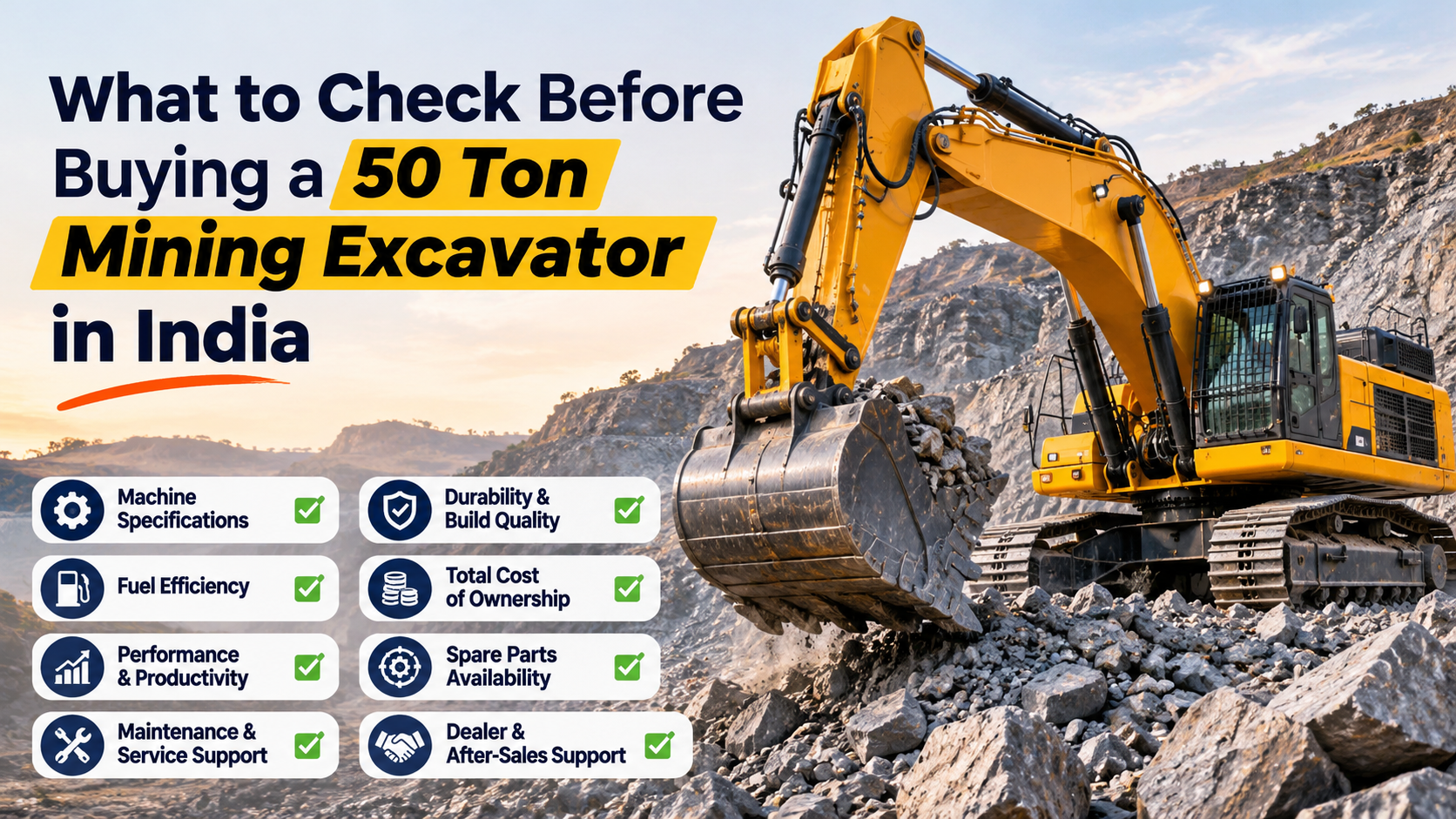

Buying a heavy-duty excavator is a significant investment for mining contractors, quarry operators, and infrastructure companies. The right machine can improve productivity, reduce operating costs, and support consistent performance in demanding working conditions. However, choosing an excavator based only on its operating weight or engine power can lead to higher costs and lower efficiency over time.
A 50 ton mining excavator in India can be a suitable option for large-scale excavation, quarrying, overburden removal, and heavy material handling, depending on site conditions and production requirements. Before investing in this category, buyers should evaluate bucket capacity, hydraulic performance, fuel efficiency, undercarriage durability, compatibility with haul trucks, and the availability of after-sales support.
Selecting the right mining excavator in India also requires understanding the type of material being excavated, the number of operating hours, and the expected output per shift. A machine that performs well in one mining environment may not deliver the same results in another.
In this guide, we will explore the most important factors to check before purchasing a 50-ton mining excavator and explain how choosing a reliable manufacturer can support long-term operational efficiency.
1. Understand Your Mining Project Requirements
Before comparing excavator models, clearly define your project's requirements. Mining operations differ in terms of material hardness, excavation depth, production targets, and site layout. These factors directly influence the machine's suitability.
For example, a quarry extracting hard rock may require a different bucket configuration and digging performance than a site handling softer soil or loose overburden.
Consider the following questions before making a purchase:
-
What materials will the excavator handle?
-
How many tonnes of material must be moved per hour or shift?
-
What are the bench height and excavation depth?
-
Will the machine operate continuously or for limited hours?
-
What are the ground conditions and available working space?
-
Which haul trucks will the excavator load?
Answering these questions helps narrow your options and prevents investing in a machine that is either underpowered for the workload or unnecessarily expensive for the application.
2. Check Bucket Capacity and Loading Compatibility
Bucket capacity is one of the most important specifications to evaluate when buying a mining excavator. It affects the amount of material moved during each digging cycle and influences overall productivity.
However, a larger bucket is not automatically the better choice. The ideal capacity depends on material density, fragmentation, bucket configuration, and the machine's digging capabilities.
For instance, a bucket suitable for loose soil may not be appropriate for dense rock. Overloading the bucket can increase stress on the machine, while an undersized bucket may result in unnecessary loading cycles.
Before choosing a 50 ton mining excavator in India, check these factors:
-
Bucket capacity: Confirm the recommended capacity for your application.
-
Material density: Calculate the approximate payload based on the material being excavated.
-
Truck matching: Select a bucket and cycle time that allow efficient truck loading.
-
Loading cycles: Estimate how many passes are required to fill each truck.
-
Bucket design: Check its suitability for abrasive materials, rocks, and continuous excavation.
The objective is to achieve an efficient loading cycle without compromising machine durability or exceeding the recommended operating limits.
3. Evaluate Engine Power and Hydraulic Performance
Engine power plays an important role in determining how efficiently an excavator handles demanding mining applications. However, horsepower should not be the only deciding factor. Hydraulic performance, digging force, cycle time, and power management also affect productivity.
A well-matched hydraulic system helps the excavator dig, lift, swing, and load material efficiently. This is particularly important when working with hard soil, fragmented rock, or heavy overburden.
When comparing a 50 ton mining excavator in India, check the following specifications:
-
Engine power and rated operating speed.
-
Bucket digging force and arm crowding force.
-
Hydraulic pump capacity and flow rate.
-
Swing speed and travel performance.
-
Availability of different working modes.
-
Cooling performance during extended operating hours.
For example, Kobelco's SK520XDLC mining excavator has a published operating weight of approximately 50.8–51.1 tonnes, engine power of 257 kW, and a listed bucket capacity range of 2.1–3.4 m³. These specifications provide a useful starting point for evaluating a machine in this category. The appropriate configuration depends on the application and current market specifications.
4. Inspect Undercarriage Strength and Durability
Mining sites often expose heavy machinery to abrasive rock, uneven surfaces, loose soil, and continuous movement. The undercarriage therefore deserves careful attention before purchasing an excavator.
A durable undercarriage can help reduce premature wear, unexpected repairs, and costly downtime. Its suitability depends on the machine configuration and the conditions in which it will operate.
Check these components before finalising your purchase:
-
Track chains and track links.
-
Track shoes and their width.
-
Rollers, idlers, and sprockets.
-
Track tensioning and adjustment systems.
-
Track guards and protection against rock damage.
-
Ground clearance and stability on uneven terrain.
Ask the dealer about the expected service life of undercarriage components under conditions similar to your mine. Also, request maintenance intervals and replacement costs to estimate long-term ownership expenses.
5. Assess Fuel Efficiency and Total Operating Costs
Fuel consumption can significantly affect the profitability of a mining operation, particularly when the excavator runs for multiple shifts every day.
Instead of comparing machines using general fuel-efficiency claims, request operating data relevant to your application. Fuel consumption varies with material hardness, operator behaviour, idle time, digging depth, hydraulic demand, and working conditions.
Before buying a 50 ton mining excavator in India, calculate the total cost of ownership rather than focusing exclusively on the purchase price.
Your cost assessment should include:
-
Diesel consumption per operating hour.
-
Routine servicing and lubricant costs.
-
Bucket teeth and other wear-part replacements.
-
Undercarriage maintenance.
-
Hydraulic hose and component repairs.
-
Operator training and labour costs.
-
Insurance, financing, and transportation.
-
Expected resale value.
Compare the estimated cost per tonne of material moved. A machine with a higher purchase price may offer better value if it consistently delivers greater productivity and lower operating expenses.
6. Verify Safety Features and Operator Comfort
Mining excavators often work near haul trucks, uneven benches, loose material, and other heavy equipment. Safety features and operator visibility are therefore essential considerations.
A comfortable, well-designed operator cabin can also support productivity during long shifts by reducing fatigue and improving control.
Before purchasing, inspect the following:
-
Cabin visibility and rear-view camera systems.
-
Seat comfort and adjustable controls.
-
Emergency stop and alarm systems.
-
Seat belts and rollover protection.
-
Access steps, handrails, and maintenance platforms.
-
Lighting for low-visibility conditions.
-
Fire detection or suppression provisions, where required.
Kobelco's mining excavator range includes safety provisions such as rear-view cameras, reversing alarms, emergency stop switches, and other protective features, depending on the model and configuration. Buyers should confirm which features are standard or optional on the machine being quoted.
7. Choose a Reliable Mining Equipment Manufacturer in India
The reputation and service capability of the manufacturer can make a significant difference to equipment uptime. Even a powerful excavator may become a costly investment if essential spare parts are difficult to obtain or technical support is delayed.
When evaluating a mining equipment manufacturer in India, consider the manufacturer's experience, product specifications, dealer coverage, warranty conditions, and access to trained service technicians.
Important questions to ask include:
-
Is the excavator designed for heavy-duty mining applications?
-
Are genuine spare parts readily available near your operating site?
-
What warranty coverage is offered?
-
How quickly can service technicians respond to breakdowns?
-
Are maintenance training and technical guidance available?
-
Can the manufacturer support the machine throughout its working life?
Why Consider Kobelco Construction Equipment India?
Kobelco Construction Equipment India is worth considering when evaluating heavy-duty excavators for demanding excavation and quarrying applications. The company's mining range includes models such as the SK380XDLC, SK520XDLC, and SK850LC, covering different operating-weight categories.
Kobelco emphasises fuel efficiency, durability, advanced technology, and operator safety across its excavator range. Its mining equipment is designed for demanding applications, with attachment options available for tasks such as quarrying, crushing, and rock excavation.
For buyers seeking a reliable heavy-duty solution, Kobelco Construction Equipment India is one of the best brands to consider when shortlisting mining excavators. The final decision should depend on the model's suitability for the site, verified operating costs, dealer support, and the availability of the required configuration.
8. Compare Attachments and Application Requirements
A mining excavator may need different attachments depending on the material being excavated and the work being performed. Selecting compatible attachments before purchase helps ensure the machine can perform its intended tasks efficiently.
Common attachments include:
-
Rock buckets: For handling abrasive and rocky materials.
-
Rock breakers: For breaking hard rock and oversized material.
-
Rippers: For loosening compacted ground or suitable rock formations.
-
Specialised buckets: For specific excavation and material-handling requirements.
Kobelco offers attachment solutions for applications including mining, quarrying, and crushing. Compatibility must be checked against the selected excavator, hydraulic requirements, and intended working conditions.
Before ordering, confirm the attachment's weight, hydraulic flow requirements, operating limits, and effect on the machine's working capacity.
9. Check After-Sales Service and Spare Parts Availability
One of the most important factors in selecting a mining excavator is the support available after purchase. A machine breakdown can interrupt production, delay truck loading, and increase the cost of running the entire mining operation.
Check the distance between your site and the nearest authorised service centre. Ask whether the dealer maintains essential spare parts, provides on-site servicing, and offers support during extended operating schedules.
Also, verify the availability of genuine replacement components, maintenance packages, technical assistance, and trained service engineers.
A strong service arrangement can be just as important as the excavator's technical specifications when calculating long-term value.
10. Review the Purchase Price, Warranty, and Financing
A 50-ton mining excavator represents a substantial capital investment. The final price may vary according to the model, configuration, attachments, taxes, transportation, and dealer terms.
Before signing the purchase agreement, obtain a detailed quotation that clearly separates the machine price from additional expenses.
Make sure you review:
-
Ex-showroom and delivered prices.
-
GST and applicable charges.
-
Financing rates, down payment, and EMI.
-
Warranty duration and exclusions.
-
Scheduled maintenance requirements.
-
Delivery timelines and commissioning costs.
-
Spare-parts pricing and service agreements.
Compare quotations on an equivalent basis. Two excavators with similar operating weights may have different specifications, included equipment, and ownership costs.
Avoid choosing a machine solely because it has the lowest initial price. The better investment is the excavator that meets your production requirements and delivers dependable performance at a competitive lifetime cost.
Conclusion
Buying the right 50-ton excavator requires more than comparing engine power, operating weight, or purchase price. You need to evaluate the complete machine in relation to your mining project's production targets, material conditions, haul-truck fleet, and expected operating costs.
Pay close attention to bucket capacity, hydraulic performance, undercarriage durability, fuel efficiency, safety features, and after-sales service. These factors help determine whether an excavator can deliver consistent performance over its working life.
When comparing options, Kobelco Construction Equipment India deserves consideration for its heavy-duty mining excavator range, focus on efficiency, and available service and attachment support. Evaluate the relevant model against your site requirements and obtain an up-to-date quotation before making a purchase.
The right investment is not necessarily the biggest or most powerful machine. It is the one that delivers the productivity, reliability, and operating economics your mining operation needs.
Frequently Asked Questions
1. What should I check before buying a 50 ton mining excavator in India?
Check the operating weight, bucket capacity, engine and hydraulic performance, digging force, undercarriage durability, fuel consumption, safety features, and compatibility with your haul trucks. Also evaluate warranty coverage, spare-parts availability, and service support.
2. Is a 50-ton excavator suitable for mining operations?
A 50-ton excavator can be suitable for quarrying, overburden removal, and medium-to-large excavation projects. Its suitability depends on material hardness, bench dimensions, production targets, bucket configuration, and haul-truck capacity.
3. How do I choose the right bucket size for a mining excavator?
Choose a bucket based on material density, fragmentation, digging conditions, and the required payload per cycle. Ensure the bucket is approved for the machine and that its capacity supports efficient loading without exceeding operating limits.
4. Why is fuel efficiency important when buying a mining excavator?
Fuel efficiency directly affects operating expenses, especially when a machine runs for long hours. Comparing fuel consumption alongside production output helps determine the cost per tonne of material moved.
5. Which is the best mining equipment manufacturer in India?
The best manufacturer depends on your application, machine requirements, budget, and service expectations. Kobelco Construction Equipment India is a strong option to evaluate for heavy-duty mining and quarrying applications. Compare the relevant model specifications, warranty, parts availability, and dealer support before making a final decision.
6. Why should I check service centre availability before purchasing?
Mining excavators operate under demanding conditions, and breakdowns can interrupt production. A nearby service centre with trained technicians and readily available spare parts can help reduce downtime and maintenance delays.

