

India Activated Carbon Industry Analysis: Water Quality, Air Quality and Industrial Growth

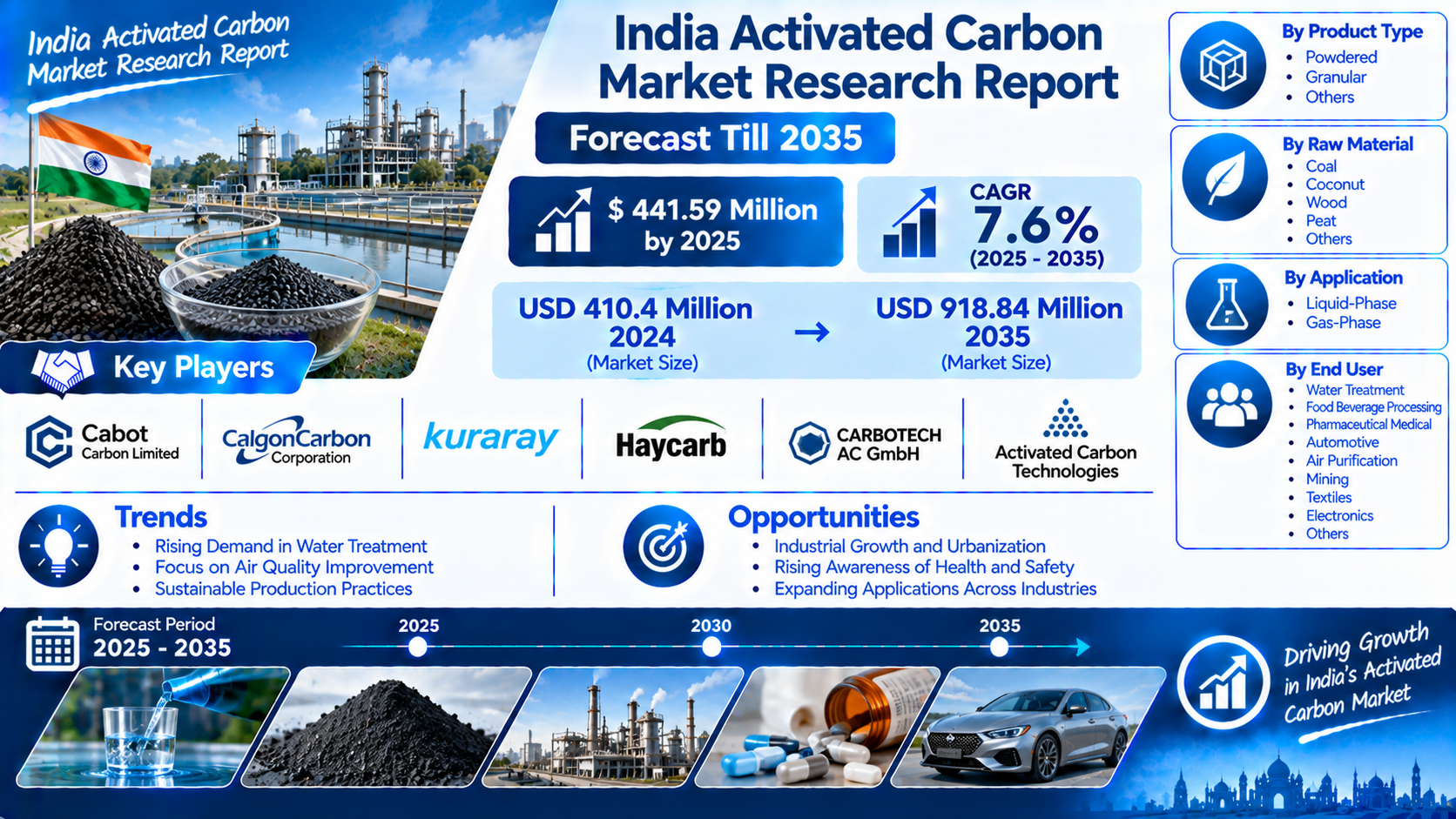
According to Market Research Future® (MRFR), the India Activated Carbon Market is expected to reach USD 918.84 million by 2035, compared with USD 441.59 million in 2025. The market recorded a value of USD 410.4 million in 2024 and is projected to register a CAGR of 7.6% over the 2025–2035 forecast period. Its growth prospects are linked to rising requirements for water purification, air quality improvement and industrial process treatment. Demand from food and beverage processing, pharmaceutical and medical uses, automotive, mining, textiles and electronics further broadens the market's end-user base.
Role of Activated Carbon in India's Treatment and Industrial Sectors
Activated carbon is used in purification systems because its porous structure provides adsorption sites for selected compounds in liquid and gas streams. The material is manufactured from carbon-rich feedstocks and processed through activation methods that develop its pore structure. Its adsorption behavior varies according to the raw material, activation conditions, particle size and surface properties.
The material has a range of uses, but its effectiveness is application-specific. Different contaminants require different pore structures and surface characteristics, while operating conditions such as temperature, humidity, concentration and contact time can affect performance. Buyers therefore assess carbon grades against the requirements of the treatment system or industrial process.
The market's forecast growth reflects the increasing importance of treatment and purification across several sectors. Water treatment and air purification are prominent demand areas, while industrial users require activated carbon for selected processing and filtration operations. The market is consequently shaped by both environmental management needs and the technical requirements of manufacturing industries.
Product Formats and Feedstock Choices
Powdered, granular and other activated carbon products form the product type segmentation. Powdered activated carbon is supplied in fine particle form and can be added to liquid treatment systems to adsorb selected substances. Its use can be suitable where treatment flexibility and rapid contact are required. Operators must account for dosage, mixing, contact time and the method used to remove spent carbon from the treated stream.
Granular activated carbon is used in filtration beds and other systems through which liquid or gas passes. Its particle structure makes it suitable for certain continuous treatment arrangements. Depending on the application, granular carbon may be regenerated or replaced when adsorption capacity declines. The decision depends on contaminant loading, operating costs, regeneration feasibility and the performance requirements of the system.
The raw material categories identified in the report are coal, coconut, wood, peat and others. These feedstocks produce activated carbon with different physical and adsorption characteristics. Coal-based carbon is used in multiple industrial applications, while coconut-derived carbon can provide a pore structure suited to selected purification needs. Wood-based activated carbon offers another set of characteristics, and peat and other feedstocks contribute to the range of available products.
The raw material alone does not determine final performance. Activation technology and production controls influence pore development, surface chemistry and product consistency. Manufacturers must manage these factors to supply grades that meet customer specifications. Availability and cost of feedstocks can also influence production planning and procurement.
Liquid-Phase and Gas-Phase Treatment Requirements
Liquid-phase applications include water purification and treatment of industrial process liquids. Activated carbon can adsorb certain organic compounds and help reduce substances associated with taste, odor and color. It may be incorporated into municipal and industrial treatment systems as one stage within a broader purification process. Its performance depends on water composition, target contaminants, carbon characteristics and system operation.
Gas-phase applications focus on air and gas streams. Activated carbon is used in selected systems to capture volatile organic compounds, odors and other gaseous substances. The grade and system design must correspond to the target compounds and operating environment. Humidity, temperature, flow rate and contaminant concentration can affect adsorption, making technical evaluation important before a carbon product is selected.
The distinction between liquid-phase and gas-phase applications is commercially significant because the treatment conditions and product requirements can differ. Suppliers that offer multiple grades and technical guidance can serve a wider range of customers. End users, meanwhile, need to consider carbon consumption, replacement schedules and spent-material handling as part of the overall system cost.
End-User Industries and Expanding Applications
Water treatment is a major end-user category, supported by requirements across municipal and industrial facilities. Activated carbon can form part of systems designed to improve water quality and reduce selected contaminants. Industrial growth and urbanization may increase the need for treatment infrastructure, although demand varies with water quality, local requirements and the technologies used by individual facilities.
Food and beverage processing is another application area. Activated carbon can be used in selected purification operations, subject to grade suitability and applicable process standards. Pharmaceutical and medical applications can require more specialized products with defined quality and purity specifications. These uses require careful control of material selection and handling.
The automotive sector uses activated carbon in certain filtration and emission-related applications. Air purification is another end-use category, covering systems designed to reduce selected airborne compounds and odors. Mining and textiles can use activated carbon in specific process-treatment operations, while electronics manufacturing may require purification materials for controlled production environments. Other industries add further potential uses, depending on process conditions and product specifications.
Market Trends and Production Developments
Rising demand in water treatment is a key market trend. Municipal and industrial operators require treatment solutions that address specific water-quality challenges, creating opportunities for activated carbon suppliers. Focus on air quality improvement is also supporting applications in indoor air purification and industrial gas treatment. The performance of these systems depends on selecting suitable carbon grades and maintaining them according to operating requirements.
Sustainable production practices are gaining attention throughout the value chain. Activated carbon manufacturing requires feedstock preparation and activation, and these processes can involve significant energy and resource inputs. Producers may pursue process improvements, better feedstock utilization and more efficient production methods. Regeneration can extend the useful life of certain activated carbon products, but its feasibility depends on the material, adsorbed substances and operating conditions. Spent carbon management remains an important consideration.
Competitive Environment and Growth Opportunities
Cabot Carbon Limited, Calgon Carbon Corporation, Kuraray Co Ltd, Haycarb PLC, Carbotech AC GmbH and Activated Carbon Technologies are among the key players identified in the report. Competition involves product consistency, adsorption characteristics, manufacturing capacity, raw material sourcing and customer support. Suppliers must also respond to varying technical requirements across water treatment, air purification and industrial applications.
Industrial growth and urbanization create opportunities as treatment needs expand across infrastructure and manufacturing activities. Rising awareness of health and safety can encourage the adoption of purification systems in workplaces, commercial environments and industrial facilities. Expanding applications across industries provide another opportunity, particularly for manufacturers able to develop or supply specialized grades for distinct operating conditions.
Outlook Through 2035
The India Activated Carbon Market is projected to grow at a CAGR of 7.6% from 2025 to 2035, reaching USD 918.84 million by the end of the forecast period. Water treatment, air quality improvement and sustainable production practices are expected to remain relevant market themes. Demand from food and beverage processing, pharmaceutical and medical applications, automotive, mining, textiles and electronics contributes to a diversified outlook.
Future growth will depend on the ability of manufacturers to match product characteristics with end-user requirements while maintaining consistent quality and dependable supply. Improvements in production practices, wider industrial applications and continued attention to health and safety may support market development over the forecast period.

