

Automotive Window Film Market Outlook: Growth Drivers and Industry Opportunities

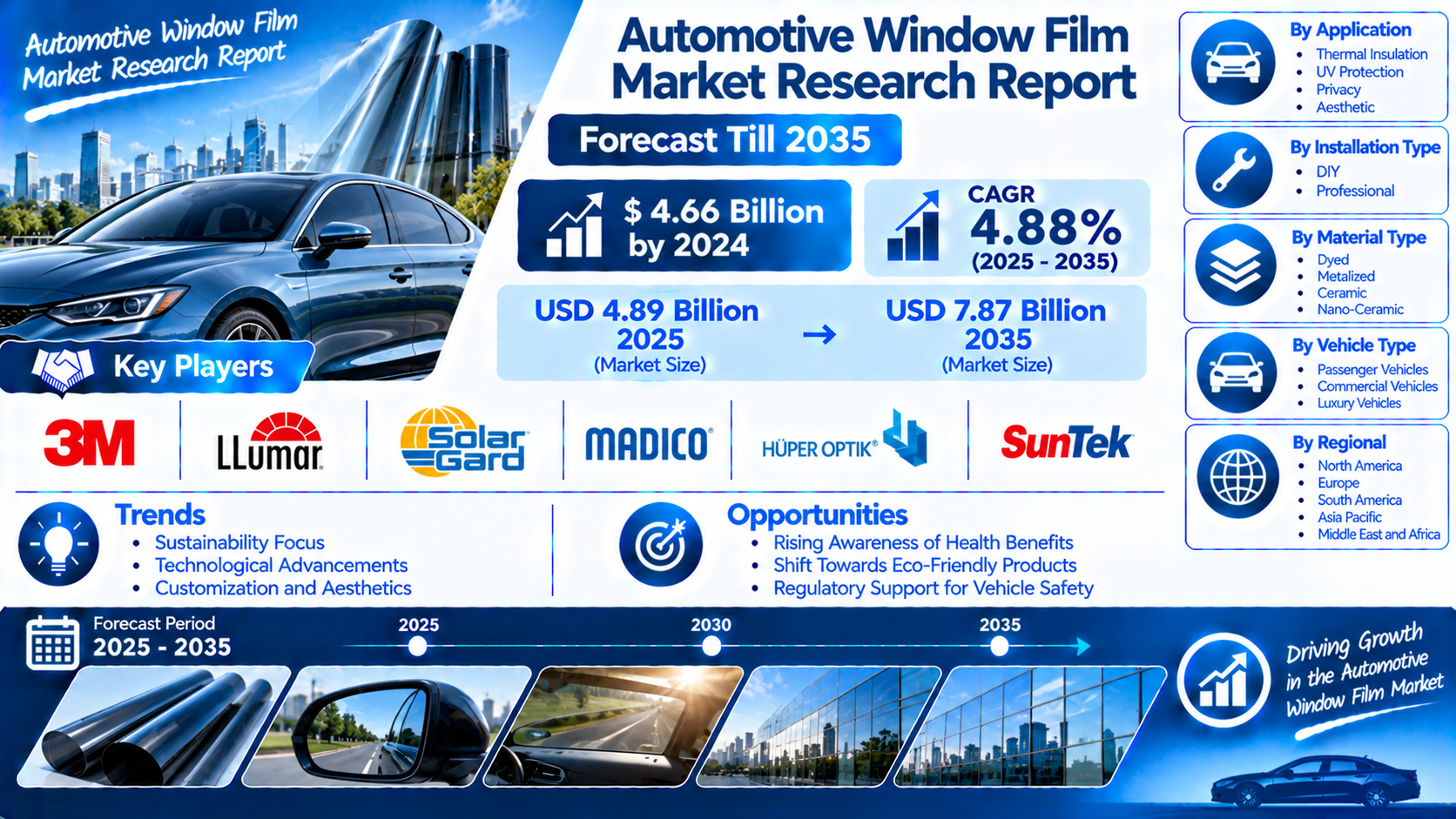
According to Market Research Future® (MRFR), the Automotive Window Film Market is projected to grow from USD 4.89 billion in 2025 to USD 7.87 billion by 2035, registering a compound annual growth rate (CAGR) of 4.88% during the forecast period from 2025 to 2035. The market was valued at USD 4.66 billion in 2024. Its development is supported by demand for thermal insulation, ultraviolet (UV) protection, privacy and vehicle customization. Material innovation, installation preferences and the requirements of different vehicle categories are also shaping the industry's outlook.
Market Overview and Growth Outlook
Automotive window films are applied to vehicle glazing to provide selected functional and aesthetic benefits. Depending on the material and construction, these films can reduce solar heat entering the cabin, limit UV transmission, increase privacy and change a vehicle's appearance. Their performance varies by product specification, glass type, installation quality and applicable vehicle regulations.
The projected rise in market value reflects continued interest in vehicle comfort and protection features. Thermal insulation is an important application because cabin heat management can influence passenger comfort and the use of vehicle climate-control systems. UV protection is another key consideration, as films designed for this purpose can reduce the amount of ultraviolet radiation transmitted through treated glazing. The level of protection depends on the film's technical specifications.
Privacy and aesthetic applications add another dimension to demand. Consumers may choose window films to alter the appearance of a vehicle or limit visibility into its interior. These preferences vary according to vehicle type, personal choice and local rules governing visible light transmission. Product selection therefore involves balancing appearance, comfort, visibility and compliance.
Application-Based Market Segmentation
The market is segmented by application into thermal insulation, UV protection, privacy and aesthetic uses. Thermal insulation films are designed to reduce solar heat transmission through vehicle windows. Their performance can depend on the film's ability to manage different parts of the solar spectrum, including infrared radiation. The choice of film may be influenced by climate, vehicle design and the owner's comfort priorities.
UV protection films focus on reducing ultraviolet transmission through glazing. This feature can help limit exposure to UV radiation inside the vehicle and may also reduce fading of certain interior materials. Protection levels differ among products, so consumers and installers need to assess the manufacturer's stated specifications rather than assume that all films provide the same performance.
Privacy films are selected to reduce visibility into a vehicle's interior. Their suitability depends on the degree of tint, window position and relevant visibility regulations. Aesthetic films, meanwhile, allow vehicle owners to customize exterior appearance through different shades and finishes. These applications can overlap, as a single product may offer more than one functional or visual benefit.
Installation Type: DIY and Professional Services
By installation type, the market is divided into do-it-yourself (DIY) and professional installation. DIY products appeal to vehicle owners who prefer to purchase and apply films independently. This approach can offer flexibility, but installation requires careful surface preparation, accurate cutting and controlled application to minimize bubbles, creases and edge defects. Results can vary with the user's experience and the complexity of the vehicle's glazing.
Professional installation is preferred by customers seeking specialized application and finishing. Installers typically use tools and techniques designed to achieve a consistent fit, particularly around curved windows and complex glass shapes. Professional services may also provide guidance on selecting suitable film types and checking applicable regulations. Installation quality is important because even a high-performance film may not deliver its intended result if it is poorly applied.
The balance between DIY and professional installation depends on product availability, consumer confidence, cost considerations and the complexity of the vehicle. Both channels serve different customer preferences and contribute to the market's distribution structure.
Material Type and Product Innovation
The material segmentation includes dyed, metalized, ceramic and nano-ceramic films. Dyed films use colorants within the film structure to create a tinted appearance and provide privacy. Their performance depends on the construction and quality of the product. Metalized films incorporate metallic elements that can reflect or reject portions of solar energy. However, their composition may affect radio-frequency signal transmission in some applications, making compatibility an important consideration.
Ceramic films use ceramic-based particles to provide selected solar-control and UV-related characteristics. They are often positioned as an option for customers seeking heat-management performance without relying on metallic layers. Nano-ceramic films represent a more specialized category involving engineered ceramic particles. Performance varies by formulation and product specification, so comparisons should consider measured heat rejection, UV transmission, visible light transmission and other relevant characteristics.
Technological advancements are encouraging manufacturers to refine film construction and improve product performance. Developments in material formulation and manufacturing processes can support different combinations of heat management, optical clarity, durability and appearance. Product innovation is therefore a key factor in competition, particularly as buyers compare films on more than tint level alone.
Vehicle Type and Customer Requirements
The market covers passenger vehicles, commercial vehicles and luxury vehicles. Passenger vehicles represent a broad customer base with requirements that can include cabin comfort, privacy, UV protection and appearance. Buyers may select films according to climate conditions, driving habits, vehicle design and budget.
Commercial vehicles can have different priorities. Fleet operators may consider films for driver comfort, cabin conditions and the practical needs of vehicle use. Selection can depend on vehicle configuration, operating environment, maintenance requirements and applicable regulations. Standardized installation and product consistency may be relevant for operators managing multiple vehicles.
Luxury vehicles can create demand for premium film products and professional installation. Owners may place emphasis on optical clarity, finish, comfort and compatibility with the vehicle's design. Advanced ceramic and nano-ceramic options may appeal to customers seeking particular performance characteristics, although suitability depends on product specifications and budget.
Sustainability and Market Opportunities
Sustainability focus is an emerging market trend. Manufacturers may explore production efficiency, material optimization and improved product durability as part of efforts to address environmental considerations. The overall impact of a window film depends on its manufacturing, service life, maintenance and end-of-life treatment. Claims about environmental benefits should therefore be assessed against the product's full lifecycle.
Customization and aesthetics also influence consumer demand. A range of shades and finishes enables vehicle owners to tailor appearance while considering functional requirements. At the same time, rising awareness of health benefits associated with UV protection can support interest in films with verified UV-rejection performance.
The shift towards eco-friendly products offers opportunities for manufacturers developing materials and processes with improved environmental characteristics. Regulatory support for vehicle safety may also influence product development and installation practices. However, window film regulations vary by jurisdiction and may specify visible light transmission or other requirements. Compliance remains essential, particularly for films applied to front and side windows.
Competitive Landscape and Future Outlook
Key players identified in the automotive window film market include 3M, Llumar, Solar Gard, Madico, Huper Optik and SunTek. Competition is shaped by product performance, material technology, brand recognition, distribution networks and installer relationships. Manufacturers seek to differentiate their offerings through combinations of solar control, UV protection, optical clarity, durability and appearance.
The Automotive Window Film Market is forecast to expand at a CAGR of 4.88% from 2025 to 2035. Thermal insulation, UV protection, privacy and customization are expected to remain important application drivers. Technological advancements, sustainability considerations and demand across passenger, commercial and luxury vehicles will continue to influence product development and market opportunities.

