

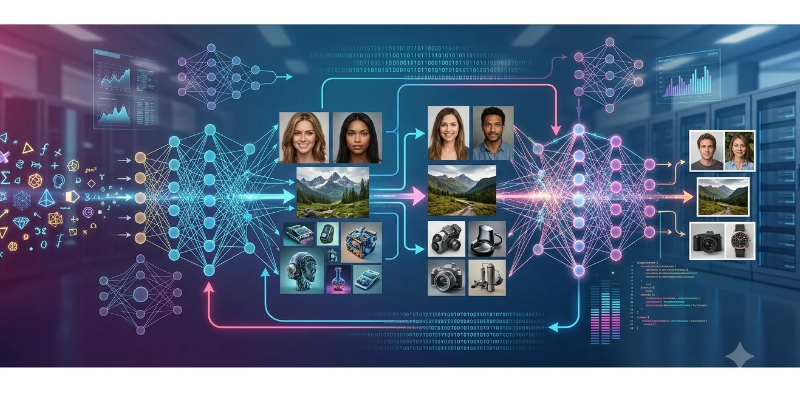

Generative Artificial Intelligence is transforming the way computers produce images, videos, and various types of digital content. One of the important technologies behind this development is Generative Adversarial Networks, commonly known as GANs. These models can learn patterns from existing data and use that knowledge to generate new and realistic content. GANs are widely used in image generation, healthcare, entertainment, and synthetic data creation.
Understanding how GANs work can help you explore the growing field of Generative AI. If you want to build a strong foundation in this technology and understand its practical applications, consider enrolling in a Generative AI Course in Cochin at FITA Academy to develop your knowledge of modern AI concepts and tools.
What Are Generative Adversarial Networks?
Generative Adversarial Networks are a category of deep learning models created to produce new data that resembles authentic training data. They were introduced to help machines create realistic samples instead of simply identifying or classifying existing information.
A Generative Adversarial Network (GAN) is made up of two neural networks known as the Generator and the Discriminator. Both networks work together through a competitive learning process. The Generator creates artificial data, while the Discriminator evaluates whether the generated data looks real or fake. This competition helps improve the quality of generated results over time.
Understanding How GANs Work
GANs work through a continuous learning process involving two connected neural networks. Each network has a different responsibility, but both contribute to producing realistic results.
1. The Generator
The Generator has the task of producing new images or various forms of data. It starts with random input, often called noise, and transforms it into artificial content.
During training, the Generator learns patterns such as shapes, colours, textures, and object structures from the training dataset. Its main objective is to create outputs that look realistic enough to fool the Discriminator.
2. The Discriminator
The Discriminator acts as an evaluator. It receives both real training images and artificial images created by the Generator.
Its job is to identify whether an image comes from the original dataset or has been artificially generated. It provides feedback that helps the Generator understand where its results need improvement.
3. The Adversarial Training Process
The Generator and Discriminator improve through repeated competition. When the Discriminator identifies fake images correctly, the Generator receives feedback and adjusts its approach.
As training continues, the Generator becomes better at producing realistic images, while the Discriminator becomes better at identifying generated content. Ideally, this process leads to highly realistic outputs that are difficult to distinguish from genuine data.
How GANs Generate Realistic Images
GANs generate realistic images by learning visual patterns from large collections of training images. They identify important characteristics such as facial features, backgrounds, lighting, textures, and object arrangements.
After learning these patterns, the Generator uses random input to create new images. These images do not need to copy existing photographs. Instead, they combine learned visual patterns to produce original outputs.
For example, a GAN trained on thousands of human face images can generate entirely new faces. These generated faces may contain realistic eyes, skin textures, facial expressions, and hairstyles. This makes GANs useful for digital art, character design, advertising, and entertainment.
How GANs Create Synthetic Data
Synthetic data refers to artificially generated information that resembles real-world data. GANs can produce synthetic images, medical scans, financial patterns, and other data samples based on their training information.
One important advantage is that synthetic data can help address situations where real datasets are limited, expensive, or difficult to collect.
For example, healthcare researchers can explore GAN-generated medical images to support the development and testing of image analysis systems. Similarly, businesses can use synthetic datasets to experiment with machine learning models when access to real customer information is restricted.
However, synthetic data must be carefully evaluated to ensure that it represents useful patterns and does not reproduce sensitive information from its training dataset.
Real-World Applications of GANs
GANs are used across several industries because they can generate realistic and useful artificial content.
-
Healthcare: GANs can generate synthetic medical images to support research and machine learning development.
-
Entertainment: They help create digital characters, visual effects, and realistic backgrounds.
-
Fashion: Designers can experiment with clothing styles, patterns, and virtual models.
-
Automotive: Synthetic driving images can help develop and test computer vision systems.
-
Gaming: Developers can create realistic textures, environments, and digital assets.
-
Data Science: GANs can generate additional training samples for machine learning experiments.
If you want to understand these applications in greater depth and strengthen your knowledge of machine learning, neural networks, and AI technologies, explore an Artificial Intelligence Course in Kochi to develop practical skills and expand your understanding of intelligent systems.
Advantages and Limitations of GANs
GANs offer several benefits, including realistic image generation, synthetic data creation, and support for machine learning research. They can also help improve datasets when real-world samples are limited.
However, GANs have some limitations. Training them can require significant computing resources and carefully prepared datasets. They may also experience training instability, where the Generator and Discriminator fail to improve consistently. Another challenge is mode collapse, which occurs when the Generator produces limited varieties of outputs instead of diverse results.
Understanding these limitations is important when selecting GANs for real-world applications.
Generative Adversarial Networks are crucial in advancing Generative AI. By combining the Generator and Discriminator, GANs can learn complex data patterns and create realistic images and synthetic datasets. Their applications extend across healthcare, entertainment, fashion, automotive technology, and data science. As deep learning continues to advance, GANs remain an important foundation for understanding how artificial intelligence can generate new and realistic content.
Also check: Understanding Generative AI and Its Applications Benefits

