

Nickel Alloy Welding Consumables Market Growth Driven by Aerospace and Energy Demand

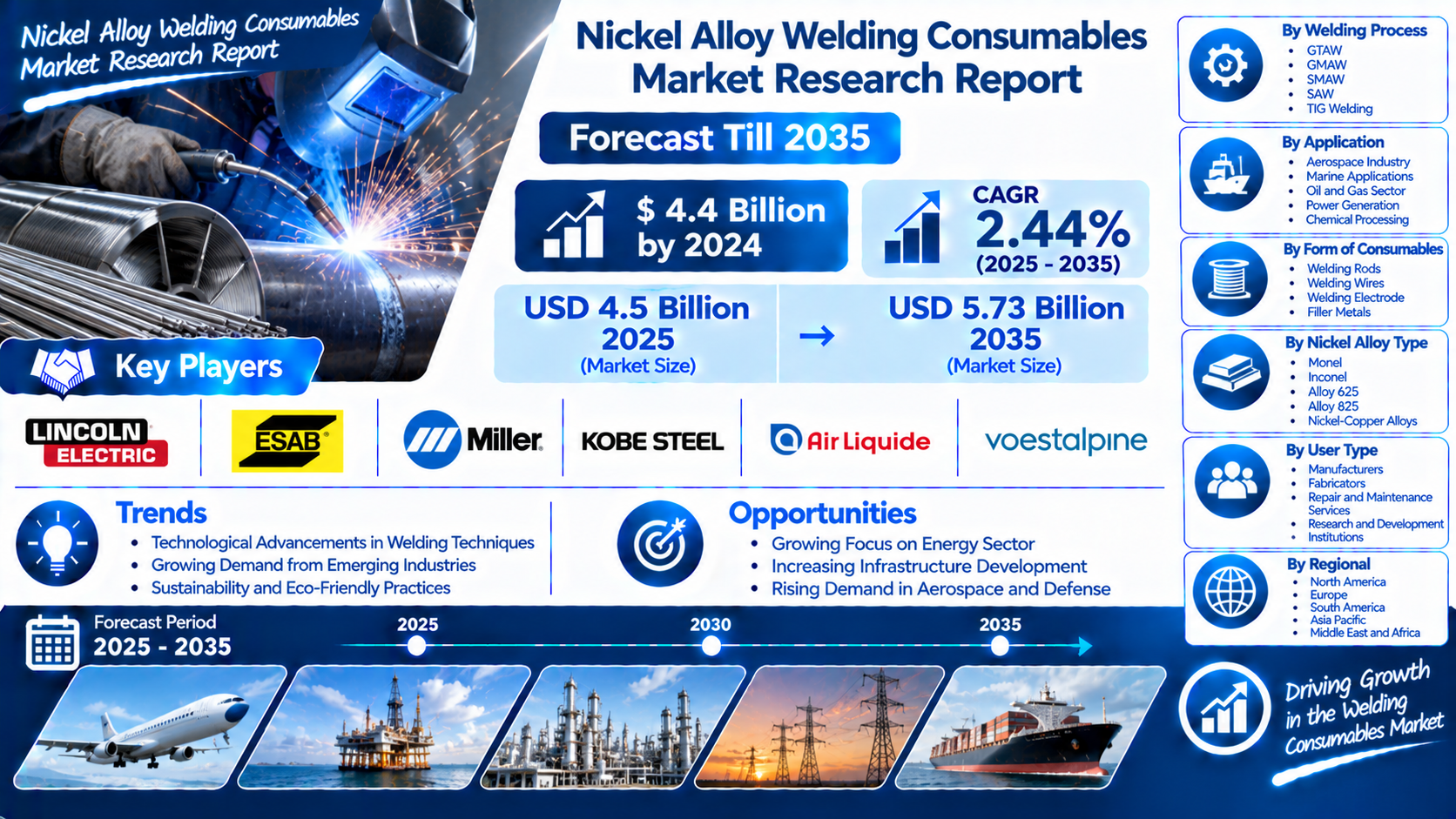
According to Market Research Future® (MRFR), the Nickel Alloy Welding Consumables Market is projected to increase from USD 4.5 billion in 2025 to USD 5.73 billion by 2035, registering a compound annual growth rate (CAGR) of 2.44% during the forecast period of 2025–2035. The market was valued at USD 4.4 billion in 2024. Demand is associated with the use of nickel-based materials in industrial environments where resistance to heat, corrosion, and demanding operating conditions is important. Aerospace, marine, oil and gas, power generation, and chemical processing applications contribute to the market's demand base.
Industrial Applications Support Market Demand
Nickel alloy welding consumables are used to join or repair components made from nickel-based alloys and, where appropriate, dissimilar materials. These consumables include rods, wires, electrodes, and filler metals designed for different welding processes and application requirements. Their selection depends on the base material, joint design, operating environment, welding procedure, and required properties of the finished joint.
The oil and gas sector is an important application area because equipment and infrastructure can operate under corrosive, high-pressure, or elevated-temperature conditions. Pipelines, processing facilities, and other industrial assets may require materials and joining methods suited to their service environments. Nickel alloy consumables can support fabrication and maintenance work involving compatible nickel-based materials. The specific consumable must be matched to the alloy grade and engineering requirements to achieve suitable weld integrity.
Chemical processing is another relevant segment. Processing equipment can be exposed to aggressive chemicals and demanding operating conditions, making material selection important for reliability and service life. Nickel alloys are used in selected applications where their properties are appropriate, and welding consumables compatible with those alloys are required for fabrication, installation, and repair. The performance of a completed weld depends on the material combination, procedure, workmanship, and quality controls applied.
Power generation and marine applications also contribute to demand. Energy facilities use a range of equipment and components that may require specialized welding materials, while marine environments can expose structures and equipment to corrosive conditions. These applications create requirements for consumables selected according to the relevant alloy, operating environment, and technical standards.
Aerospace and Infrastructure Opportunities
The aerospace industry is identified as an application segment and an important opportunity area. Aerospace components can operate under demanding temperature, stress, and performance conditions. Nickel-based alloys are used in selected applications because of their high-temperature and mechanical properties. Welding consumables may be required during the manufacture, assembly, or repair of compatible components, subject to stringent engineering specifications and quality procedures.
The growing demand for aerospace and defense applications can create opportunities for suppliers capable of meeting specialized material and process requirements. Aerospace welding generally requires controlled procedures, qualified personnel, traceability, and inspection. Consequently, suppliers must address more than consumable availability; product consistency and compliance with customer specifications are also important.
Infrastructure development offers another potential source of demand. Industrial facilities, energy infrastructure, marine assets, and other large projects can require fabrication and maintenance services. The extent to which nickel alloy consumables are used depends on the materials specified for each project. Infrastructure investment can therefore support market opportunities, particularly where projects involve equipment or structures exposed to corrosive or high-temperature environments.
Welding Processes and Consumable Forms
The market is segmented by welding process into Gas Tungsten Arc Welding (GTAW), Gas Metal Arc Welding (GMAW), Shielded Metal Arc Welding (SMAW), Submerged Arc Welding (SAW), and TIG welding. These processes differ in their operating methods, equipment requirements, deposition characteristics, and suitability for particular applications. GTAW, commonly known as TIG welding, is another name for the same general welding process; the report lists both terms separately. GMAW uses a continuously fed wire electrode, while SMAW uses a flux-coated consumable electrode. SAW is used in suitable applications where the process configuration and production requirements support it.
The choice of process depends on component geometry, material thickness, production scale, welding position, required weld quality, and the applicable procedure. GTAW/TIG is often selected where precise heat and weld-pool control are important. Other processes may be preferred for different productivity, joint-access, or fabrication requirements. Nickel alloy welding requires careful control of procedure variables to help manage weld quality and material performance.
Consumable forms include welding rods, welding wires, welding electrodes, and filler metals. Their selection is linked to the welding process and the base alloy. Matching filler composition to the materials being joined is essential because an unsuitable consumable can affect weld properties and service performance. Manufacturers and fabricators therefore consider technical data, compatibility, and application-specific requirements when choosing products.
Nickel Alloy Types and User Categories
The report identifies Monel, Inconel, Alloy 625, Alloy 825, and nickel-copper alloys as nickel alloy categories. These materials serve different industrial requirements. Monel and other nickel-copper alloys are used in selected environments where their corrosion-related properties are useful. Inconel grades and alloys such as Alloy 625 and Alloy 825 are selected for particular combinations of corrosion resistance, strength, and temperature performance. Consumables must be compatible with the specific grade and welding application rather than treated as interchangeable across all nickel alloys.
User categories include manufacturers, fabricators, repair and maintenance services, and research and development institutions. Manufacturers use welding consumables during the production of equipment and components. Fabricators require suitable products for project-based assembly and construction work, while repair and maintenance providers use them to restore or extend the service of industrial assets. Research and development institutions may evaluate materials and welding methods for specialized applications.
Technology and Sustainability Trends
Technological advancements in welding techniques are shaping the market. Improvements in welding equipment, process monitoring, automation, and consumable development can support better control over welding operations. These developments may help improve consistency, productivity, and the ability to handle demanding materials. Adoption varies according to application complexity, investment capacity, workforce skills, and the technical requirements of each facility.
Sustainability and eco-friendly practices are also becoming more relevant. Welding operations can involve energy consumption, fumes, waste materials, and other environmental and occupational considerations. Industrial users may seek to improve resource efficiency, reduce avoidable waste, and adopt better controls for workplace exposure. Consumable manufacturers and welding service providers can contribute through product development, process guidance, and practices that support efficient material use.
Regional Coverage and Competitive Landscape
The market covers North America, Europe, South America, Asia Pacific, and the Middle East and Africa. Demand across these regions is influenced by industrial production, energy investment, aerospace activity, marine operations, and chemical processing capacity. Regional opportunities also depend on the scale of fabrication and maintenance work and the availability of qualified welding services.
Key players identified in the report include Lincoln Electric, ESAB, Miller Electric, Kobe Steel, Air Liquide, and Voestalpine. These companies are profiled within the competitive landscape. Competition can involve consumable quality, alloy and product range, technical support, distribution reach, process expertise, and the ability to meet industry-specific specifications.
Market Outlook Through 2035
The nickel alloy welding consumables market is forecast to reach USD 5.73 billion by 2035, growing at a CAGR of 2.44% from 2025 to 2035. Demand from energy, aerospace, marine, and chemical processing applications provides a foundation for market development. Infrastructure investment and industrial maintenance requirements may add further opportunities.
Future performance will depend on industrial project activity, the adoption of advanced welding techniques, and the need for reliable joining solutions in demanding environments. Suppliers that maintain consistent consumable quality and support customers with application-specific products and technical expertise may be well positioned to serve the market through 2035.

