

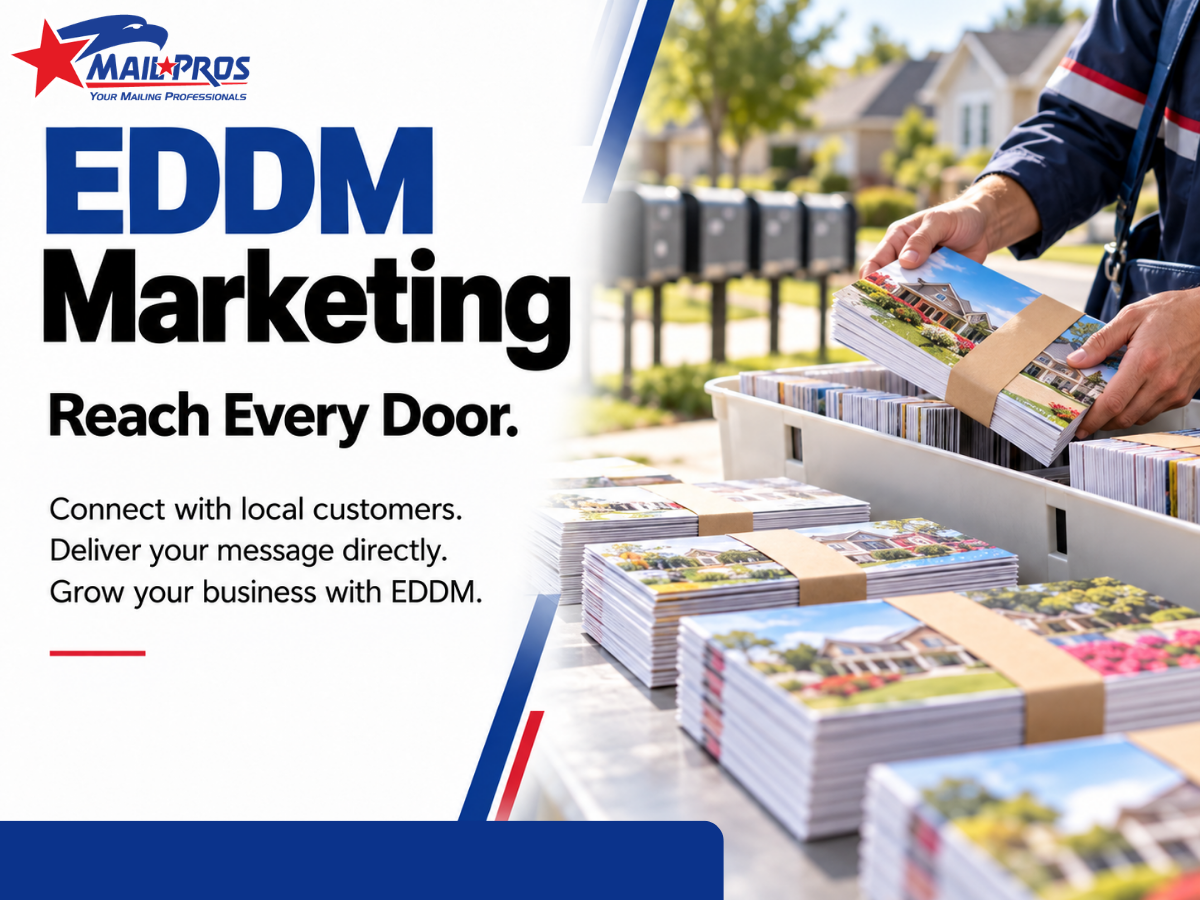
Choosing the right direct mail strategy can make a significant difference in how effectively a business reaches local customers. Both EDDM and traditional direct mail offer practical ways to connect with people through physical mail, but each approach serves different marketing goals.
EDDM Marketing vs. Traditional Direct Mail: Which Is Better?
For many small business owners, local advertising creates a difficult balancing act. You want to reach more potential customers, control your marketing expenses, and make sure your message reaches the right households. However, choosing between different mailing options can feel confusing, especially when every campaign requires careful planning and a clear budget.
At MailProsUSA, we understand that successful direct mail starts with knowing your audience and choosing the right mailing strategy. EDDM Marketing and traditional direct mail both help businesses connect with customers through printed materials, but they approach audience selection, mailing routes, personalization, and campaign planning differently.
So, which option should your business choose? The answer depends on your target audience, marketing objectives, budget, and the type of customers you want to reach. Let's explore both methods and understand how each one works in real business situations.
What Is EDDM Marketing and How Does It Work?
Every Door Direct Mail, commonly known as EDDM, helps businesses distribute promotional mail to residential and business addresses within selected USPS delivery routes. Instead of purchasing a specific mailing list, businesses select geographic areas and reach eligible addresses along those routes.
We often see local businesses choose this approach when they want to introduce their services to an entire neighborhood. For example, a restaurant opening a new location may want nearby residents to learn about its menu, while a home improvement company may want to reach households throughout its service area.
How EDDM Reaches Local Customers
EDDM focuses on geographic coverage rather than individual customer information. Businesses select postal routes based on their location, service coverage, and audience requirements.
The process generally involves:
-
Identifying neighborhoods within the business's service area.
-
Reviewing available USPS delivery routes.
-
Selecting eligible residential or business addresses.
-
Preparing mailpieces that meet applicable postal requirements.
-
Printing and organizing postcards or other qualifying mailpieces.
-
Delivering the prepared mailing through USPS.
This approach works well when businesses value neighborhood visibility more than individual household personalization.
Why Local Businesses Consider EDDM
A local business does not always need a detailed customer database to begin reaching potential customers. Sometimes, the most practical starting point involves introducing a service to households within a reasonable distance.
For example, a dental practice, landscaping company, fitness center, or neighborhood retailer can use EDDM to introduce its services to nearby residents. The strategy helps businesses establish local awareness without first building or purchasing a traditional mailing list.
However, geographic reach alone does not guarantee results. Businesses still need a relevant offer, clear messaging, attractive design, and a convenient way for recipients to respond.
What Is Traditional Direct Mail Marketing?
Traditional direct mail marketing allows businesses to send printed advertising materials to selected recipients using mailing lists and customer databases. Unlike EDDM, this method gives marketers more control over who receives each mailpiece.
Businesses can select recipients using information such as geographic location, household characteristics, business type, purchasing interests, and existing customer relationships, depending on the data available and permitted uses.
We often recommend considering this approach when a campaign needs a more specific audience. For instance, a real estate company may want to contact homeowners in particular neighborhoods, while a B2B company may want to reach businesses within a defined industry.
How Traditional Direct Mail Works
Traditional direct mail follows a more targeted process. Businesses first define their ideal audience and then select a suitable mailing list.
A typical campaign includes:
-
Defining the campaign's marketing objective.
-
Identifying the ideal customer profile.
-
Selecting or developing an appropriate mailing list.
-
Cleaning and verifying mailing addresses.
-
Designing personalized or general mailpieces.
-
Printing, addressing, sorting, and preparing mail.
-
Coordinating delivery through the appropriate postal service.
Each step contributes to the campaign's overall quality. An outdated mailing list, for example, can create unnecessary printing and postage expenses.
Where Traditional Direct Mail Offers More Flexibility
Traditional direct mail supports campaigns that require audience segmentation and personalization. Businesses can create different messages for different customer groups instead of sending the same postcard to every household.
A financial services company, for example, might prepare separate mailpieces for different customer segments. A home services provider might communicate different messages to existing customers and prospective customers.
This flexibility helps businesses make their communication more relevant. However, targeted mailing also requires accurate data, careful planning, and regular list maintenance.
EDDM vs. Traditional Direct Mail: Key Differences
Both strategies use printed materials to communicate with potential customers, but their audience selection and campaign requirements differ.
Understanding these differences helps business owners avoid choosing a mailing method simply because it appears cheaper or easier.
1. Audience Targeting
EDDM uses geographic delivery routes to reach eligible addresses within selected areas. It works well when a business wants broad exposure throughout nearby neighborhoods.
Traditional direct mail uses selected mailing lists to reach specific households, individuals, or businesses. This approach makes more sense when the campaign requires a defined audience.
Our practical insight: If a business wants to introduce a new restaurant to nearby residents, EDDM may offer a straightforward starting point. If that same business wants to communicate with previous customers or a carefully selected audience, traditional direct mail may offer better control.
2. Mailing List Requirements
EDDM does not require businesses to purchase a conventional customer mailing list. The business selects USPS routes and follows the applicable EDDM requirements.
Traditional direct mail depends on mailing data. Businesses must select an appropriate list and check address accuracy before printing and mailing.
The difference matters because poor data quality can increase campaign costs. We encourage businesses to review their mailing lists before committing to large print quantities.
3. Personalization Options
EDDM generally focuses on broad geographic distribution rather than recipient-level personalization. Businesses usually prepare one common message for the selected delivery area.
Traditional direct mail offers more opportunities for personalization. Marketers can segment audiences, customize messaging, and use recipient-specific information when their data and campaign setup support it.
For businesses with different customer groups, personalized messaging can make communication more relevant.
4. Campaign Costs
Both mailing methods involve several expenses, including printing, postage, design, preparation, and campaign management.
EDDM can reduce the need for conventional mailing list acquisition and address-level processing. However, businesses must still account for printing quantities, qualifying mailpiece specifications, postage, and preparation requirements.
Traditional direct mail may involve additional list-related expenses, but a carefully targeted campaign can help businesses avoid sending unnecessary mail to unrelated audiences.
We recommend comparing the total campaign cost rather than looking at postage alone.
5. Mailing Flexibility
EDDM works around geographic delivery routes. This structure makes it useful for businesses that want to reach a defined neighborhood or surrounding community.
Traditional direct mail offers greater flexibility when a business wants to select recipients across multiple locations or reach a particular customer segment.
For example, a regional service provider may prefer traditional direct mail when its customers live across several distant neighborhoods rather than within one concentrated service area.
6. Best Business Applications
EDDM generally supports businesses that need broad local visibility, while traditional direct mail supports campaigns that require more selective audience targeting.
Restaurants, retail stores, salons, gyms, and local home service providers may benefit from EDDM.
Real estate companies, insurance agencies, B2B organizations, and businesses with established customer databases may find traditional direct mail more suitable for certain campaigns.
Neither method works equally well for every industry. The right choice depends on the audience and the marketing objective.
When Should You Choose EDDM Marketing?
EDDM makes sense when your business wants to introduce its products or services to people within a specific geographic area.
We frequently see this approach fit businesses that depend on local customers. A neighborhood gym, for example, may want nearby residents to discover its location, facilities, and membership options.
Rather than trying to identify every potential customer individually, the business can select delivery routes that cover its intended community.
You Want to Reach an Entire Neighborhood
Businesses that serve customers within a limited geographic area often benefit from neighborhood-level advertising.
A plumbing company, for example, may want homeowners throughout nearby communities to recognize its name and understand the services it provides. EDDM can help introduce that business to households along selected routes.
You Are Introducing a New Business
New businesses often struggle with local awareness. Even when a business offers useful services, nearby residents may not know that it exists.
EDDM postcards can introduce a new restaurant, retail store, fitness studio, or service provider to the surrounding community.
A simple design with the business name, location, core service, and clear contact information can help recipients understand what the business offers.
You Want to Avoid Buying a Traditional Mailing List
Some businesses do not have an established customer database. Others simply want to reach a wider neighborhood without selecting individual recipients.
EDDM offers a route-based alternative that removes the need for a conventional mailing list. Businesses still need to select routes carefully and follow USPS eligibility requirements.
When Is Traditional Direct Mail the Better Choice?
Traditional direct mail works well when audience selection matters more than broad geographic coverage.
Businesses with established customer records or a clearly defined ideal audience may prefer this approach because it offers greater control over recipient selection.
You Have a Specific Customer Profile
Suppose a home renovation company specializes in kitchen remodeling. Instead of reaching every household within a large geographic area, the company may want to target selected homeowners who fit its customer profile.
Traditional mailing lists can support this type of audience selection when reliable, legally usable data is available.
You Want to Personalize Your Marketing Message
Personalized communication can help businesses make their mailpieces more relevant to individual recipients.
For example, a company may create separate postcards for previous customers, new prospects, and customers who requested information about a particular service.
This approach requires accurate customer information and a thoughtful segmentation strategy. Personalization alone cannot fix an unclear offer or poorly designed message.
You Need to Reach Customers Across Multiple Locations
Some businesses operate across several cities or regions. Their customers may not live near one central location.
Traditional direct mail allows marketers to select recipients from multiple areas without relying on one concentrated neighborhood route.
This flexibility can help regional businesses coordinate campaigns around different service locations.
How to Calculate the Real Cost of Each Direct Mail Strategy
Budget plays an important role in every marketing decision. However, comparing EDDM and traditional direct mail only through their postage rates can create an incomplete picture.
We encourage businesses to review the entire campaign before deciding. A low mailing cost does not automatically create a cost-effective campaign if the message reaches people who have little reason to become customers.
Understand the Main Campaign Expenses
Start by identifying the major expenses involved in your mailing project:
-
Graphic design and artwork preparation.
-
Postcard or mailpiece printing.
-
Paper stock and finishing options.
-
Postage and postal preparation.
-
Mailing list acquisition or data processing, where applicable.
-
Fulfillment, sorting, and mailing coordination.
-
Tracking and campaign measurement.
Some expenses vary depending on the mailing method. Others depend on print quantity, postcard dimensions, production specifications, and the complexity of the campaign.
Compare Cost Per Response, Not Just Cost Per Piece
A useful way to evaluate mailing performance involves tracking how much each campaign spends to generate a response.
For example, imagine two campaigns:
-
Campaign A costs $1,000 and generates 20 responses.
-
Campaign B costs $1,500 and generates 50 responses.
Campaign A spends $50 per response, while Campaign B spends $30 per response.
Although Campaign B requires a higher total budget, it generates responses at a lower cost.
This example highlights why businesses should measure campaign outcomes rather than relying only on the initial mailing expense.
Consider the Value of Each Customer
Not every response creates the same business value. A customer who makes one small purchase may contribute less revenue than a customer who purchases repeatedly or signs a long-term service agreement.
When comparing mailing strategies, consider customer acquisition cost, average order value, repeat business, and overall profitability.
These measurements provide a more useful picture of campaign performance than response volume alone.
Practical Tips for Creating a Successful Direct Mail Campaign
The mailing method matters, but campaign execution matters just as much. Even a carefully selected audience may ignore a postcard if the message lacks relevance or the design makes important information difficult to understand.
From a printing and marketing perspective, we recommend focusing on a few fundamentals before sending any large mailing.
Start with One Clear Marketing Objective
Decide what you want recipients to do after reading your mailpiece.
Do you want them to visit your store, call your business, request an estimate, book an appointment, or visit a website?
A postcard that tries to communicate too many messages can confuse readers. One clear objective gives the design and copy a stronger direction.
Create a Headline That Communicates Value
Your headline should quickly explain why the recipient should pay attention.
A landscaping company might use a headline about seasonal yard maintenance, while a fitness center might introduce nearby residents to its training programs.
Avoid vague statements that do not explain the business's value. Specific, relevant messaging gives readers a clearer reason to continue reading.
Use Professional Print Design
Printed marketing materials need to communicate clearly at a glance. Use readable typography, suitable contrast, organized content, and high-quality images.
Keep the most important information easy to find. Include your business name, essential service details, website, and contact information where appropriate.
Also, review the final artwork at its actual print dimensions. Text that looks readable on a computer screen may become difficult to read after printing.
Verify Mailing Routes and Addresses
Route selection plays an important role in EDDM campaigns, while address accuracy matters in traditional direct mail.
Businesses should confirm that their selected delivery areas match their actual service coverage. They should also review eligibility rules, postal requirements, and mailing documentation before production.
For additional guidance, explore this route verification guide.
Track Every Campaign
A mailing campaign should provide useful information about customer behavior.
Use campaign-specific landing pages, unique promotional codes, dedicated phone numbers, or trackable website links where appropriate.
These methods help businesses identify which campaign generated a response. They also provide useful information for future mailing decisions.
Common Direct Mail Marketing Mistakes Businesses Should Avoid
Even experienced businesses sometimes make avoidable mistakes when planning printed marketing campaigns. Many problems start before printing, especially when companies rush through audience selection or approve artwork without reviewing the details.
We recommend giving the planning stage enough attention to prevent unnecessary expenses and confusion.
Choosing the Wrong Mailing Area
A business may select a large delivery area because it wants maximum reach. However, some households may fall outside its practical service coverage.
For example, a local cleaning company may receive inquiries from neighborhoods that sit too far from its operating area.
Choose routes that match your service availability and customer priorities instead of focusing only on the number of addresses.
Sending Too Much Information
Business owners often want to explain every service, benefit, and company detail on one postcard. Unfortunately, this can make the design crowded and difficult to understand.
Focus on one main message, one primary benefit, and one clear next step. Keep supporting details short and relevant.
Ignoring Postal Specifications
Every mailing format has its own preparation and postal requirements. Incorrect dimensions, missing markings, unsuitable layouts, or improper preparation can create avoidable production and mailing problems.
Check the latest USPS requirements before approving artwork or beginning production. Never assume that a standard postcard automatically qualifies for every mailing program.
Failing to Measure Results
Some businesses complete a mailing campaign without tracking responses. As a result, they struggle to understand what worked and what they should improve.
Establish measurement methods before the campaign begins. Record the mailing date, quantity, campaign cost, response volume, and resulting sales.
Over time, these records can help you make better decisions about audience selection, design, messaging, and budget allocation.
Can Businesses Combine EDDM and Traditional Direct Mail?
Yes. Businesses can use both methods as part of a broader direct mail strategy when their marketing goals support different types of audience coverage.
For example, a new retail store might use EDDM to introduce its location to nearby households. At the same time, it could use traditional direct mail to communicate with existing customers or a selected audience from its customer database.
This combination allows the business to approach local awareness and customer retention through different mailing methods.
Use EDDM for Broad Local Awareness
Start with selected neighborhoods that make sense for your business. Introduce your brand, explain your main services, and give recipients a straightforward way to learn more.
This stage can help establish familiarity with households that may not know your business yet.
Use Traditional Direct Mail for Targeted Follow-Ups
Use a suitable mailing list to reach previous customers, qualified prospects, or other defined audience groups.
For example, a home improvement company could introduce its services through neighborhood mailings and later send targeted seasonal messages to customers who previously requested estimates.
Review Performance Before Expanding
Do not assume that combining two mailing methods will automatically improve results. Measure each campaign separately and compare response rates, customer acquisition costs, and revenue.
Keep the strategy that supports your business objectives and adjust the parts that underperform.
How to Choose the Right Mailing Strategy for Your Business
Before selecting EDDM or traditional direct mail, answer a few practical questions about your business.
The best mailing method should support your customer acquisition goals, operating area, budget, and available marketing data.
Choose EDDM If Your Priority Is Geographic Coverage
EDDM may suit your business when:
-
You serve customers within specific neighborhoods.
-
You want to introduce a new local business.
-
You need broad household coverage.
-
You do not have a traditional mailing list.
-
You want to test local interest in a product or service.
Choose Traditional Direct Mail If Your Priority Is Audience Precision
Traditional direct mail may suit your business when:
-
You have an accurate customer mailing list.
-
You want to reach a defined customer segment.
-
You need personalized mailpieces.
-
Your customers live across different locations.
-
You want to communicate with previous customers or qualified prospects.
Evaluate Your Business Goals Before Making a Decision
Consider your service area, audience, campaign purpose, and available resources. A neighborhood restaurant may benefit more from broad local coverage, while a specialized B2B company may need a carefully selected business mailing list.
We recommend choosing the method that matches your actual customer acquisition needs rather than following what another business does.
Frequently Asked Questions About EDDM and Traditional Direct Mail
1. Is EDDM cheaper than traditional direct mail?
EDDM can reduce mailing list expenses and some address-level preparation requirements. However, total campaign costs depend on printing, postage, mailpiece specifications, preparation, and mailing quantity. Traditional direct mail may offer better cost efficiency when a business needs to reach a smaller, carefully selected audience.
2. Can small businesses use EDDM marketing?
Yes. EDDM can help small businesses introduce their products and services to households within selected neighborhoods. Restaurants, salons, gyms, retailers, and home service providers often consider this approach when they want to build local awareness.
3. Does traditional direct mail offer better targeting than EDDM?
Traditional direct mail generally offers more precise recipient selection because businesses can use mailing lists to identify specific households, individuals, or business audiences. EDDM focuses on geographic delivery routes rather than individual recipient selection.
4. Can we use EDDM and traditional direct mail together?
Yes. Businesses can use EDDM for neighborhood-level awareness and traditional direct mail for customer segmentation or targeted follow-up campaigns. The key involves giving each method a clear purpose and measuring its individual performance.
Conclusion: Which Direct Mail Strategy Should You Choose?
EDDM and traditional direct mail both offer valuable ways to connect with customers through printed marketing materials. However, they serve different purposes. EDDM works well when businesses want to reach eligible households across selected geographic areas, while traditional direct mail offers greater control over recipient selection and personalization.
The right choice depends on your business goals, target audience, service coverage, and campaign budget. Before investing in a mailing project, review your audience, compare the complete campaign costs, prepare a clear message, and establish a reliable way to measure results.
At MailProsUSA, we understand the importance of thoughtful planning, accurate mailing preparation, and quality print production. Businesses exploring different direct mail options can visit MailProsUSA to learn more about mailing and printing solutions. A well-planned campaign starts with the right audience and a message that gives people a genuine reason to pay attention.

