

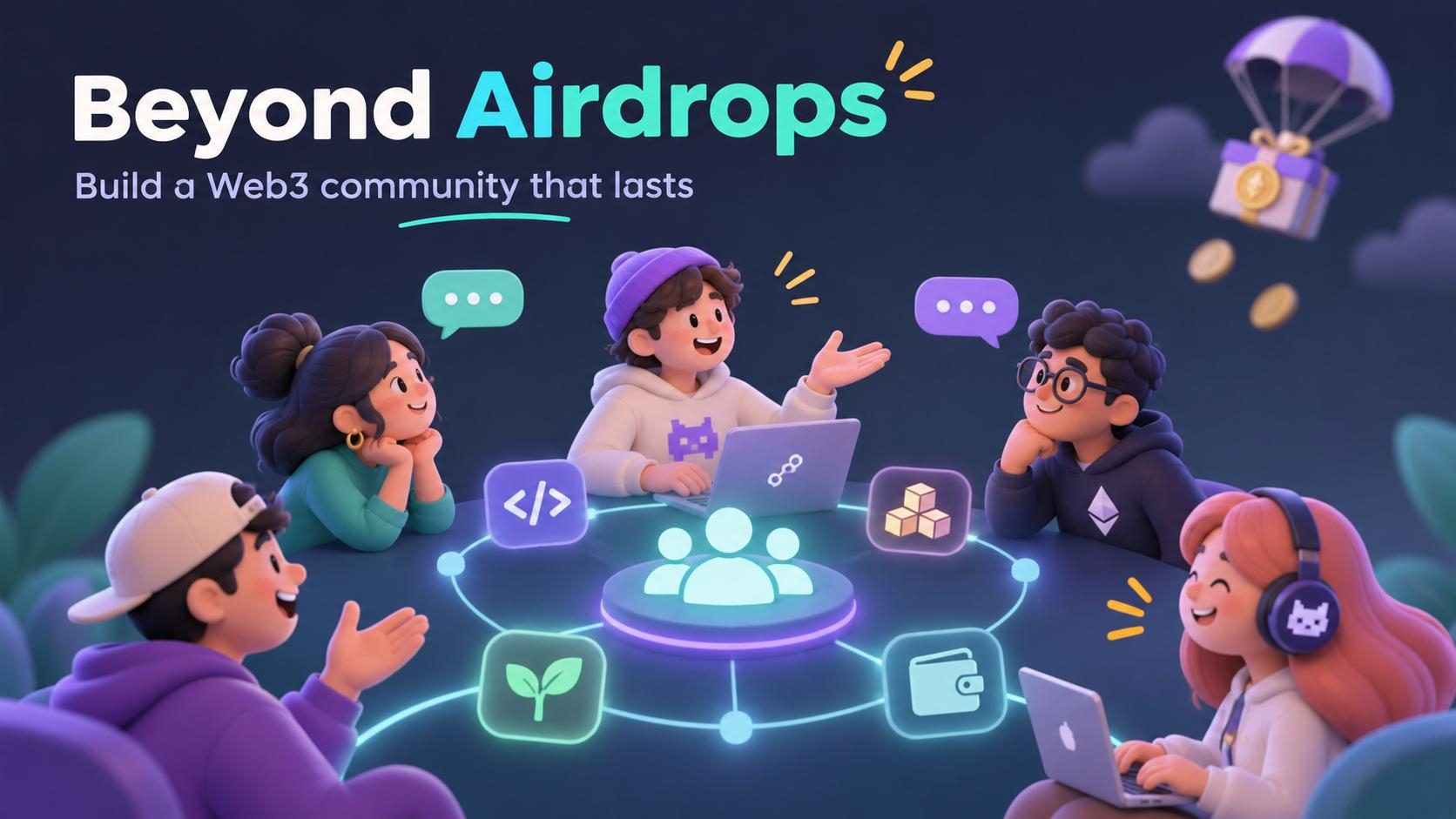

Would people still show up in your Discord if you stopped promising free tokens tomorrow? That question reveals more about your Web3 community than a five-digit member count. Airdrops can make a launch visible, but attention earned through a possible payout often disappears when the claiming window closes. You need people who understand the product, use it, and help others succeed with it.
Recent data shows why that distinction matters. Bitquery's 2026 investigation found that, in the median large airdrop it studied, 73% of claimers moved tokens within a day. Moving tokens does not necessarily mean abandoning a project, but it shows how quickly reward-driven behavior can change. Here's how to build participation that lasts beyond the next token giveaway.
Why Airdrop-First Communities Lose Momentum
A campaign that pays for follows, invites, and wallet connections teaches people to complete tasks, not to care about your product. Once eligibility is confirmed, many have little reason to return. Bot networks and people using multiple wallets can also inflate your numbers, leaving moderators answering eligibility questions while genuine product feedback gets buried.
The gap between ownership and participation is already significant. Andreessen Horowitz's a16z crypto research estimated 40 million to 70 million monthly active crypto users in 2025, compared with approximately 716 million crypto owners. Those figures describe different populations, not airdrop performance, but they illustrate why attracting holders and building active usage are separate challenges.
Start by examining who remains active two weeks after a campaign ends. Are they testing features, answering questions, or reporting bugs? If the conversation stops when rewards stop, changing the prize will only postpone the same problem. Change the reason people joined instead.
Give People a Product Worth Returning To
Show Value Before Discussing Tokens
Your community needs a clear answer to one question: what can I accomplish here? A DeFi app might help users compare lending positions. A gaming project could offer a genuinely enjoyable free session. A developer network might provide working examples and technical help. Explain that benefit in plain language, then demonstrate it through a short walkthrough or live session.
Ask newcomers to complete one useful action, such as trying a no-deposit demo or publishing a simple integration. The goal is confidence, not transaction volume at any cost.
Make Onboarding a Conversation
A welcome bot can point to documentation, but it cannot replace a helpful person. Create a start-here channel with three steps, common questions, and a clear way to ask for assistance. Ask new members what brought them in, then guide them toward a relevant discussion instead of sending everyone the same quest list.
When you plan your outreach, a Web3 community growth and marketing strategy should connect discovery, onboarding, and ongoing participation. More traffic does little for a project if newcomers never experience its value.
Turn Community Members Into Contributors
Give People Small, Meaningful Responsibilities
Participation becomes stickier when members can influence something real. Invite experienced users to review tutorials, test releases, translate guides, or help newcomers with common problems. Give developers clearly scoped issues and give creators access to product information they can explain accurately. Define what a good contribution looks like, acknowledge completed work, and share how it changed the product.
Gitcoin offers a practical example of purpose-driven participation. Its Grants 24 round allocated approximately $1.8 million across six problem-focused domains in 2025. Members had projects and public goods to support, rather than only a token eligibility checklist.
Build Rituals That Survive Campaigns
Regular events give people reasons to return without dangling a surprise reward. Hold a weekly product clinic, a monthly roadmap discussion, and occasional sessions where developers answer technical questions. Publish a short recap showing what was discussed, what changed, and what still needs attention.
A healthy Discord or Telegram group should feel like a useful workshop, not a permanently running countdown. Consistency matters more than hosting an event every day.
Reward Contributions Without Creating Dependency
Rewards are not the enemy. The problem starts when every action requires a payout. Use incentives for work that benefits other members or improves the product. Make expectations clear before an activity begins, and avoid suggesting that ordinary participation guarantees a future token allocation.
| Approach | Likely short-term behavior | Stronger community alternative |
|---|---|---|
| Points for follows | Quick sign-ups | Guided product trials with feedback |
| Rewards for raw referrals | Duplicate or low-intent invites | Credit for invited users who return |
| Mystery airdrop hints | Speculation and repeated questions | Published participation rules |
| Contributor grants | Focused project work | Milestones and public outcome reports |
Protect Fairness and Trust
Publish how contributors are selected, what work qualifies, and when decisions are reviewed. Use proportionate checks against duplicate accounts without demanding unnecessary personal information. Offer payment, credit, early access, or influence where appropriate. Give members meaningful ways to participate even if they never hold your token.
Uniswap's governance process, for example, includes public forum discussions before proposals reach a vote. The lesson is not that every project needs a DAO, but that members take participation more seriously when their input has a visible path to a decision.
Measure Retention, Then Improve It Every Month
Track Behavior Beyond Member Counts
Instead of celebrating total Discord joins, measure the percentage of new members who remain meaningfully active after seven and 30 days. Define meaningful activity in advance: a helpful answer, a completed product action, an accepted bug report, or attendance at a substantive discussion. Track repeat product usage separately from social engagement, because a busy chat can coexist with an unused app.
Compare organic search visitors, partner referrals, and airdrop participants. A smaller channel that brings more returning users may deserve more attention than a high-volume campaign.
Try a Practical 30-Day Reset
In week one, interview ten active members and ten who disappeared. Find out what helped them and where they got stuck. In week two, simplify onboarding and publish two guides addressing the most common problems. In week three, launch a small contributor program and a recurring product session. In week four, review retention, product activation, and feedback quality.
Keep activities that produce real participation. Drop inflated dashboard metrics. Repeat monthly and share the results, including what still needs fixing.
Conclusion
Airdrops can introduce people to a Web3 project, but they cannot give people a reason to care. That comes from a useful product, accessible guidance, respected contributors, and a community that sees its feedback taken seriously. Start with one meaningful onboarding action, one recurring event, and a simple retention report. When members return because they learn, build, and belong, token rewards become a supporting tool rather than the entire growth strategy.
Frequently Asked Questions
1. Can a Web3 Community Grow Without an Airdrop?
Yes. Useful educational content, developer tutorials, partnerships, public product testing, and regular conversations can attract interested members. Growth may be slower initially, but you can judge progress through repeat participation instead of registrations alone.
2. Which Platform Is Better for Web3 Community Building, Discord or Telegram?
Choose based on your audience. Discord suits structured technical channels, roles, and long-running discussions. Telegram works well for quick updates and accessible group chats. Many projects use both, with clear purposes to avoid splitting conversations unnecessarily.
3. What Should Web3 Ambassadors Do Besides Promote Posts?
Ambassadors can help onboard new users, translate documentation, moderate discussions, collect feedback, and demonstrate real product use. Set clear responsibilities and review contributions based on quality, not just referral totals or post impressions.
4. How Do You Measure Web3 Community Retention?
Group newcomers by join date and check how many complete meaningful actions seven or 30 days later. Compare those results with repeat app usage and contributor activity. Filter out bots and avoid counting token claims as engagement by themselves.
5. Should a Web3 Project Stop Using Airdrops Completely?
Not necessarily. A targeted airdrop can introduce your product to relevant users or recognize past activity. Give participants a useful next step, publish clear eligibility rules, and evaluate whether they remain active after the campaign ends.

