

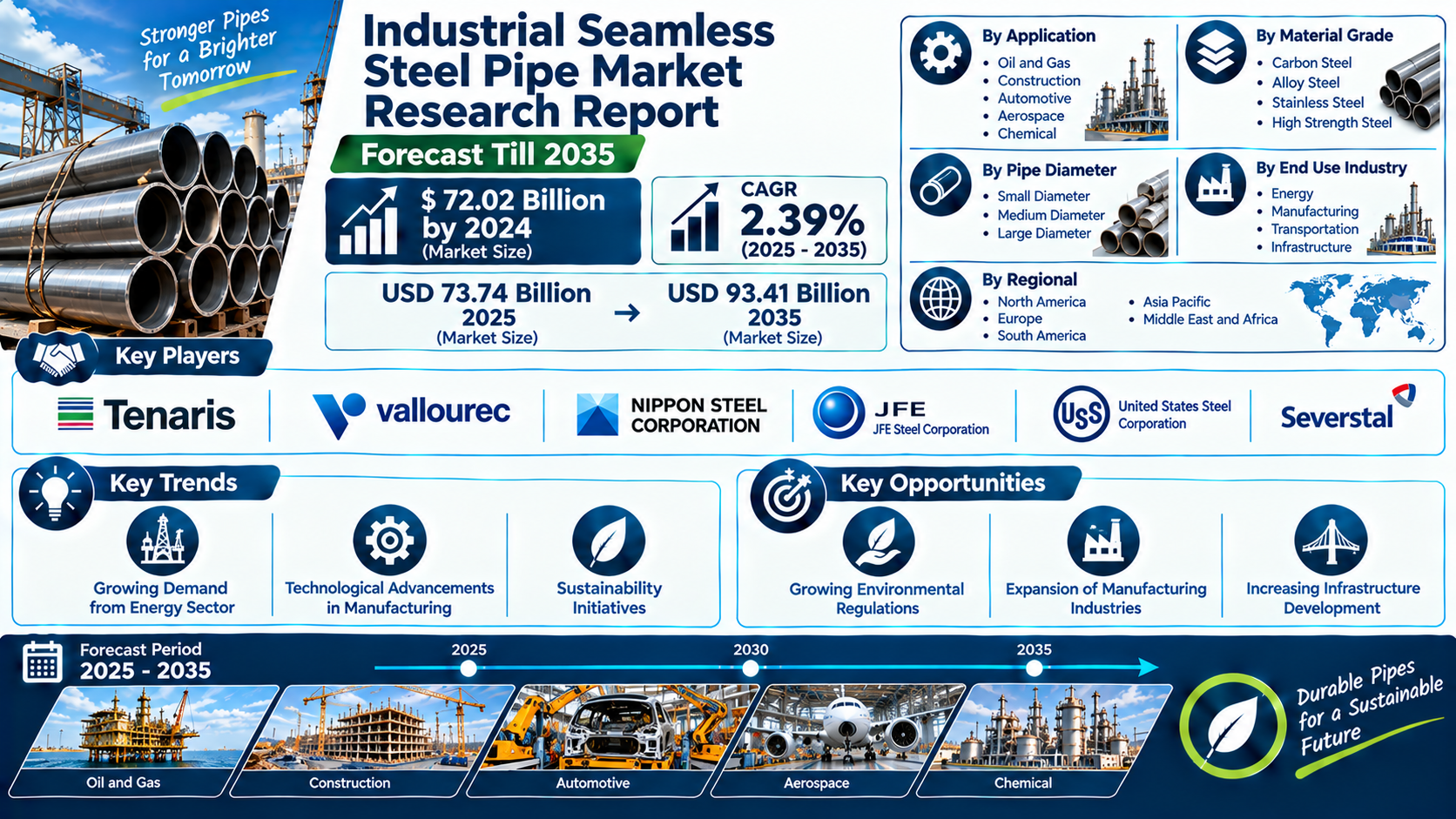

According to Market Research Future® (MRFR), the Industrial Seamless Steel Pipe Market is projected to increase from USD 73.74 billion in 2025 to USD 93.41 billion by 2035, registering a compound annual growth rate (CAGR) of 2.39% during the forecast period from 2025 to 2035. The market was valued at USD 72.02 billion in 2024. Demand across energy, construction, automotive, aerospace and chemical applications supports the industry's position as an important supplier of durable tubular products for industrial operations and infrastructure.
Market Overview and Growth Outlook
Industrial seamless steel pipes are manufactured without a welded seam, making them suitable for applications that require strength, structural consistency and dependable performance under demanding operating conditions. Their use across different industries reflects the need for pipes capable of handling pressure, temperature variations and challenging service environments. Product selection depends on factors such as material grade, diameter, operating requirements and the conditions in which a pipe will be installed.
The market's projected expansion indicates steady demand over the forecast period. Its growth is connected to industrial activity and investment in infrastructure, as well as requirements for reliable piping systems in energy and manufacturing operations. The increase from USD 73.74 billion in 2025 to USD 93.41 billion in 2035 represents a gradual expansion rather than a rapid change in market scale. The reported CAGR of 2.39% provides an indication of the expected pace of growth.
Demand Across Major Applications
The oil and gas sector is an important application area for industrial seamless steel pipes. Exploration, production, processing and transportation operations rely on piping systems designed to withstand demanding service conditions. Seamless construction is relevant where pressure resistance and material integrity are important considerations. Energy-sector demand therefore remains a significant factor influencing product requirements and purchasing decisions.
Construction is another major application. Industrial and infrastructure projects use steel pipes in systems and structures where durability and dependable material performance are necessary. The scale and nature of a project influence the required pipe specifications, including diameter and grade. As infrastructure development continues to create requirements for industrial materials, this application remains relevant to the market's longer-term outlook.
Automotive and aerospace applications have their own technical requirements. In these industries, component specifications can place emphasis on material strength, dimensional consistency and performance. Chemical applications also require careful product selection because piping systems may operate in environments involving demanding process conditions. These varied requirements encourage suppliers to provide products suited to different industrial uses rather than relying on a single standard specification.
Material Grades and Product Specifications
The market is segmented by material grade into carbon steel, alloy steel, stainless steel and high strength steel. Each category addresses different performance and operating requirements. Carbon steel is used in a wide range of industrial applications, while alloy steel can be selected when particular mechanical or service characteristics are needed. Stainless steel is relevant where corrosion resistance is an important consideration, and high strength steel serves applications requiring elevated strength characteristics.
Pipe diameter provides another basis for market segmentation. Small diameter, medium diameter and large diameter pipes serve different installation and operating requirements. The appropriate size depends on factors such as the intended application, flow requirements, system design and operating conditions. These distinctions make product range and specification capabilities important considerations for suppliers serving multiple end-use industries.
End-Use Industries and Regional Landscape
The end-use industry categories include energy, manufacturing, transportation and infrastructure. Energy operations require dependable piping products for industrial facilities and related systems. Manufacturing uses pipes in a variety of production and processing environments, while transportation and infrastructure projects create demand through industrial development and the construction of supporting systems. These end-use categories overlap with the report's application segments but provide a separate perspective on where products are ultimately utilized.
The market covers North America, Europe, South America, Asia Pacific, and the Middle East and Africa. Regional demand is influenced by industrial capacity, energy activity, manufacturing requirements and infrastructure investment. Each region has a different mix of end-use industries and project requirements, creating varied opportunities for producers and suppliers. The broad geographic coverage also reflects the international nature of steel production, distribution and industrial procurement.
Manufacturing Technology and Sustainability Trends
Technological advancements in manufacturing are an important trend shaping the market. Improvements in production processes can support product consistency, manufacturing efficiency and the ability to meet specific customer requirements. As industrial users seek pipes with defined mechanical and dimensional characteristics, manufacturers have an incentive to refine production capabilities and quality-control practices.
Sustainability initiatives are also becoming more relevant to industrial manufacturing. Steel production and processing involve resource and energy considerations, making environmental performance an important area of attention. Manufacturers may evaluate production efficiency, resource utilization and operational practices as part of their sustainability efforts. Growing environmental regulations add to this focus by increasing the importance of meeting applicable standards and managing industrial impacts.
The growing demand from the energy sector remains another defining trend. Energy-related applications require materials that can perform reliably in demanding environments. Changes in energy infrastructure and industrial requirements can influence the types and specifications of seamless pipes sought by customers.
Competitive Landscape and Market Opportunities
The competitive landscape includes Tenaris, Vallourec, Nippon Steel Corporation, JFE Steel Corporation, United States Steel Corporation and Severstal. These companies operate within the broader steel and tubular products industry. Competition in the market can involve product quality, manufacturing capabilities, technical specifications, customer relationships and the ability to serve different geographic markets.
Environmental regulations may create opportunities for manufacturers that can align production practices and product offerings with evolving requirements. Compliance considerations can influence procurement decisions, particularly among industrial customers operating in regulated sectors. The expansion of manufacturing industries also offers potential demand as production facilities and industrial operations require suitable piping products.
Increasing infrastructure development represents another opportunity. Infrastructure projects require materials that meet defined engineering and durability specifications, and seamless steel pipes can serve relevant applications within these projects. The extent of the opportunity will depend on project activity, procurement requirements and the ability of suppliers to provide suitable products.
Outlook Through 2035
The industrial seamless steel pipe market is expected to maintain a measured growth trajectory through 2035. Energy-sector requirements, manufacturing expansion, infrastructure development and advances in production technology are central elements of its outlook. At the same time, environmental regulations and sustainability initiatives are likely to remain important considerations for manufacturers.
With a projected market value of USD 93.41 billion in 2035 and a CAGR of 2.39% over 2025–2035, the industry is positioned for steady expansion. Suppliers that maintain product quality, address varied material and diameter requirements, and respond to changing industrial and environmental expectations will remain relevant in this evolving market.

